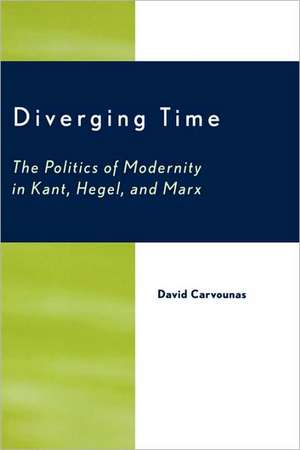
Diverging Time: The Politics of Modernity in Kant, Hegel, and Marx
Autor David Carvounasen Limba Engleză Paperback – 5 aug 2002
Preț: 282.08 lei
Preț vechi: 386.79 lei
-27%
Puncte Express: 423
Carte tipărită la comandă
Livrare economică 26 noiembrie-10 decembrie
Livrare prin curier în România Termenul estimat este afișat lângă disponibilitate.
Transport gratuit de la 400.00 lei Plată online sau ramburs, în funcție de opțiunile comenzii.
Retur gratuit în 14 zile Comandă securizată și suport în română.
Specificații
ISBN-13: 9780739103739
ISBN-10: 0739103733
Pagini: 136
Dimensiuni: 148 x 230 x 10 mm
Greutate: 0.21 kg
Editura: Bloomsbury Publishing
Colecția Lexington Books
Locul publicării:New York, United States
ISBN-10: 0739103733
Pagini: 136
Dimensiuni: 148 x 230 x 10 mm
Greutate: 0.21 kg
Editura: Bloomsbury Publishing
Colecția Lexington Books
Locul publicării:New York, United States
V-ar putea interesa
-
 The True BelieverEric HofferPreț: 100.92 lei
 -
 Rising Up and Rising DownWilliam T. VollmannPreț: 155.48 lei
 -
 Political Philosophy: A Very Short IntroductionDavid Miller-20%Preț: 57.33 lei71.22 lei
 -
 Political ThoughtMichael Rosen-11%Preț: 373.09 lei417.89 lei
 -
 John Rawls: His Life and Theory of JusticeThomas Pogge-13%Preț: 300.51 lei345.78 lei
 -
 Perspectives on Thomas HobbesG. A. J. Rogers-29%Preț: 350.58 lei490.48 lei
 -
 Social JusticeDavid Miller-20%Preț: 304.15 lei381.35 lei
 -
 Theories of RightsJeremy Waldron-22%Preț: 388.92 lei496.67 lei
 -
 Contemporary Political Philosophy: An IntroductionWill Kymlicka-20%Preț: 408.79 lei511.61 lei
 -
 Ethics, Economics, and Politics: Principles of Public PolicyI. M. D. Little-33%Preț: 705.62 lei1051.05 lei
 -
 AnarchismKropotkin-18%Preț: 85.26 lei104.25 lei
 -
 Philosophy of MathematicsPaul BenacerrafPreț: 346.60 lei
 -
 An Introduction to Political PhilosophyColin Bird-14%Preț: 201.41 lei234.35 lei
 -
 Amartya SenChristopher MorrisPreț: 297.66 lei
 -
 A World beyond Politics? – A Defense of the Nation–StatePierre Manent-23%Preț: 428.89 lei557.00 lei
 -
 The Philosophy of FriendshipM. Vernon-15%Preț: 662.39 lei779.29 lei
 -
 General Theory of Law and StateHans KelsenPreț: 379.00 lei
Cuprins
Part 1 Introduction
Chapter 2 Modernity and the Future as a Problem
Chapter 3 Enlightened Future: Kant
Chapter 4 Recapturing the Spirit of the Past: Hegel
Chapter 5 Jumping over Rhodes: Marx
Chapter 6 Dawn and Decline
Chapter 2 Modernity and the Future as a Problem
Chapter 3 Enlightened Future: Kant
Chapter 4 Recapturing the Spirit of the Past: Hegel
Chapter 5 Jumping over Rhodes: Marx
Chapter 6 Dawn and Decline
Recenzii
This is an excellent piece of work. Carvounas' powerful treatment of the ideas of Kant, Hegel, and Marx reflects careful reading and a comprehensive grasp of their work.
For all those who have felt that the postmodern speed of late modern life has disrupted their relation to the past and future by disorienting their very experience of time in the present, Carvounas's work offers great insight into the challenges that mustbe met if a coherent sense of time joining what we have been to what we are and could possibly become is to be restored. Carvounas teaches us why our past has had a future, and what we must do in the present to take our future back. An original and compelling theoretical and philosophical perspective on late modernity, and on how we are situated in relation to a temporal understanding of the world constructed by Kant, Hegel, and Marx...
This work is at once thoughtful and thought-provoking.
For all those who have felt that the postmodern speed of late modern life has disrupted their relation to the past and future by disorienting their very experience of time in the present, Carvounas's work offers great insight into the challenges that mustbe met if a coherent sense of time joining what we have been to what we are and could possibly become is to be restored. Carvounas teaches us why our past has had a future, and what we must do in the present to take our future back. An original and compelling theoretical and philosophical perspective on late modernity, and on how we are situated in relation to a temporal understanding of the world constructed by Kant, Hegel, and Marx...
This work is at once thoughtful and thought-provoking.