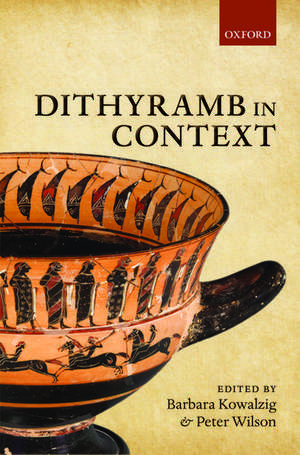
Dithyramb in Context
Editat de Barbara Kowalzig, Peter Wilsonen Limba Engleză Hardback – 27 iun 2013
Preț: 1429.82 lei
Preț vechi: 2078.02 lei
-31%
Puncte Express: 2145
Carte tipărită la comandă
Livrare economică 04-15 decembrie
Livrare prin curier în România Termenul estimat este afișat lângă disponibilitate.
Transport gratuit pentru acest produs Plată online sau ramburs, în funcție de opțiunile comenzii.
Retur gratuit în 14 zile Comandă securizată și suport în română.
Specificații
ISBN-13: 9780199574681
ISBN-10: 0199574685
Pagini: 508
Ilustrații: 35 in-text illustrations
Dimensiuni: 163 x 239 x 32 mm
Greutate: 1.03 kg
Editura: OUP OXFORD
Colecția OUP Oxford
Locul publicării:Oxford, United Kingdom
ISBN-10: 0199574685
Pagini: 508
Ilustrații: 35 in-text illustrations
Dimensiuni: 163 x 239 x 32 mm
Greutate: 1.03 kg
Editura: OUP OXFORD
Colecția OUP Oxford
Locul publicării:Oxford, United Kingdom
V-ar putea interesa
-
 -28%Preț: 424.83 lei589.84 lei
 -
 The Oxford Handbook of Roman EpigraphyChrister Brunn-18%Preț: 405.94 lei494.77 lei
 -
 -30%Preț: 702.32 lei1002.26 lei
 -
 -20%Preț: 284.42 lei355.13 lei
 -
 Citizens of Discord: Rome and Its Civil WarsBrian Breed-30%Preț: 882.88 lei1262.07 lei
 -
 The Oxford Handbook of Hellenic StudiesGeorge Boys-Stones-14%Preț: 1044.60 lei1214.65 lei
 -
 Children, Memory, and Family Identity in Roman CultureVéronique Dasen-31%Preț: 1028.56 lei1495.26 lei
 -
 -30%Preț: 1105.80 lei1590.87 lei
 -
 -30%Preț: 766.07 lei1095.58 lei
 -
 Italy's Lost Greece: Magna Graecia and the Making of Modern ArchaeologyGiovanna Ceserani-30%Preț: 750.90 lei1072.76 lei
 -
 -30%Preț: 688.76 lei980.41 lei
 -
 Bandits in the Roman Empire: Myth and RealityThomas Grunewald-15%Preț: 462.09 lei543.63 lei
 -
 The Athenian ConstitutionAristotlePreț: 40.40 lei
 -
 Preț: 184.66 lei
 -
 The Idea of ProgressJ. B. BuryPreț: 133.22 lei
 -
 Preț: 200.70 lei
 -
 Preț: 225.07 lei
 -
 History of Cleopatra, Queen of EgyptJacob AbbottPreț: 144.77 lei
 -
 The History of Rome (Volumes 1-5)Theodore MommsenPreț: 447.23 lei
 -
 The History of Rome, Volumes 1-5Theodore Mommsen-19%Preț: 507.39 lei626.41 lei
 -
 CHALL FOR SIN ECO AFT GLOB FINAN CRISISWilson Peter-15%Preț: 550.27 lei647.37 lei
Recenzii
Important...Its cutting-edge contributions impressively succeed, even if, inevitably, some items appear repeatedly, while interpretations display contributors not singing from one dithyramb sheet. One of numerous strengths is that many different styles of scholarship are applied.
Notă biografică
Barbara Kowalzig is Associate Professor of Classics and History at New York University, and an Associate of the Centre Louis Gernet in Paris. Her research focuses on religion, music and performance, and cultural and economic anthropology in ancient Greece and the Mediterranean. She is the author of Singing for the Gods: Performances of Myth and Ritual in Archaic and Classical Greece (2007; 2011) and has published widely on Greek song-culture, ritual, and drama.Peter Wilson is William Ritchie Professor of Classics at the University of Sydney and the inaugural Director of the Centre for Classical & Near Eastern Studies of Australia. He is the author of The Athenian Institution of the 'Khoregia': the Chorus, the City and the Stage, Greek Theatre and Festivals: Documentary Studies (2007) and Performance, Reception, Iconography: Studies in Honour of Oliver Taplin (with M. Revermann, 2008).
Cuprins
- Acknowledgements
- Table of contents
- List of contributors
- List of Illustrations
- Conventions and Abbreviations
- 1: Barbara Kowalzig and Peter Wilson: Introduction: The World of Dithyramb
- I Social and Religious Contexts
- 2: Barbara Kowalzig: Dancing Dolphins: Dithyramb and Society in the Archaic Period
- 3: Salvatore Lavecchia: Becoming like Dionysos: Dithyramb and Dionysian Initiation
- 4: Lucia Prauscello: Demeter and Dionysos in the Sixth-Century Argolid: Lasos of Hermione, the Cult of Demeter Chthonia and the Origins of Dithyramb
- 5: Luigi Battezzato: Dithyramb and Greek Tragedy
- II Defining an Elusive Performance Form
- 6: Giovan Battista D Alessio: The Name of the Dithyramb: Diachronic and Diatopic Variations
- 7: David Fearn: Athens and the Empire: The Contextual Flexibility of Dithyramb, and its Imperialist Ramifications
- 8: Paola Ceccarelli: Cyclic Choroi and the Dithyramb in the Classical and Hellenistic period: a Problem of Definition
- 9: Guy Hedreen: The Semantics of Processional Dithyramb: Pindar s Second Dithyramb and Archaic Athenian Vase-Painting
- 10: Armand D Angour: Music and Movement in the Dithyramb
- III New Music
- 11: John Curtis Franklin: Songbenders of circular choruses : Dithyramb and the Demise of Music
- 12: Timothy Power: Kyklops Kitharoidos: Dithyramb and Nomos in Play
- 13: Mark Griffith: Satyr-play, dithyramb and the Geopolitics of Dionysian Style in Fifth-Century Athens
- 14: Alexander Heinemann: Performance and the Drinking Vessel: Looking for an Imagery of Dithyramb in the Time of the New Music
- IV Towards a Poetics of Dithyramb
- 15: Andrew Ford: The Poetics of Dithyramb
- 16: Claude Calame: The Dithyramb, a Dionysiac Poetic Form: Genre Rules and Cultic Contexts
- 17: Anastasia-Erasmia Peponi: Dithyramb in Greek Thought: The Problem of Choral Mimesis
- 18: Giorgio Ieranò: One for whom the tribes dispute: The Dithyrambic Poet and the City of Athens
- V Dithyramb in the Roman Empire
- 19: Julia L. Shear: Choroi and tripods: The Politics of the Choregia in Roman Athens
- 20: Ian Rutherford: Dithyrambos, Thriambos, Triumphus: Dionysiac Discourse at Rome
- Bibliography
- Index of Passages
- Subject Index