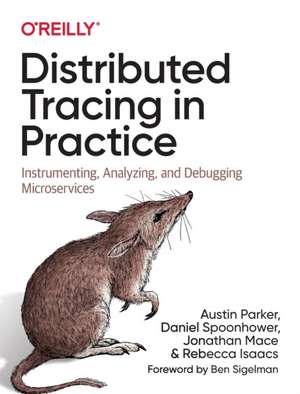
Distributed Tracing in Practice
Autor Austin Parker, Daniel Spoonhower, Jonathan Mace, Ben Sigelman, Rebecca Isaacsen Limba Engleză Paperback – 19 mai 2020
Diferența majoră dintre Distributed Tracing in Practice și documentația tehnică standard rezidă în abordarea pragmatică a implementării: nu ne limităm la sintaxă, ci explorăm deciziile de arhitectură care previn degradarea performanței. Remarcăm modul în care autorii, experți în cadrul LightStep, reușesc să demistifice complexitatea monitorizării sistemelor distribuite, transformând un proces adesea considerat anevoios într-o metodologie structurată de profilare a microserviciilor. Cartea analizează riguros cele trei piloni ai procesului: instrumentarea eficientă, colectarea coerentă a datelor și, cel mai important, extragerea unor concluzii operaționale care să reducă timpul de remediere a regresiunilor. Considerăm că această lucrare completează perfect bagajul de cunoștințe al inginerilor care au lucrat deja cu alte aspecte ale observabilității. Cititorul care a aplicat ideile din Monitoring Microservices and Containerized Applications va găsi aici veriga lipsă: trecerea de la monitorizarea simplă a stării la înțelegerea fluxului complet al unei cereri prin multiple servicii. În timp ce alte resurse se concentrează pe metrici și loguri, acest ghid pune accent pe trasabilitatea distribuită ca instrument de diagnoză profundă. Structura narativă este una tehnică, dar extrem de fluidă, ghidând cititorul prin bunele practici de instrumentare și oferind soluții concrete pentru evitarea overhead-ului prin tehnici de eșantionare (sampling). Față de alte lucrări ale autorului Austin Parker, cum este Data-driven Generation of Policies, unde accentul cădea pe algoritmi de schimbare a stării, volumul de față este mult mai ancorat în realitatea de producție a sistemelor cloud-native actuale, oferind un cadru de lucru direct aplicabil în ecosistemele moderne de software.
Preț: 374.27 lei
Preț vechi: 467.83 lei
-20%
Carte disponibilă
Livrare economică 07-21 noiembrie
Specificații
ISBN-10: 1492056634
Pagini: 327
Dimensiuni: 175 x 237 x 20 mm
Greutate: 0.57 kg
Editura: O'Reilly
V-ar putea interesa
-
 Preț: 291.45 lei
 -
 BPF Performance ToolsBrendan Gregg-20%Preț: 398.39 lei497.99 lei
 -
 Khononov, V: Balancing Coupling in Software DesignVlad Khononov-20%Preț: 259.90 lei324.87 lei
 -
 Understanding Software DynamicsRichard Sites-20%Preț: 310.88 lei388.60 lei
 -
 Patterns of Distributed SystemsUnmesh Joshi-20%Preț: 291.34 lei364.18 lei
 -
 Assassin's Creed BrotherhoodOliver BowdenPreț: 81.15 lei
 -
 -20%Preț: 339.99 lei424.99 lei
 -
 -20%Preț: 400.70 lei500.88 lei
 -
 Chaos EngineeringCasey Rosenthal-20%Preț: 383.75 lei479.69 lei
 -
 -8%Preț: 378.98 lei411.93 lei
 -
 Microservices in ActionMorgan Bruce-20%Preț: 293.98 lei367.48 lei
 -
 Microservice Patterns: With examples in JavaChris Richardson-20%Preț: 337.30 lei421.62 lei
 -
 Micro Frontends in ActionMichael Geers-20%Preț: 364.70 lei455.88 lei
 -
 Software Telemetry: Reliable logging and monitoringJamie Riedesel-20%Preț: 398.66 lei498.32 lei
 -
 Distributed Machine Learning PatternsYuan Tang-20%Preț: 326.97 lei408.71 lei
 -
 Think Distributed SystemsDominik Tornow-20%Preț: 332.09 lei415.11 lei
 -
 Logs and TelemetryPhil WilkinsPreț: 390.45 lei
 -
 Atomic HabitsJames Clear-23%Preț: 105.69 lei136.87 leiRecomandat
 -
 Observability for Kubernetes ApplicationsVikram Venkataraman-20%Preț: 232.58 lei290.72 lei
 -
 AI and MicroservicesDileep Kumar Pandiya-20%Preț: 263.90 lei329.88 lei
De ce să citești această carte
Recomandăm această carte inginerilor DevOps și arhitecților de sistem care doresc să implementeze o observabilitate reală în sisteme distribuite complexe. Cititorul câștigă strategii clare pentru a reduce latența și a înțelege comportamentul microserviciilor în producție, trecând de la simple alerte la o vizibilitate totală asupra fluxurilor de date. Este un manual tehnic esențial pentru optimizarea performanței software-ului modern.
Despre autor
Echipa de autori reunește unii dintre cei mai respectați experți în observabilitatea sistemelor. Austin Parker este un lider recunoscut în comunitatea open-source, fiind implicat activ în dezvoltarea standardelor de telemetrie, în timp ce Ben Sigelman este co-fondator LightStep și unul dintre creatorii sistemului Dapper la Google, pionierul trasabilității distribuite. Experiența lor cumulată în companii de top oferă cărții o autoritate tehnică rară, transformând-o dintr-un simplu manual într-un ghid strategic fundamentat pe provocări reale de scalabilitate și performanță întâlnite în industria IT globală.
Descriere scurtă
You'll learn:
- The pieces of a distributed tracing deployment: instrumentation, data collection, and analysis
- Best practices for instrumentation: methods for generating trace data from your services
- How to deal with (or avoid) overhead using sampling and other techniques
- How to use distributed tracing to improve baseline performance and to mitigate regressions quickly
- Where distributed tracing is headed in the future