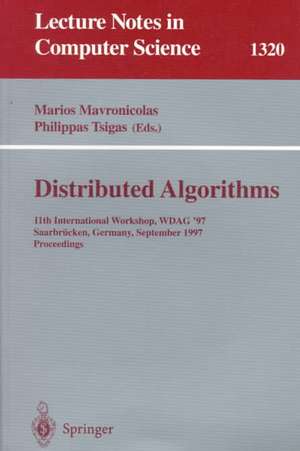
Distributed Algorithms
Editat de Marios Mavronicolas, Philippas Tsigasen Limba Engleză Paperback – 10 sep 1997
The volume presents 20 revised full papers selected from 59 submissions. Also included are three invited papers by leading researchers. The papers address a variety of current issues in the area of distributed algorithms and, more generally, distributed systems such as various particular algorithms, randomized computing, routing, networking, load balancing, scheduling, message-passing, shared-memory systems, communication, graph algorithms, etc.
Preț: 324.82 lei
Preț vechi: 406.03 lei
-20%
Puncte Express: 487
Carte tipărită la comandă
Livrare economică 26 noiembrie-10 decembrie
Livrare prin curier în România Termenul estimat este afișat lângă disponibilitate.
Transport gratuit de la 400.00 lei Plată online sau ramburs, în funcție de opțiunile comenzii.
Retur gratuit în 14 zile Comandă securizată și suport în română.
Specificații
ISBN-13: 9783540635758
ISBN-10: 3540635750
Pagini: 352
Ilustrații: XI, 341 p.
Dimensiuni: 155 x 235 x 20 mm
Greutate: 0.53 kg
Ediția:1997
Editura: Springer
Locul publicării:Berlin, Heidelberg, Germany
ISBN-10: 3540635750
Pagini: 352
Ilustrații: XI, 341 p.
Dimensiuni: 155 x 235 x 20 mm
Greutate: 0.53 kg
Ediția:1997
Editura: Springer
Locul publicării:Berlin, Heidelberg, Germany
V-ar putea interesa
-
 Computer VisionSimon J. D. Prince-20%Preț: 574.23 lei717.78 lei
 -
 Enterprise Content and Search Management for Building Digital PlatformsShailesh Kumar Shivakumar-20%Preț: 510.94 lei638.68 lei
 -
 Spock: Up and RunningRob Fletcher-20%Preț: 351.55 lei439.44 lei
 -
 Tragic DesignJonathan Shariat-20%Preț: 192.19 lei240.24 lei
 -
 Thoughtful Machine Learning with PythonMatthew Kirk-20%Preț: 258.34 lei322.92 lei
 -
 This is Service Design DoingMarc Stickdorn-20%Preț: 264.28 lei330.35 lei
 -
 Karau, H: High Performance SparkHolden Karau-20%Preț: 242.50 lei303.13 lei
 -
 Practical TableauRyan Sleeper-20%Preț: 319.04 lei398.80 lei
 -
 Course in Mathematical CryptographyGilbert Baumslag-20%Preț: 343.49 lei429.36 lei
 -
 New Trends in Systems AnalysisA. Bensoussan-20%Preț: 358.16 lei447.71 lei
 -
 -20%Preț: 314.37 lei392.97 lei
 -
 Optimization TechniquesJ. Stoer-20%Preț: 345.14 lei431.42 lei
 -
 -20%Preț: 357.49 lei446.85 lei
 -
 -20%Preț: 333.46 lei416.82 lei
 -
 Theory and Application of Random FieldsG. Kallianpur-20%Preț: 330.40 lei413.00 lei
 -
 -20%Preț: 335.85 lei419.81 lei
 -
 -20%Preț: 317.39 lei396.74 lei
 -
 Internet and Network EconomicsPaul Spirakis-20%Preț: 341.23 lei426.53 lei
 -
 -20%Preț: 329.91 lei412.39 lei
 -
 -20%Preț: 324.99 lei406.23 lei
Public țintă
ResearchCuprins
Towards fault-tolerant and secure agentry.- Workflow management — An exercise in distributed computing.- In memory of Anya Pogosyants.- Verification of the randomized consensus algorithm of Aspnes and Herlihy: A case study.- A simple DFS-Based algorithm for linear interval routing.- ATM layouts with bounded hop count and congestion.- Scheduling in synchronous networks and the greedy algorithm.- Rapid convergence of a local load balancing algorithm for asynchronous rings.- Performing tasks on restartable message-passing processors.- Revisiting the Paxos algorithm.- Heartbeat: A timeout-free failure detector for quiescent reliable communication.- Genuine atomic multicast.- Low-overhead time-triggered group membership.- Virtual precedence in asynchronous systems: Concept and applications.- Detecting global predicates in distributed systems with clocks.- Fault tolerance bounds for memory consistency.- Precedence-based memory models.- Strong interaction fairness in a fully distributed system with unbounded speed variability.- Reliable communication over partially authenticated networks.- Self-stabilizing depth-first token passing on rooted networks.- Secure distributed storage and retrieval.- Optimal wait-free clock synchronization protocol on a shared-memory multi-processor system.- Transparent support for wait-free transactions.- On the power of multi-objects.