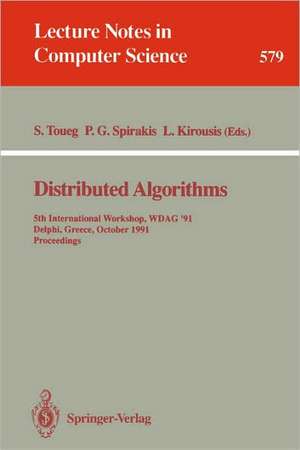
Distributed Algorithms
Editat de Sam Toueg, Paul G. Spirakis, Lefteris Kirousisen Limba Engleză Paperback – 11 mar 1992
Preț: 324.02 lei
Preț vechi: 405.03 lei
-20%
Puncte Express: 486
Carte tipărită la comandă
Livrare economică 26 noiembrie-10 decembrie
Livrare prin curier în România Termenul estimat este afișat lângă disponibilitate.
Transport gratuit de la 400.00 lei Plată online sau ramburs, în funcție de opțiunile comenzii.
Retur gratuit în 14 zile Comandă securizată și suport în română.
Specificații
ISBN-13: 9783540552369
ISBN-10: 3540552367
Pagini: 336
Ilustrații: X, 326 p.
Dimensiuni: 155 x 235 x 19 mm
Greutate: 0.51 kg
Ediția:1992
Editura: Springer
Locul publicării:Berlin, Heidelberg, Germany
ISBN-10: 3540552367
Pagini: 336
Ilustrații: X, 326 p.
Dimensiuni: 155 x 235 x 19 mm
Greutate: 0.51 kg
Ediția:1992
Editura: Springer
Locul publicării:Berlin, Heidelberg, Germany
V-ar putea interesa
-
 Computer VisionSimon J. D. Prince-20%Preț: 574.23 lei717.78 lei
 -
 Enterprise Content and Search Management for Building Digital PlatformsShailesh Kumar Shivakumar-20%Preț: 510.94 lei638.68 lei
 -
 Spock: Up and RunningRob Fletcher-20%Preț: 351.55 lei439.44 lei
 -
 Tragic DesignJonathan Shariat-20%Preț: 192.19 lei240.24 lei
 -
 Thoughtful Machine Learning with PythonMatthew Kirk-20%Preț: 258.34 lei322.92 lei
 -
 This is Service Design DoingMarc Stickdorn-20%Preț: 264.28 lei330.35 lei
 -
 Karau, H: High Performance SparkHolden Karau-20%Preț: 242.50 lei303.13 lei
 -
 Practical TableauRyan Sleeper-20%Preț: 319.04 lei398.80 lei
 -
 New Models for Population ProtocolsOthon Michail-20%Preț: 260.34 lei325.43 lei
 -
 Course in Mathematical CryptographyGilbert Baumslag-20%Preț: 343.49 lei429.36 lei
 -
 -18%Preț: 825.80 lei1007.07 lei
 -
 LATIN 2004: Theoretical InformaticsMartin Farach-Colton-20%Preț: 641.69 lei802.12 lei
 -
 Typed Lambda Calculi and ApplicationsPawel Urzyczyn-20%Preț: 329.94 lei412.42 lei
 -
 -20%Preț: 646.05 lei807.57 lei
 -
 -20%Preț: 639.38 lei799.23 lei
 -
 -20%Preț: 650.30 lei812.89 lei
 -
 -20%Preț: 483.48 lei604.35 lei
 -
 MetainformaticsPeter J. Nürnberg-20%Preț: 317.04 lei396.30 lei
 -
 Automata, Languages and ProgrammingFernando Orejas-20%Preț: 363.30 lei454.12 lei
 -
 Rough Sets and Current Trends in ComputingSalavatore Greco-20%Preț: 685.17 lei856.46 lei
 -
 Euro-Par 2012 Parallel ProcessingChristos Kaklamanis-20%Preț: 371.67 lei464.59 lei
 -
 Algorithms and ComplexityPaul G. Spirakis-20%Preț: 340.35 lei425.44 lei
Public țintă
ResearchCuprins
On the limitation of the global time assumption in distributed systems.- Causal memory.- More on the power of random walks: Uniform self-stabilizing randomized algorithms.- Pseudo read-modify-write operations: Bounded wait-free implementations.- Maintaining digital clocks in step.- Implementing FIFO queues and stacks.- Optimal amortized distributed consensus.- Optimally simulating crash failures in a byzantine environment.- Efficient distributed consensus with n=(3 + ?)t processors.- Randomized consensus in expected O(n2log n) operations.- Using adaptive timeouts to achieve at-most-once message delivery.- Uniform dynamic self-stabilizing leader election.- The quickest path problem in distributed computing systems.- The communication complexity of the two list problem.- Distributed algorithms for updating shortest paths.- Minimal shared information for concurrent reading and writing.- Reading many variables in one atomic operation solutions with linear or sublinear complexity.- Analysis of distributed algorithms based on recurrence relations.- Detection of global state predicates.- Using consistent subcuts for detecting stable properties.- Atomic m-register operations.- A robust distributed mutual exclusion algorithm.- Message delaying synchronizers.