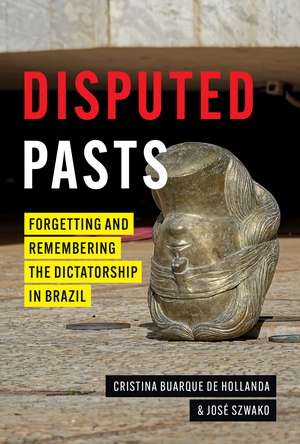
Disputed Pasts: Forgetting and Remembering the Dictatorship in Brazil
Autor Cristina Buarque de Hollanda, José Szwakoen Limba Engleză Hardback – 14 iul 2026
Brazil’s military dictatorship ended in 1985, but its history still looms large over the country. Since the restoration of democracy, national politics have been shaped by heated contestation over the dictatorship’s legacy. Cristina Buarque de Hollanda and José Szwako examine how the state, the military, and civil society have variously mourned, celebrated, and suppressed memories of Brazil’s violent past—and to what ends.
As the dictatorship faltered under pressure from the opposition in the streets and in Congress, popular opinion favored democracy, which often meant forgetting. Today, the Brazilian left contends that the past has been silenced, paving the way for Jair Bolsonaro and the far right. Yet the past has been intensely contested: media outlets, social movements, and official commissions have long documented the dictatorship and spurred reparations. Disputed Pasts argues that the conservative ascendency is a reaction to these efforts of remembrance. The right seeks to rehabilitate the violent past by discrediting victims and elevating the dictatorship’s anti-communist ideology. Far from forgetting the past, Bolsonaro and Bolsonarismo actively remember and celebrate it.
Preț: 338.53 lei
Nou
Puncte Express: 508
Carte disponibilă
Livrare economică 29 octombrie-12 noiembrie
Livrare express 15-21 octombrie pentru 44.70 lei
Livrare prin curier în România Termenul estimat este afișat lângă disponibilitate.
Transport gratuit de la 400.00 lei Plată online sau ramburs, în funcție de opțiunile comenzii.
Retur gratuit în 14 zile Comandă securizată și suport în română.
Specificații
ISBN-13: 9781477334072
ISBN-10: 1477334076
Pagini: 256
Dimensiuni: 152 x 229 x 25 mm
Greutate: 0.59 kg
Editura: University of Texas Press
Colecția University of Texas Press
ISBN-10: 1477334076
Pagini: 256
Dimensiuni: 152 x 229 x 25 mm
Greutate: 0.59 kg
Editura: University of Texas Press
Colecția University of Texas Press
Notă biografică
Cristina Buarque de Hollanda is an adjunct associate professor of political science at New York University Abu Dhabi and a collaborating associate professor of political science at the State University of Rio de Janeiro. She is the author of Teoria das elites and Modos da representação política: O experimento da Primeira República brasileira.
José Szwako is a professor of sociology at the Institute of Social and Political Studies of the State University of Rio de Janeiro. He is the coauthor of Dicionário dos negacionismos no Brasil and Movimentos sociais e institucionalização: Políticas sociais, raça e gênero no Brasil pós-transição.
José Szwako is a professor of sociology at the Institute of Social and Political Studies of the State University of Rio de Janeiro. He is the coauthor of Dicionário dos negacionismos no Brasil and Movimentos sociais e institucionalização: Políticas sociais, raça e gênero no Brasil pós-transição.
Cuprins
- Introduction
- Part I: Forgetting
- 1. Scenes, Alliances, and Actors at the Roots of the Transition
- 2. The “Mean-Spirited” Amnesty and Platforms of Forgetting
- 3. From Forgetfulness to Publicity: Fear, Hope, and Punishment in the 1980s
- Part II: Remembering
- 4. Toward the Special Commission on Political Dead and Disappeared: Steps and Countersteps in Remembering the Past
- 5. The Political Roots of the Memory Turn: The Amnesty Commission and the Enduring Barriers to Remembering
- Part III: Celebrating
- 6. Politics and Policies of Remembering: The National Truth Commission and Commissionism
- 7. Human Rights in Dispute: Celebrating the Violent Past
- Conclusions
- Acknowledgments
- Abbreviations and Acronyms
- Timeline
- Cast of Characters
- Notes
- Index
Recenzii
Beautifully written in engaging fast-paced prose, this in-depth study of the fight for truth and justice in the aftermath of Brazil’s military regime is mandatory reading for anyone interested in the human rights movement and its impact on contemporary Brazilian society. Based on oral histories and a careful reading of multiple sources, Disputed Pasts offers a sophisticated analysis about how civil society, government bureaucrats, international institutions, and other allies persisted in promoting a set of memories related to the dictatorship that faced constant pushback from defenders of the military regime, who first insisted on forgetting the nation’s recent past and then attempted to officialize their own version of the country’s history.
Emancipation can come through memory if the past becomes a counterexample to transcend. But memory can also haunt, when it is a source of longing, nostalgia, and revival. The afterlives of Brazil’s twenty-year dictatorship have served diverse kinds of actors and different visions of politics, and this superb reconstruction is an excellent guide to their ambiguous deployments.
Emancipation can come through memory if the past becomes a counterexample to transcend. But memory can also haunt, when it is a source of longing, nostalgia, and revival. The afterlives of Brazil’s twenty-year dictatorship have served diverse kinds of actors and different visions of politics, and this superb reconstruction is an excellent guide to their ambiguous deployments.
Descriere
How the memory of military dictatorship shapes Brazil's political divides and the far-right's rise.