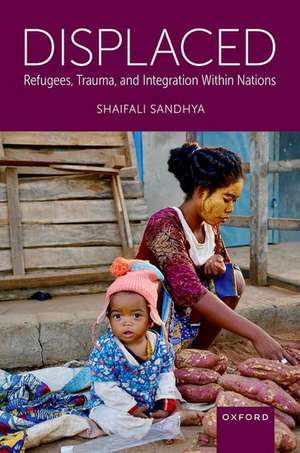
Displaced: Refugees, Trauma, and Integration Within Nations
Autor Shaifali Sandhyaen Limba Engleză Hardback – 24 iun 2024
Preț: 296.67 lei
Preț vechi: 371.62 lei
-20%
Puncte Express: 445
Carte disponibilă
Livrare economică 06-11 noiembrie
Livrare express 22-28 octombrie pentru 125.17 lei
Livrare prin curier în România Termenul estimat este afișat lângă disponibilitate.
Transport gratuit de la 400.00 lei Plată online sau ramburs, în funcție de opțiunile comenzii.
Retur gratuit în 14 zile Comandă securizată și suport în română.
Specificații
ISBN-13: 9780197579886
ISBN-10: 0197579884
Pagini: 360
Ilustrații: 13
Dimensiuni: 127 x 231 x 36 mm
Greutate: 0.79 kg
Editura: Oxford University Press
Colecția OUP USA
Locul publicării:New York, United States
ISBN-10: 0197579884
Pagini: 360
Ilustrații: 13
Dimensiuni: 127 x 231 x 36 mm
Greutate: 0.79 kg
Editura: Oxford University Press
Colecția OUP USA
Locul publicării:New York, United States
Recenzii
Dr. Sandhya helps us understand the relation between trauma and integration for refugee populations worldwide. She draws upon first-hand narratives from hundreds of refugees, skillfully weaving in statistics and historical context lacking from any single academic article in this sphere. Sharing her own clinical and personal experiences, she models the power in vulnerability and openness in our own responses to trauma and emotions that can pose challenges for mental health, legal, and other helping professionals. Dr. Sandhya promises a roadmap for countries, local/regional bodies, and institutions to use in navigating how responses to trauma in refugee populations. Above all, she emphasizes the enormous potential and value to our communities that refugees can bring if properly supported and welcomed.
Shaifali Sandhya's book Displaced by far is probably the only book which touches upon the aspect of trauma of refugees across the world and how their appropriate integration into the mainstream can benefit the society at large. Often, refugees are overlooked as a population which has moved from one country to the other owing to oppression or violence and one bereft of the potential to contribute to nation building. Shaifali's book delves into these intricacies of refugee trauma, post-trauma care, and the geopolitics and provides interesting perspectives which will be useful for not only the general reader but also those who are engaged in various refugee-related work. With the world witnessing increased conflicts, the refugee issue is something that all nations ought to address as a global community with much urgency.
Displaced is an exceptional and wide-ranging examination of the multiplicity of hardships that refugees face in the 21st century. Shaifali Sandhya book will be of great interest to anyone concerned about the individual and collective traumas that affects millions of refugees today. A major contribution to 21st century refugee studies.
Sandhya's Displaced is a compassionate work that will help our most vulnerable world citizens.
This is a comprehensive book that meets its objectives. It is useful for a broad audience seeking to learn about the trauma of refugees and ways to improve their integration into host nations. The information provided, despite being gathered from various resources and told through multiple perspectives, is well-organized. Overall, this book is of utmost quality, providing a thorough understanding of its purpose, the actions that can be taken to improve refugees' mental health outcomes, and the resources that can be sought out for further knowledge.
Shaifali Sandhya's book Displaced by far is probably the only book which touches upon the aspect of trauma of refugees across the world and how their appropriate integration into the mainstream can benefit the society at large. Often, refugees are overlooked as a population which has moved from one country to the other owing to oppression or violence and one bereft of the potential to contribute to nation building. Shaifali's book delves into these intricacies of refugee trauma, post-trauma care, and the geopolitics and provides interesting perspectives which will be useful for not only the general reader but also those who are engaged in various refugee-related work. With the world witnessing increased conflicts, the refugee issue is something that all nations ought to address as a global community with much urgency.
Displaced is an exceptional and wide-ranging examination of the multiplicity of hardships that refugees face in the 21st century. Shaifali Sandhya book will be of great interest to anyone concerned about the individual and collective traumas that affects millions of refugees today. A major contribution to 21st century refugee studies.
Sandhya's Displaced is a compassionate work that will help our most vulnerable world citizens.
This is a comprehensive book that meets its objectives. It is useful for a broad audience seeking to learn about the trauma of refugees and ways to improve their integration into host nations. The information provided, despite being gathered from various resources and told through multiple perspectives, is well-organized. Overall, this book is of utmost quality, providing a thorough understanding of its purpose, the actions that can be taken to improve refugees' mental health outcomes, and the resources that can be sought out for further knowledge.
Notă biografică
Dr. Shaifali Sandhya is a US and UK-trained psychologist. She earned a PhD in Human Development and Psychology from The University of Chicago, US as a Mellon Fellow and an MA in Natural Sciences from the University of Cambridge, UK as a Cambridge Commonwealth Fellow and Rajiv Gandhi Fellow. As a professor of Clinical Psychology, Dr. Sandhya has taught courses on international mental health, gender, and health disparities in marginalized populations to doctoral students. The author and editor of research articles, books, and chapters, she has conducted interviews with the media and briefed state officials, local legislators, and federal judges to provide independent assessments of the social and mental health impacts on varied topics such as asylum and immigration, environmental resources, and community health. Dr. Sandhya's work has been featured in international media including the New York Times, Fox TV, CBS, US News and World Report, and National Public Radio. Dr. Sandhya is an expert coupleand family therapist and an internationally acclaimed book author. Her previous book Love will Follow: Why the Indian Marriage is Burning was published by Penguin Random House.
Cuprins
- 1. Our Refugee Crisis: Trauma, Integration and Resettlement
- 2. Trauma Beyond Borders: At Sea in the World
- 3. A White Coat or a White Heart?: The Methodology
- 4. Queen of Proofs and Kings of Torment: Psychological Sequelae of Torture
- 5. Enrique Iglesias Goes German: Identity Politics or Identity Repair?
- 6. Culture and Globalization in Post-Conflict Trauma Care
- 7. What's the Trouble with Mrs. Khaled?: Gender and Sexual Violence
- 8. Family Trauma: The Psychological Legacy of War
- 9. Mental Health and Integration: Structuring Refuge for Resettled Refugees
- 10. Best Practices in Traumatized Refugee Care: Ecology of Trauma-Informed and Cultural Health Interventions
- Appendix: Quantitative Data on Anxiety and Depression Subscales