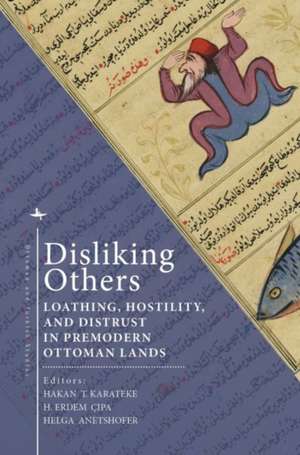
Disliking Others
Editat de Hakan T Karateke, Ç&, Helga Anetshoferen Limba Engleză Hardback – 7 sep 2018
Preț: 861.15 lei
Preț vechi: 1118.38 lei
-23%
Puncte Express: 1292
Carte tipărită la comandă
Livrare economică 07-21 decembrie
Livrare prin curier în România Termenul estimat este afișat lângă disponibilitate.
Transport gratuit pentru acest produs Plată online sau ramburs, în funcție de opțiunile comenzii.
Retur gratuit în 14 zile Comandă securizată și suport în română.
Specificații
ISBN-13: 9781618118806
ISBN-10: 1618118803
Pagini: 400
Dimensiuni: 156 x 234 x 21 mm
Greutate: 0.67 kg
Editura: Academic Studies Press
ISBN-10: 1618118803
Pagini: 400
Dimensiuni: 156 x 234 x 21 mm
Greutate: 0.67 kg
Editura: Academic Studies Press
Notă biografică
Hakan T. Karateke (PhD, Bamberg University) is Professor of Ottoman and Turkish Culture, Language, and Literature at the University of Chicago. He is the author of Evliya Çelebi's Journey from Bursa to the Dardanelles and Edirne (2013) and an article titled "The Rosy History of Jews in the Ottoman Empire: A Critical Approach to Jewish Historiography."
H. Erdem Ç¿pa (PhD, Harvard University) is Associate Professor of Ottoman history at the University of Michigan. He is the author of The Making of Selim: Succession, Legitimacy, and Memory in the Early Modern Ottoman World (2017) and co-editor, with E. Fetvac¿, of Writing History at the Ottoman Court: Editing the Past, Fashioning the Future (2013).
Helga Anetshofer (PhD, Vienna University) is Lecturer for Ottoman and Turkish Studies at the University of Chicago. Her publications include her recent articles "Folk Etymologies and Stories of Toponyms from Danishmendid Territory in Evliya Çelebi's Seyahatname" (2015) and "The Hero Dons a Talismanic Shirt for Battle: Magic Objects Aiding the Warrior in a Turkish Epic Romance" (2018).
H. Erdem Ç¿pa (PhD, Harvard University) is Associate Professor of Ottoman history at the University of Michigan. He is the author of The Making of Selim: Succession, Legitimacy, and Memory in the Early Modern Ottoman World (2017) and co-editor, with E. Fetvac¿, of Writing History at the Ottoman Court: Editing the Past, Fashioning the Future (2013).
Helga Anetshofer (PhD, Vienna University) is Lecturer for Ottoman and Turkish Studies at the University of Chicago. Her publications include her recent articles "Folk Etymologies and Stories of Toponyms from Danishmendid Territory in Evliya Çelebi's Seyahatname" (2015) and "The Hero Dons a Talismanic Shirt for Battle: Magic Objects Aiding the Warrior in a Turkish Epic Romance" (2018).
Cuprins
Introduction
Changing Perceptions about Christian-born Ottomans: Anti-¿ul Sentiments in Ottoman Historiography
H. Erdem Ç¿pa
Circassian Mamluks in Ottoman Egypt and Istanbul, ca. 1500-1730: The Eastern Alternative
Jane Hathaway
Dispelling the Darkness of the Halberdier's Treatise: A Comparative Look at Black Africans in Ottoman Letters in the Early Modern Period
Baki Tezcan
The Jew, the Orthodox Christian, and the European in Ottoman Eyes, ca. 1550-1700
Bilha Moor
An Ottoman Anti-Judaism
Hakan T. Karateke
Evliy¿ Çeleb¿'s Perception of Jews
Hakan T. Karateke
Ambiguous Subjects and Uneasy Neighbors: Bosnian Franciscans' Attitudes toward the Ottoman State, 'Turks,' and Vlachs
Vjeran Kursar
'Those Violating the Good, Old Customs of our Land': Forms and Functions of Graecophobia in the Danubian Principalities, 16th-18th Centuries
Konrad Petrovszky
Representing the Margins: The Many Faces of the 'Gypsy' in Early Modern Ottoman Discourse
Faika Çelik
Gendered Infidels in Fiction: A Case Study on S¿¿bit's ¿ik¿ye-i ¿v¿ce Fes¿d
¿pek Hüner-Cora
'The Greatest of Tribulations': Constructions of Femininity in Sixteenth-Century Ottoman Physiognomy
Emin Leli¿
Defining and Defaming the Other in Early Seventeenth-Century Ottoman Invective
Michael Sheridan
'Are You From Çorum?': Derogatory Attitudes Toward the "Unruly Mob" of the Provinces as Reflected in a Proverbial Saying
Helga Anetshofer
Changing Perceptions about Christian-born Ottomans: Anti-¿ul Sentiments in Ottoman Historiography
H. Erdem Ç¿pa
Circassian Mamluks in Ottoman Egypt and Istanbul, ca. 1500-1730: The Eastern Alternative
Jane Hathaway
Dispelling the Darkness of the Halberdier's Treatise: A Comparative Look at Black Africans in Ottoman Letters in the Early Modern Period
Baki Tezcan
The Jew, the Orthodox Christian, and the European in Ottoman Eyes, ca. 1550-1700
Bilha Moor
An Ottoman Anti-Judaism
Hakan T. Karateke
Evliy¿ Çeleb¿'s Perception of Jews
Hakan T. Karateke
Ambiguous Subjects and Uneasy Neighbors: Bosnian Franciscans' Attitudes toward the Ottoman State, 'Turks,' and Vlachs
Vjeran Kursar
'Those Violating the Good, Old Customs of our Land': Forms and Functions of Graecophobia in the Danubian Principalities, 16th-18th Centuries
Konrad Petrovszky
Representing the Margins: The Many Faces of the 'Gypsy' in Early Modern Ottoman Discourse
Faika Çelik
Gendered Infidels in Fiction: A Case Study on S¿¿bit's ¿ik¿ye-i ¿v¿ce Fes¿d
¿pek Hüner-Cora
'The Greatest of Tribulations': Constructions of Femininity in Sixteenth-Century Ottoman Physiognomy
Emin Leli¿
Defining and Defaming the Other in Early Seventeenth-Century Ottoman Invective
Michael Sheridan
'Are You From Çorum?': Derogatory Attitudes Toward the "Unruly Mob" of the Provinces as Reflected in a Proverbial Saying
Helga Anetshofer
Descriere
Recent historical studies on the Ottoman Empire have taken for granted that subjects of the Ottoman polity flourished under a so-called ""Pax Ottomanica"". This volume probes the rosy narrative of Ottoman tolerance that has long dominated the discussions.