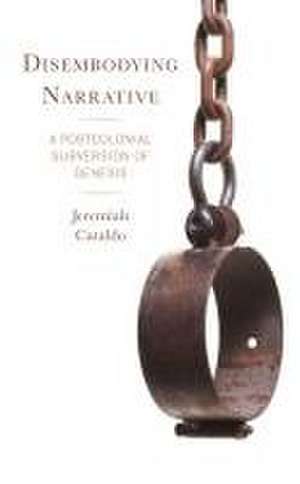
Disembodying Narrative: A Postcolonial Subversion of Genesis: Dispatches from the New Diaspora
Autor Visiting Assistant Professor Jeremiah W. Cataldoen Limba Engleză Hardback – 21 noi 2023


Preț: 536.10 lei
Preț vechi: 782.64 lei
-32%
Puncte Express: 804
Carte tipărită la comandă
Livrare economică 07-21 decembrie
Livrare prin curier în România Termenul estimat este afișat lângă disponibilitate.
Transport gratuit pentru acest produs Plată online sau ramburs, în funcție de opțiunile comenzii.
Retur gratuit în 14 zile Comandă securizată și suport în română.
Specificații
ISBN-13: 9781978714977
ISBN-10: 1978714971
Pagini: 224
Dimensiuni: 152 x 230 x 20 mm
Greutate: 0.5 kg
Editura: Bloomsbury Publishing
Colecția Fortress Academic
Seria Dispatches from the New Diaspora
Locul publicării:New York, United States
ISBN-10: 1978714971
Pagini: 224
Dimensiuni: 152 x 230 x 20 mm
Greutate: 0.5 kg
Editura: Bloomsbury Publishing
Colecția Fortress Academic
Seria Dispatches from the New Diaspora
Locul publicării:New York, United States
Cuprins
Chapter 1: Introduction
Chapter 2: Adam, Eve, and Steve's Serpent
Chapter 3: Colonizing Cain
Chapter 4: Highbrow Hamitic Hypothesis
Chapter 5: Flooding the world and saving a few
Chapter 6: Inverting the Tower of Babel
Chapter 7: Father Abraham sentenced a son, or two
Chapter 8: A(n incestual, pedophilic) cave-dwelling Lot
Chapter 9: Sarah's (colonizing) laughter and Hagar's (colonized) tears
Chapter 10: Jacob and Esau
Chapter 11: Joseph from lowly status into authoritative body
Conclusion: Taking stock of the trajectory of Genesis\
Chapter 2: Adam, Eve, and Steve's Serpent
Chapter 3: Colonizing Cain
Chapter 4: Highbrow Hamitic Hypothesis
Chapter 5: Flooding the world and saving a few
Chapter 6: Inverting the Tower of Babel
Chapter 7: Father Abraham sentenced a son, or two
Chapter 8: A(n incestual, pedophilic) cave-dwelling Lot
Chapter 9: Sarah's (colonizing) laughter and Hagar's (colonized) tears
Chapter 10: Jacob and Esau
Chapter 11: Joseph from lowly status into authoritative body
Conclusion: Taking stock of the trajectory of Genesis\
Recenzii
This important study brings postcolonial thought back to Genesis, rather than the obvious texts of Exodus or prophetic works . Indeed, Cataldo also employs a call-and-response method to challenge and comment upon the ideas themselves throughout.
This volume contains a number of self-contained chapters that can become assigned reading in courses or segments of a syllabus designed to address the impact of the Bible, in Western culture primarily, over the past 300-odd years. Any of them are sure to stimulate lively discussion and debate and accomplish the author's goal of reassessing the meanings we assign to biblical texts and the objectified values and assumptions about truth that have resulted from their association with the Bible.
Scholars interested in what a neo-postcolonial approach to biblical studies may entail will surely find this book very helpful. The chapters following the introduction can serve well as a starting point for in-class, thoughtful debates and learning among undergraduate (and graduate) students in academic institutions, particularly, but not only, in the USA.
This work aims to challenge the conservative underpinnings of marriage, gender, family, and the right to the promised land in the Book of Genesis, which serve as fundamental pillars of Western societies. A postcolonial reading of the selected Genesis passages seeks to challenge assumptions within the social and religious realms, not solely for subversion or deconstruction, but rather to create an inclusive space for diverse human identities and dignities beyond dominant frameworks. The reading strategy employed here is subversive and provocative, not as an attempt to undermine the Bible or religion but to prompt productive conversations about societal assumptions, ideologies, and traditions.
A valuable contribution to the expanding body of literature in the field of postcolonial biblical criticism. This book possesses a remarkable theoretical sophistication that is sure to captivate readers who have a keen interest in various scriptural approaches and hegemonic criticism.
In Disembodying Narrative: A Postcolonial Subversion of Genesis, Jeremiah Cataldo unsettles any simplistic notions about the Bible's first book and how it should be read. Attentive to both the Bible's history and its history of reception, Cataldo exposes how the Bible and subsequent, particularly Christian, interpretations have disfigured, even erased, the bodies of marginalized characters only to reconfigure them to suit colonizing interests. With irreverent candor and the skill of a seasoned teacher, Cataldo tracks a history of scandalous biblical interpretation that has damaged bodies, minds, and societies. Serious students of the Bible will find themselves reoriented by this thoughtful, impassioned appeal for a less naïve, more responsible reading of this most important book.
This volume contains a number of self-contained chapters that can become assigned reading in courses or segments of a syllabus designed to address the impact of the Bible, in Western culture primarily, over the past 300-odd years. Any of them are sure to stimulate lively discussion and debate and accomplish the author's goal of reassessing the meanings we assign to biblical texts and the objectified values and assumptions about truth that have resulted from their association with the Bible.
Scholars interested in what a neo-postcolonial approach to biblical studies may entail will surely find this book very helpful. The chapters following the introduction can serve well as a starting point for in-class, thoughtful debates and learning among undergraduate (and graduate) students in academic institutions, particularly, but not only, in the USA.
This work aims to challenge the conservative underpinnings of marriage, gender, family, and the right to the promised land in the Book of Genesis, which serve as fundamental pillars of Western societies. A postcolonial reading of the selected Genesis passages seeks to challenge assumptions within the social and religious realms, not solely for subversion or deconstruction, but rather to create an inclusive space for diverse human identities and dignities beyond dominant frameworks. The reading strategy employed here is subversive and provocative, not as an attempt to undermine the Bible or religion but to prompt productive conversations about societal assumptions, ideologies, and traditions.
A valuable contribution to the expanding body of literature in the field of postcolonial biblical criticism. This book possesses a remarkable theoretical sophistication that is sure to captivate readers who have a keen interest in various scriptural approaches and hegemonic criticism.
In Disembodying Narrative: A Postcolonial Subversion of Genesis, Jeremiah Cataldo unsettles any simplistic notions about the Bible's first book and how it should be read. Attentive to both the Bible's history and its history of reception, Cataldo exposes how the Bible and subsequent, particularly Christian, interpretations have disfigured, even erased, the bodies of marginalized characters only to reconfigure them to suit colonizing interests. With irreverent candor and the skill of a seasoned teacher, Cataldo tracks a history of scandalous biblical interpretation that has damaged bodies, minds, and societies. Serious students of the Bible will find themselves reoriented by this thoughtful, impassioned appeal for a less naïve, more responsible reading of this most important book.