Cantitate/Preț
Produs

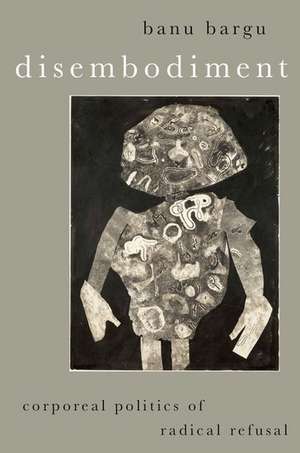
Disembodiment: Corporeal Politics of Radical Refusal: Heretical Thought

Autor Banu Bargu
en Limba Engleză Hardback – 19 dec 2024

Această monografie densă, publicată de Oxford University Press în seria Heretical Thought, propune o reevaluare radicală a gesturilor de autodistrugere, privite nu ca patologii individuale, ci ca instrumente politice de ultimă instanță. Subliniem modul în care Banu Bargu destabilizează narațiunile istorice despre progres și agenție, oferind o teorie materialistă a corpului care refuză să fie domesticit de structurile de putere. Considerăm că forța acestui volum rezidă în capacitatea de a conecta experiențele corpului suferind din Sudul Global cu marile tradiții ale teoriei critice occidentale.

Analiza se întinde pe un spectru istoric și geografic impresionant, de la rezistența sclavilor în timpul traversării transatlantice până la practicile contemporane de coasere a buzelor ale solicitanților de azil în zonele de frontieră. Disembodiment servește ca o alternativă teoretică la Reclaiming Humanity in Palestinian Hunger Strikes de Ashjan Ajour pentru cursurile de filozofie politică sau studii de gen, având avantajul unei abordări globale care nu se limitează la un singur conflict, ci caută un „repertoriu corporal de luptă” universal. În timp ce Ajour se concentrează pe etnografia rezistenței în închisorile israeliene, Banu Bargu construiește un cadru conceptual mai larg, chestionând însăși natura umanității și a demnității în condiții de deposedare extremă.

Lucrarea se înscrie organic în traiectoria academică a autoarei, rafinând temele explorate în Starve and Immolate – The Politics of Human Weapons și Turkey's Necropolitical Laboratory. Dacă în scrierile anterioare Banu Bargu analiza mecanismele morții sub egida statului, în Disembodiment ea mută accentul pe agenția expresivă a corpului care irupe și anulează disciplina impusă, oferind o critică necruțătoare a prezentului.

Citește tot Restrânge

Din seria Heretical Thought

Preț: 17423 lei

Preț vechi: 20476 lei
-15%

Puncte Express: 261

Carte disponibilă

Livrare economică 07-13 mai
Livrare express 18-24 aprilie pentru 7357 lei


Specificații

ISBN-13: 9780197608531
ISBN-10: 0197608531
Pagini: 504
Dimensiuni: 165 x 241 x 46 mm
Greutate: 0.79 kg
Editura: Oxford University Press
Colecția OUP USA
Seria Heretical Thought

Locul publicării:New York, United States

De ce să citești această carte

Recomandăm această carte cercetătorilor în științe politice și sociologie care doresc să înțeleagă formele extreme de protest contemporan. Cititorul va câștiga o perspectivă profundă asupra modului în care lipsa de putere este transformată în agenție prin utilizarea propriului corp ca armă politică. Este un studiu esențial pentru oricine investighează limitele libertății și ale demnității umane în spațiile de detenție și la frontierele lumii moderne.


Despre autor

Banu Bargu este o voce proeminentă în teoria critică contemporană, specializată în intersecția dintre politică, filozofie și corp. Opera sa se concentrează pe biopolitică, necropolitică și mișcări de rezistență radicală, fiind recunoscută pentru analizele asupra regimurilor de detenție și a transformării corpului în instrument de luptă. Pe lângă volumele autorale, a coordonat lucrări importante precum The Biopolitics of Punishment, investigând dialogul dintre Foucault și Derrida, și a contribuit la volume colective care analizează relația dintre capitalism și feminism prin prisma operei lui Nancy Fraser.


Descriere

Disembodiment examines self-destruction, self-injury, and self-endangerment as actions that express the injustices and indignities of the life conditions of impoverished, dispossessed, and dominated peoples. Author Banu Bargu troubles the dominant approach that treats these acts as individual pathologies, cries for help, and signs of despair. Instead, she suggests that they should be read as unconventional performances of resistance and refusal that are erased, marginalized, and distorted by metanarratives of history as progress and of agency as freedom and intentionality. Situating these practices in a dialectic of desubjectivation and counter-subjectivation, Bargu argues that they dispel a western metaphysics of subjecthood and invoke alternative ways of being human and of relating to one's body and the world. Pursuing philosophical questions about the meaning of agency, the direction of history, and the limits of the political generated by the forfeiture of the body, Bargu offers a stark and unforgiving critique of our present. As a work in global critical theory whose normative compass is the suffering body, Disembodiment brings together corporeal enactments of defiance and refusal from the global south with major thinkers of western modernity and prominent critical-theoretical traditions of the twentieth century. Bargu moves from such historical precedents as the suicides of enslaved Africans during the transatlantic crossing, the hunger strikes of woman suffragists in England's prisons, and Gandhian fasting practices in the Indian anticolonial struggle to contemporary examples that include the hunger and thirst strikes in the Maze and Guantánamo, the self-incineration of Mohammed Bouazizi, and the lip-sewing practices of migrants and asylum seekers in detention centers and border zones of the global north today. She takes the reader on an unsettling journey that delineates the emergence of a corporeal repertoire of contention. Performed by the powerless who find themselves in crisis, this repertoire is built on the expressive agency of the body and its ability to irrupt, undoing its training in composure and radicalizing the meaning of dignity. Disembodiment presents a bold materialist theory of corporeal agency, which upholds the body's powers as fundamentally rebellious and ultimately undomesticatable

Notă biografică

Banu Bargu is Professor in History of Consciousness at University of California, Santa Cruz. Her research and publications are situated at the intersection of political and critical theory, anthropology, history of social movements and resistance practices, and Middle East politics. She is the author of Starve and Immolate: The Politics of Human Weapons, which received the First Book Award given by the Foundations of Political Theory section of the American Political Science Association and was named an Outstanding Academic Title by Choice. She is the incoming co-editor of Political Theory, the flagship journal of the field.