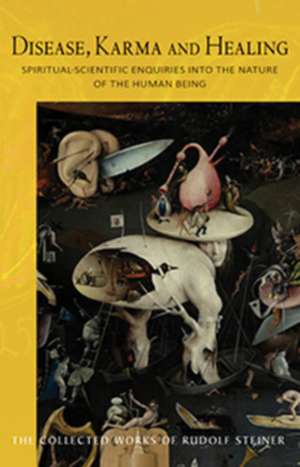
Disease, Karma and Healing
Autor Rudolf Steiner Traducere de Matthew Bartonen Limba Engleză Paperback – 24 oct 2013
Găsim în această primă ediție contribuția de bază a unui singur autor, Rudolf Steiner, ale cărui optsprezece prelegeri susținute la Berlin între anii 1908 și 1909 sunt traduse din limba germană de Matthew Barton. Deși materialul nu provine dintr-un centru medical convențional și nu reflectă o experiență clinică tradițională, volumul publicat de Rudolf Steiner Press propune o extindere teoretică a practicii medicale prin prisma științei spirituale. Premisa concretă de la care pornim este aceea că boala se manifestă în corpul fizic, dar își are originile în afara lui, necesitând o înțelegere a nucleului esențial al individului. Considerăm ca element distinctiv analiza detaliată a interacțiunii dintre corpul fizic, cel eteric, cel astral și Eu, raportate la procesele ritmice ale organismului. Ritmul textului este unul academic și analitic, investigând de la fenomene uzuale, precum durerile de cap sau capacitatea de a râde și de a plânge, până la dimensiunile spirituale ale memoriei și uitării. Lucrarea se situează pe linia clinică a lui Introducing Anthroposophical Medicine, dar cu accent pe influența karmei și a proceselor evolutioniste asupra stării de sănătate. În contextul celorlalte scrieri ale autorului, apreciem modul în care acest volum se raportează la temele din On Epidemics; dacă acolo accentul se punea pe frică ca generator al bolii, aici structura narativă extinde viziunea către dimensiunea cosmică și morală a constituției umane, oferind un aparat conceptual dens, completat de ilustrații alb-negru.
Preț: 155.26 lei
Carte disponibilă
Livrare economică 03-17 decembrie
Livrare express 19-25 noiembrie pentru 32.19 lei
Specificații
ISBN-10: 1855843838
Pagini: 304
Ilustrații: black & white illustrations, frontispiece
Dimensiuni: 236 x 151 x 23 mm
Greutate: 0.47 kg
Ediția:First
Editura: Rudolf Steiner Press
V-ar putea interesa
-
 The Soul's CalendarRudolf SteinerPreț: 102.58 lei
-
 Preț: 153.97 lei
-
 Preț: 132.87 lei
-
 The Son of Love and the Birth of the New MysteriesRon MacFarlanePreț: 66.24 lei
-
 Preț: 55.06 lei
-
 Preț: 140.97 lei
-
 Theosophy, the Final AnswerMatzota, MR EugenePreț: 101.15 lei
-
 The Essential Rudolf SteinerRudolf SteinerPreț: 258.53 lei
-
 An Introduction to Waldorf Education and Other EssaysRudolf SteinerPreț: 132.94 lei
-
 The Stanzas of Dzjn TheogenesisRaleigh, Dr Albert SidneyPreț: 57.20 lei
-
 The Birth and Evolution of the SoulAnnie BesantPreț: 55.36 lei
-
 The Elements of TheosophyLilian EdgerPreț: 85.70 lei
-
 KarmaRudolf SteinerPreț: 61.25 lei
-
 Preț: 50.45 lei
-
 John Wesley's Heart-Warming ReligionJ. C. McPheetersPreț: 40.96 lei
-
 Preț: 65.99 lei
-
 Preț: 129.37 lei
De ce să citești această carte
Recomandăm această carte terapeuților și practicienilor din sfera de medicină alternativă care doresc să înțeleagă rădăcinile non-fizice ale patologiei umane. Cititorul câștigă o perspectivă sistemică asupra modului în care procesele ritmice și corpurile subtile influențează organismul. Este un instrument teoretic util pentru aprofundarea conexiunilor dintre karmă, evoluție spirituală și procesul de vindecare.
Despre autor
Rudolf Steiner (1861–1925) a fost un filozof, ezoterist și reformator social austriac, fondator al antroposofiei, un curent spiritual cu rădăcini în filozofia idealistă germană și în știința goetheană. În prima fază a activității sale, Steiner a încercat să realizeze o sinteză între știință și spiritualitate, dezvoltând ceea ce a numit „știință spirituală”. Ulterior, după Primul Război Mondial, el a transpus aceste idei în inițiative practice de amploare, punând bazele pedagogiei Waldorf, agriculturii biodinamice și medicinei antroposofice, domeniu direct corelat cu prelegerile din volumul de față.