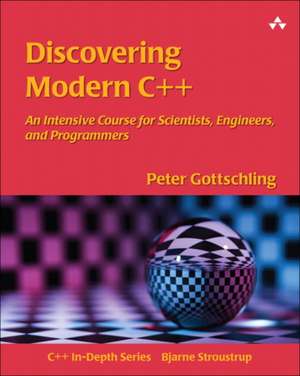
Discovering Modern C++
Autor Peter Gottschlingen Limba Engleză Paperback – 17 dec 2015
Preț: 338.84 lei
Puncte Express: 508
Preț estimativ în valută:
59.99€ • 69.85$ • 52.11£
59.99€ • 69.85$ • 52.11£
Carte indisponibilă temporar
Doresc să fiu notificat când acest titlu va fi disponibil:
Se trimite...
Preluare comenzi: 021 569.72.76
Specificații
ISBN-13: 9780134383583
ISBN-10: 0134383583
Pagini: 480
Dimensiuni: 187 x 233 x 27 mm
Greutate: 0.78 kg
Editura: Pearson Education
ISBN-10: 0134383583
Pagini: 480
Dimensiuni: 187 x 233 x 27 mm
Greutate: 0.78 kg
Editura: Pearson Education
Notă biografică
Peter Gottschling is founder of SimuNova, a company that works on developing the Matrix Template Library (MTL4) and offers C++ training. He is a member of the ISO C++ standards committee, vice-chair of Germany's programming language standards committee, and founder of the C++ User Group in Dresden. He earned his Ph.D. in computer science at Technische Universität Dresden in 2002.
Cuprins
Preface xvii Reasons to Learn C++ xvii
Reasons to Read This Book xviii
The Beauty and the Beast xviii
Languages in Science and Engineering xix
Typographical Conventions xx
Acknowledgments xxiii
About the Author xxv
Chapter 1: C++ Basics 1
1.1 Our First Program 1
1.2 Variables 3
1.3 Operators 10
1.4 Expressions and Statements 21
1.5 Functions 28
1.6 Error Handling 34
1.7 I/O 40
1.8 Arrays, Pointers, and References 47
1.9 Structuring Software Projects 58
1.10 Exercises 63
Chapter 2: Classes 65
2.1 Program for Universal Meaning Not for Technical Details 65
2.2 Members 67
2.3 Setting Values: Constructors and Assignments 72
2.4 Destructors 89
2.5 Method Generation Résumé 95
2.6 Accessing Member Variables 96
2.7 Operator Overloading Design 100
2.8 Exercises 104
Chapter 3: Generic Programming 107
3.1 Function Templates 107
3.2 Namespaces and Function Lookup 115
3.3 Class Templates 123
3.4 Type Deduction and Definition 131
3.5 A Bit of Theory on Templates: Concepts 136
3.6 Template Specialization 136
3.7 Non-Type Parameters for Templates 144
3.8 Functors 146
3.9 Lambda 154
3.10 Variadic Templates 159
3.11 Exercises 161
Chapter 4: Libraries 165
4.1 Standard Template Library 165
4.2 Numerics 186
4.3 Meta-programming 198
4.4 Utilities 202
4.5 The Time Is Now 209
4.6 Concurrency 211
4.7 Scientific Libraries Beyond the Standard 213
4.8 Exercises 215
Chapter 5: Meta-Programming 219
5.1 Let the Compiler Compute 219
5.2 Providing and Using Type Information 226
5.3 Expression Templates 245
5.4 Meta-Tuning: Write Your Own Compiler Optimization 253
5.5 Exercises 283
Chapter 6: Object-Oriented Programming 287
6.1 Basic Principles 287
6.2 Removing Redundancy 298
6.3 Multiple Inheritance 299
6.4 Dynamic Selection by Sub-typing 306
6.5 Conversion 308
6.6 CRTP 316
6.7 Exercises 320
Chapter 7: Scientific Projects 321
7.1 Implementation of ODE Solvers 321
7.2 Creating Projects 332
7.3 Some Final Words 345
Appendix A: Clumsy Stuff 347
A.1 More Good and Bad Scientific Software 347
A.2 Basics in Detail 353
A.3 Real-World Example: Matrix Inversion 362
A.4 Class Details 371
A.5 Method Generation 375
A.6 Template Details 386
A.7 Using std::vector in C++03 391
A.8 Dynamic Selection in Old Style 392
A.9 Meta-Programming Details 392
Appendix B: Programming Tools 403
B.1 gcc 403
B.2 Debugging 404
B.3 Memory Analysis 408
B.4 gnuplot 409
B.5 Unix, Linux, and Mac OS 411
Appendix C: Language Definitions 413
C.1 Value Categories 413
C.2 Operator Overview 413
C.3 Conversion Rules 416
Bibliography 419
Index 423
Reasons to Read This Book xviii
The Beauty and the Beast xviii
Languages in Science and Engineering xix
Typographical Conventions xx
Acknowledgments xxiii
About the Author xxv
Chapter 1: C++ Basics 1
1.1 Our First Program 1
1.2 Variables 3
1.3 Operators 10
1.4 Expressions and Statements 21
1.5 Functions 28
1.6 Error Handling 34
1.7 I/O 40
1.8 Arrays, Pointers, and References 47
1.9 Structuring Software Projects 58
1.10 Exercises 63
Chapter 2: Classes 65
2.1 Program for Universal Meaning Not for Technical Details 65
2.2 Members 67
2.3 Setting Values: Constructors and Assignments 72
2.4 Destructors 89
2.5 Method Generation Résumé 95
2.6 Accessing Member Variables 96
2.7 Operator Overloading Design 100
2.8 Exercises 104
Chapter 3: Generic Programming 107
3.1 Function Templates 107
3.2 Namespaces and Function Lookup 115
3.3 Class Templates 123
3.4 Type Deduction and Definition 131
3.5 A Bit of Theory on Templates: Concepts 136
3.6 Template Specialization 136
3.7 Non-Type Parameters for Templates 144
3.8 Functors 146
3.9 Lambda 154
3.10 Variadic Templates 159
3.11 Exercises 161
Chapter 4: Libraries 165
4.1 Standard Template Library 165
4.2 Numerics 186
4.3 Meta-programming 198
4.4 Utilities 202
4.5 The Time Is Now 209
4.6 Concurrency 211
4.7 Scientific Libraries Beyond the Standard 213
4.8 Exercises 215
Chapter 5: Meta-Programming 219
5.1 Let the Compiler Compute 219
5.2 Providing and Using Type Information 226
5.3 Expression Templates 245
5.4 Meta-Tuning: Write Your Own Compiler Optimization 253
5.5 Exercises 283
Chapter 6: Object-Oriented Programming 287
6.1 Basic Principles 287
6.2 Removing Redundancy 298
6.3 Multiple Inheritance 299
6.4 Dynamic Selection by Sub-typing 306
6.5 Conversion 308
6.6 CRTP 316
6.7 Exercises 320
Chapter 7: Scientific Projects 321
7.1 Implementation of ODE Solvers 321
7.2 Creating Projects 332
7.3 Some Final Words 345
Appendix A: Clumsy Stuff 347
A.1 More Good and Bad Scientific Software 347
A.2 Basics in Detail 353
A.3 Real-World Example: Matrix Inversion 362
A.4 Class Details 371
A.5 Method Generation 375
A.6 Template Details 386
A.7 Using std::vector in C++03 391
A.8 Dynamic Selection in Old Style 392
A.9 Meta-Programming Details 392
Appendix B: Programming Tools 403
B.1 gcc 403
B.2 Debugging 404
B.3 Memory Analysis 408
B.4 gnuplot 409
B.5 Unix, Linux, and Mac OS 411
Appendix C: Language Definitions 413
C.1 Value Categories 413
C.2 Operator Overview 413
C.3 Conversion Rules 416
Bibliography 419
Index 423