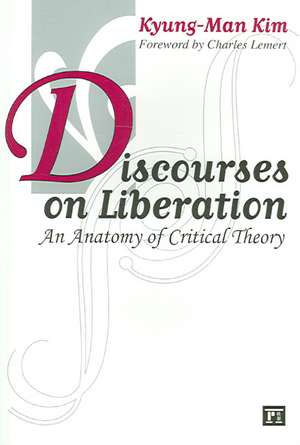
Discourses on Liberation: An Anatomy of Critical Theory
Autor Kyung-Man Kimen Limba Engleză Paperback – 15 ian 2006
| Toate formatele și edițiile | Preț | Express |
|---|---|---|
| Paperback (1) | 268.70 lei 22-36 zile | |
| Taylor & Francis – 15 ian 2006 | 268.70 lei 22-36 zile | |
| Hardback (1) | 1363.41 lei 22-36 zile | |
| Taylor & Francis – 15 aug 2005 | 1363.41 lei 22-36 zile |
Preț: 268.70 lei
Preț vechi: 309.87 lei
-13%
Puncte Express: 403
Preț estimativ în valută:
47.52€ • 55.76$ • 41.21£
47.52€ • 55.76$ • 41.21£
Carte disponibilă
Livrare economică 16 februarie-02 martie
Specificații
ISBN-13: 9781594511288
ISBN-10: 1594511284
Pagini: 156
Dimensiuni: 152 x 229 x 12 mm
Greutate: 0.23 kg
Ediția:1
Editura: Taylor & Francis
Colecția Routledge
Locul publicării:Oxford, United Kingdom
ISBN-10: 1594511284
Pagini: 156
Dimensiuni: 152 x 229 x 12 mm
Greutate: 0.23 kg
Ediția:1
Editura: Taylor & Francis
Colecția Routledge
Locul publicării:Oxford, United Kingdom
V-ar putea interesa
-
 American Civil Religion: What Americans Hold SacredPeter GardellaPreț: 280.22 lei
 -
 -18%Preț: 345.35 lei423.35 lei
 -
 -28%Preț: 344.02 lei475.56 lei
 -
 Social DynamicsBrian Skyrms-13%Preț: 305.21 lei348.87 lei
 -
 -37%Preț: 980.27 lei1547.86 lei
 -
 -9%Preț: 261.76 lei288.05 lei
 -
 -15%Preț: 666.98 lei784.68 lei
 -
 Globalization: A ReaderCharles LemertPreț: 436.52 lei
 -
 Media, Society, WorldNick CouldryPreț: 239.02 lei
 -
 Preț: 125.24 lei
 -
 On the State: Lectures at the College de France, 1989 - 1992Pierre Bourdieu-19%Preț: 495.62 lei611.87 lei
 -
 The Body and Social TheoryChris ShillingPreț: 434.23 lei
 -
 Immaterial BodiesLisa Blackman-11%Preț: 432.66 lei486.12 lei
 -
 The Goffman ReaderC Lemert-23%Preț: 429.06 lei557.22 lei
 -
 Uncertain Worlds: World-systems Analysis in Changing TimesImmanuel Wallerstein-18%Preț: 1329.15 lei1620.91 lei
 -
 -18%Preț: 183.25 lei224.33 lei
 -
 Blueprint for RevolutionSrdja PopovicPreț: 75.92 lei
 -
 The Project SocietyAnders Fogh JensenPreț: 136.85 lei
Recenzii
"Kyung-Man Kim offers a comprehensive inventory of the obstacles the most powerful and influential thinkers of our time tried to overcome, the questions they asked without finding good answers, and the questions they've overlooked or avoided. No one concerned with the ethical impact of knowledge and the role it may play in winning the case of human freedom can neglect Kyung-Man Kim's analysis."
-Zygmunt Bauman
"This is a powerful book, compelling for every reader who wants to know how current sociological theory can be used to change, not just interpret, the social world. Kyung-man Kim offers masterful readings of the main theoretical formations of the last century."
-Norman K. Denzin, University of Illinois
"A lucid exposition and critique of Bourdieu, Giddens, and Habermas, and of the phenomenological ethnographies of Garfinkel and the ethnomethodologists who provided their starting point. Kim, who has honed his skills in his acute contributions to the hyper-reflexive sociology of scientific knowledge, now successfully takes on the big game of the emancipatory theory world.
-Randall Collins, University of Pennsylvania
-Zygmunt Bauman
"This is a powerful book, compelling for every reader who wants to know how current sociological theory can be used to change, not just interpret, the social world. Kyung-man Kim offers masterful readings of the main theoretical formations of the last century."
-Norman K. Denzin, University of Illinois
"A lucid exposition and critique of Bourdieu, Giddens, and Habermas, and of the phenomenological ethnographies of Garfinkel and the ethnomethodologists who provided their starting point. Kim, who has honed his skills in his acute contributions to the hyper-reflexive sociology of scientific knowledge, now successfully takes on the big game of the emancipatory theory world.
-Randall Collins, University of Pennsylvania
Notă biografică
Kyung-Man Kim Department of Sociology Sogang University, Korea
Cuprins
Chapter 1 Introduction; Chapter 2 The Management of Temporality; Chapter 3 Can Bourdieu's Critical Theory Liberate Us from Symbolic Violence?; Chapter 4 Critical Theory Criticized; Chapter 5 On the Failure of Habermas's Hermeneutic Reconstructionism; Chapter 6 Is Social Theory an Interactive Kind?; Chapter 7 Richard Rorty's Critique of the Will to Power; Chapter 8 Epilogue;
Descriere
What binds the theoretical work of Pierre Bourdieu, Anthony Giddens, and Jurgen Habermas? The author offers a reading of contemporary critical theorists and explains how, by reading them together, we may find a practical basis for progressive social change.