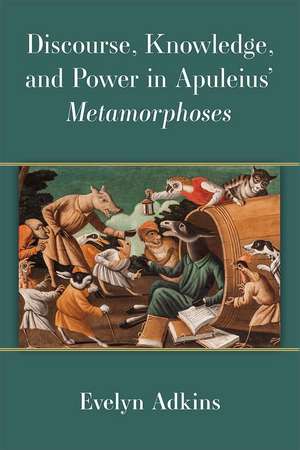
Discourse, Knowledge, and Power in Apuleius’ Metamorphoses
Autor Evelyn Adkinsen Limba Engleză Hardback – 23 mai 2022
Discourse, Knowledge, and Power presents a new approach to the Metamorphoses: it is the first in-depth investigation of the use of speech and discourse as tools of characterization in Apuleius’ novel. It argues that discourse, broadly defined to include speech, silence, written text, and nonverbal communication, is the primary tool for negotiating identity, status, and power in the Metamorphoses. Although it takes as its starting point the role of discourse in the characterization of literary figures, it contends that the process we see in the Metamorphoses reflects the real world of the second century CE Roman Empire. Previous scholarship on Apuleius’ novel has read it as either a literary puzzle or a source-text for social, philosophical, or religious history. In contrast, this book uses a framework of discourse analysis, an umbrella term for various methods of studying the social political functions of discourse, to bring Latin literary studies into dialogue with Roman rhetoric, social and cultural history, religion, and philosophy as well as approaches to language and power from the fields of sociology, linguistics, and linguistic anthropology. Discourse, Knowledge, and Power argues that a fictional account of a man who becomes an animal has much to tell us not only about ancient Roman society and culture, but also about the dynamics of human and gendered communication, the anxieties of the privileged, and their implications for swiftly shifting configurations of status and power whether in the second or twenty-first centuries.
Preț: 518.17 lei
Preț vechi: 639.72 lei
-19%
Puncte Express: 777
Preț estimativ în valută:
91.60€ • 109.22$ • 79.45£
91.60€ • 109.22$ • 79.45£
Carte indisponibilă temporar
Doresc să fiu notificat când acest titlu va fi disponibil:
Se trimite...
Specificații
ISBN-13: 9780472133055
ISBN-10: 0472133055
Pagini: 290
Dimensiuni: 152 x 229 x 33 mm
Greutate: 0.48 kg
Editura: UNIVERSITY OF MICHIGAN PRESS
Colecția University of Michigan Press
ISBN-10: 0472133055
Pagini: 290
Dimensiuni: 152 x 229 x 33 mm
Greutate: 0.48 kg
Editura: UNIVERSITY OF MICHIGAN PRESS
Colecția University of Michigan Press
Notă biografică
Evelyn Adkins is Assistant Professor of Classics at Case Western Reserve University.
Recenzii
"[B]oth a readable introduction to the novel of Apuleius and a significant contribution to Apuleian criticism. Its reading is a necessary complement to the classic studies such as those by J. Winkler (1985), C. Schlam (1992), L. Graverini (2010) and S.J. Harrison (2015)."
"A.’s insightful book makes a welcome contribution to Apuleian studies and fills an important gap by exploring how language, knowledge and power are interconnected in the novel. It is thorough, well written and carefully edited, and contains an extensive bibliography. A. is particularly strong when she turns to the novel’s lesser-known characters and episodes which have received relatively little attention from scholarship."
"Although it provides richly documented references to primary and secondary literature, so varied in its perspectives: sociohistorical, religious, philosophical, and linguistic, the book addresses not only the Classicists, but also any interested reader, the Greek and Latin quotations being offered first in translation and in original afterwards. We cannot but salute the clearness of the argumentation, and the versatility that characterizes the three associated terms «discourse», «knowledge» and «power» along with the accuracy of the current edition."
"[A] convincing account not only of Apuleius’ keen awareness of the discursive dimensions of power but also of the transformations that various discourses inherited from the classical tradition undergo in the second century, when their authority increasingly gives way to the attraction radiated by the transcendental promises of magic and Oriental cults."
"A.’s insightful book makes a welcome contribution to Apuleian studies and fills an important gap by exploring how language, knowledge and power are interconnected in the novel. It is thorough, well written and carefully edited, and contains an extensive bibliography. A. is particularly strong when she turns to the novel’s lesser-known characters and episodes which have received relatively little attention from scholarship."
"Although it provides richly documented references to primary and secondary literature, so varied in its perspectives: sociohistorical, religious, philosophical, and linguistic, the book addresses not only the Classicists, but also any interested reader, the Greek and Latin quotations being offered first in translation and in original afterwards. We cannot but salute the clearness of the argumentation, and the versatility that characterizes the three associated terms «discourse», «knowledge» and «power» along with the accuracy of the current edition."
"[A] convincing account not only of Apuleius’ keen awareness of the discursive dimensions of power but also of the transformations that various discourses inherited from the classical tradition undergo in the second century, when their authority increasingly gives way to the attraction radiated by the transcendental promises of magic and Oriental cults."
Descriere
The first in-depth examination of speech and discourse as tools of characterization in Apuleius’ Metamorphoses