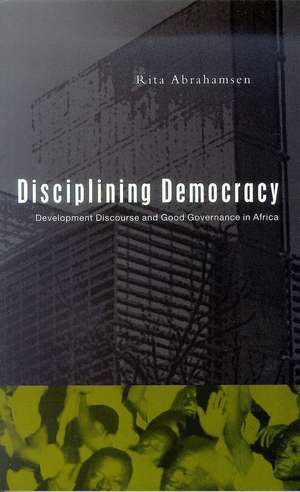
Disciplining Democracy: Development Discourse and Good Governance in Africa
Autor Rita Abrahamsenen Limba Engleză Paperback – 16 dec 2000
Using the example of the good governance discourse, Rita Abrahamsen contributes powerfully to our understanding of development, not as some universally valid set of goals or procedures, but as a historically contingent form of knowledge intimately connected to prevailing structures and relations of power. Her book argues that a key effect of contemporary development discourse, despite all its proclamations in favour of democracy, is to help reproduce a world order that is essentially undemocratic.
Preț: 264.52 lei
Preț vechi: 311.13 lei
-15%
Puncte Express: 397
Carte tipărită la comandă
Livrare economică 08-22 decembrie
Livrare prin curier în România Termenul estimat este afișat lângă disponibilitate.
Transport gratuit de la 400.00 lei Plată online sau ramburs, în funcție de opțiunile comenzii.
Retur gratuit în 14 zile Comandă securizată și suport în română.
Specificații
ISBN-13: 9781856498593
ISBN-10: 185649859X
Pagini: 192
Dimensiuni: 138 x 214 x 14 mm
Greutate: 0.52 kg
Editura: Bloomsbury Publishing
Colecția Zed Books
Locul publicării:London, United Kingdom
ISBN-10: 185649859X
Pagini: 192
Dimensiuni: 138 x 214 x 14 mm
Greutate: 0.52 kg
Editura: Bloomsbury Publishing
Colecția Zed Books
Locul publicării:London, United Kingdom
V-ar putea interesa
-
 World On FireAmy ChuaPreț: 93.56 lei
 -
 -22%Preț: 189.65 lei241.98 lei
 -
 Governing Globalization: Issues and InstitutionsDeepak Nayyar-28%Preț: 454.43 lei632.78 lei
 -
 -13%Preț: 358.21 lei412.83 lei
 -
 Education, Globalization, and Social ChangeHugh Lauder-18%Preț: 463.33 lei567.80 lei
 -
 -27%Preț: 362.16 lei493.48 lei
 -
 -27%Preț: 400.11 lei548.52 lei
 -
 The Global Economy 1944-2000: The Limits of IdeologyProf. Scott NewtonPreț: 235.51 lei
 -
 -15%Preț: 457.51 lei538.25 lei
 -
 Preț: 315.25 lei
 -
 A New World OrderAnne-Marie SlaughterPreț: 298.12 lei
 -
 Multinational Firms in the World EconomyGiorgio Barba NavarettiPreț: 505.69 lei
 -
 Globalisation In World HistoryA. G. Hopkins-29%Preț: 101.49 lei143.70 lei
 -
 Minor TransnationalismFrançoise LionnetPreț: 296.13 lei
 -
 Rethinking GlobalizationNick BisleyPreț: 284.79 lei
 -
 Preț: 570.55 lei
 -
 -20%Preț: 98.63 lei123.71 lei
 -
 The World Is Not for SaleJose BovePreț: 97.58 lei
Cuprins
Acknowledgments
Introduction
1. Democratisation and Development Discourse
2. New World Order, New Development Discourse
3. The Seductiveness of Good Governance
4. The Democratisation of Poverty
5. Whose Democracy?
6. Economic Liberalisation and Democratic Erosion
7. The Success of the Good Governance Discourse
Introduction
1. Democratisation and Development Discourse
2. New World Order, New Development Discourse
3. The Seductiveness of Good Governance
4. The Democratisation of Poverty
5. Whose Democracy?
6. Economic Liberalisation and Democratic Erosion
7. The Success of the Good Governance Discourse
Recenzii
Disciplining Democracy brings a fresh, unorthodox, and original new perspective to the topic of democracy and development in Africa?her work should be required reading?
This book's greatest contribution is its ability to challenge the widely held assumption by the Western institutions and agencies over the relations between democracy and development.
This book's greatest contribution is its ability to challenge the widely held assumption by the Western institutions and agencies over the relations between democracy and development. It successfully does so by providing empirical examples from African countries.
Serious, ambitious and well-written, this energetically argued book is likely to be received by the scholarly community as a genuine contribution to a central and highly controversial area of policy debate, the interconnectedness of liberal structural adjustment and democratization.
This book's greatest contribution is its ability to challenge the widely held assumption by the Western institutions and agencies over the relations between democracy and development.
This book's greatest contribution is its ability to challenge the widely held assumption by the Western institutions and agencies over the relations between democracy and development. It successfully does so by providing empirical examples from African countries.
Serious, ambitious and well-written, this energetically argued book is likely to be received by the scholarly community as a genuine contribution to a central and highly controversial area of policy debate, the interconnectedness of liberal structural adjustment and democratization.