Cantitate/Preț
Produs

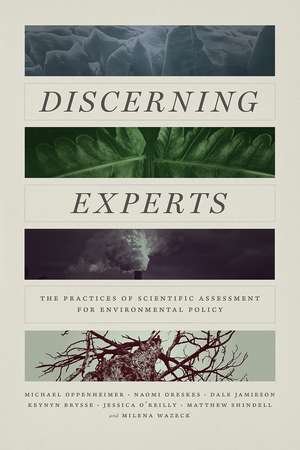
Discerning Experts: The Practices of Scientific Assessment for Environmental Policy

Autor Michael Oppenheimer, Naomi Oreskes, Dale Jamieson, Keynyn Brysse, Jessica O’Reilly, Matthew Shindell, Milena Wazeck
en Limba Engleză Paperback – 7 mar 2019

Observăm în Michael Oppenheimer un cercetător care își extrage autoritatea dintr-o vastă experiență în planificarea scenariilor climatice, fiind recunoscut pentru capacitatea de a transforma datele brute în ghiduri practice pentru decidenți. În lucrarea Discerning Experts, el colaborează cu un colectiv de specialiști, printre care se numără și Naomi Oreskes, pentru a diseca modul în care evaluările științifice devin fundament pentru politicile de mediu. Dacă în lucrarea sa anterioară, Pivotal Countries, Alternate Futures, autorul se concentra pe proiecții și strategii de viitor, volumul de față adoptă o perspectivă retrospectivă și analitică asupra mecanismelor de putere din spatele științei aplicate.

Structura cărții este riguros segmentată pe studii de caz tehnice: de la Programul Național de Evaluare a Precipitațiilor Acide din SUA, până la predicțiile privind stratul de gheață din Antarctida de Vest între 1981 și 2007. Putem afirma că autorii nu se limitează la o descriere a proceselor, ci investighează „granița” dintre știință și politică, oferind o listă de interviuri și date tabelare care susțin concluziile despre prejudecățile sistematice. Abordarea diferă de cea din Nature's Experts de Stephen Bocking prin gradul ridicat de aplicabilitate tehnică; în timp ce Bocking explorează democrația deliberativă, Discerning Experts funcționează ca o autopsie a procesului de expertiză, fiind mai puțin abstractă și mult mai orientată către identificarea erorilor de management al datelor.

Merită menționat că textul nu evită controversele legate de modul în care este „construită” expertiza, oferind o perspectivă rară asupra modului în care consensul științific este negociat în spatele ușilor închise ale comisiilor guvernamentale. Este o resursă esențială pentru a înțelege limitele și punctele forte ale științei în serviciul binelui comun.

Citește tot Restrânge

Preț: 26702 lei

Puncte Express: 401

Carte disponibilă

Livrare economică 17-31 octombrie
Livrare express 03-09 octombrie pentru 2856 lei

Livrare prin curier în România Termenul estimat este afișat lângă disponibilitate.
Transport gratuit de la 40000 lei Plată online sau ramburs, în funcție de opțiunile comenzii.
Retur gratuit în 14 zile Comandă securizată și suport în română.

Specificații

ISBN-13: 9780226602011
ISBN-10: 022660201X
Pagini: 304
Ilustrații: 1 halftone, 8 line drawings, 11 tables
Dimensiuni: 152 x 229 x 18 mm
Greutate: 0.43 kg
Ediția:First Edition
Editura: University of Chicago Press
Colecția University of Chicago Press

De ce să citești această carte

Această carte este indispensabilă pentru profesioniștii din administrația publică și cercetătorii care doresc să înțeleagă cum se transformă datele științifice în legi. Cititorul câștigă o înțelegere critică asupra modului în care erorile de judecată pot influența politicile de mediu și primește soluții concrete pentru a îmbunătăți rigurozitatea evaluărilor viitoare, asigurând o mai bună corelare între cercetare și realitatea administrativă.


Despre autor

Michael Oppenheimer este un expert marcant în domeniul politicilor de mediu și al planificării scenariilor, având o carieră dedicată înțelegerii impactului schimbărilor climatice. Alături de Naomi Oreskes, cunoscută pentru analizele sale asupra istoriei științei, și o echipă multidisciplinară formată din Dale Jamieson, Jessica O’Reilly și alții, aceștia aduc în Discerning Experts o expertiză colectivă ce acoperă istoria, filosofia și științele naturii. Oppenheimer este recunoscut la nivel internațional pentru contribuțiile sale la interfața dintre știință și diplomație, analizând constant modul în care incertitudinea științifică este gestionată în forurile decizionale globale.


Descriere scurtă

Discerning Experts assesses the assessments that many governments rely on to help guide environmental policy and action. Through their close look at environmental assessments involving acid rain, ozone depletion, and sea level rise, the authors explore how experts deliberate and decide on the scientific facts about problems like climate change. They also seek to understand how the scientists involved make the judgments they do, how the organization and management of assessment activities affects those judgments, and how expertise is identified and constructed.
 
Discerning Experts uncovers factors that can generate systematic bias and error,  and  recommends how the process can be improved. As the first study of the internal workings of large environmental assessments, this book reveals their  strengths and weaknesses,  and explains what assessments can—and cannot—be expected to contribute to public policy and the common good.
 

Notă biografică

Michael Oppenheimer is the Albert G. Milbank Professor of Geosciences and International Affairs at Princeton University. Naomi Oreskes is professor of the history of science at Harvard University. Dale Jamieson is professor of environmental studies and philosophy at New York University. Keynyn Brysse is a historian of science with a focus on the history of paleontology. Jessica O’Reilly is an assistant professor of international studies at Indiana University Bloomington. Matthew Shindell is a space history curator at the Smithsonian’s National Air and Space Museum in Washington, DC. Milena Wazeck is a historian of science and the author of Einstein’s Opponents.

Cuprins

Preface
List of Abbreviations

1 The Need for Expert Judgment
2 Assessing Acid Rain in the United States: The National Acid Precipitation Assessment Program
3 Assessing Ozone Depletion
4 Assessing the Ice: Sea Level Rise Predictions for the West Antarctic Ice Sheet, 1981–2007
5 Patrolling the Science/Policy Border
6 What Assessments Do
Conclusion
 
List of Interviews
Notes
Bibliography
Index

Recenzii

"This book provides an essential examination of the factors that shape and dictate our climate policy."

"A meticulously researched study . . . . Oppenheimer et al. have produced what is essentially an assessment of assessments, and so its syntheses of insights across the case-study chapters add new knowledge even while they validate old knowledge that had formerly been largely anecdotal for most of us. This volume is therefore essential reading for participants of any large environmental assessment. . . . Discerning Experts is not exactly the ‘first’ comparative study of multiple assessments, but it is an important one because of the extraordinary quality of its documentation and analysis as well as its clever creation of critical and instructive diversity across its three case studies. . . . Natural and physical scientists will see how their work can be transmitted across humanity to help inform opinion about what is going on and perhaps what to do—on the basis of rigorous science. Perhaps, the largest value will be found among the young scholars who do their homework after being invited to participate in their first assessment. After they read this volume, they will understand what to expect and why their signing on is a valuable investment of their time."

"What do the ozone layer, the Antarctic ice sheet, and acid rain have in common? All are sites of scientific 'assessments': prolonged, focused, collaborative, and often international work of experts. The thousands of pages of reports they draft offer the hope of summarizing scientific findings, extending scientific questions, and recommending policy outcomes. But do the elusive dream of consensus and fear of accusations of political bias produce watered down policy? Or should scientists be bolder in their assessments of impending disasters? Combining the insights of science, policy, and science studies, this valuable book offers a guide for experts of all kinds navigating the always messy world of policy-relevant science."

"This book is a must-read for scientists and leaders of ongoing assessments, because it showcases the dilemma between consolidated knowledge, communicated as consensus, and challenges of uncertainties associated with emerging science."
 

"This is the first major study of what scientists actually do when they 'assess' in an assessment. It makes graphic how the development and assessment of scientific knowledge are interwoven and the vexed production of 'policy-ready knowledge' from this. Altogether a rich, original, and thought-provoking work."

"The book is rich with insights about the ways assessments contribute to the agendas of science and policy, often in unintended ways. Reading it can improve the contribution of every scientist thinking of working on an assessment and the value obtained by every policymaker planning to use one."