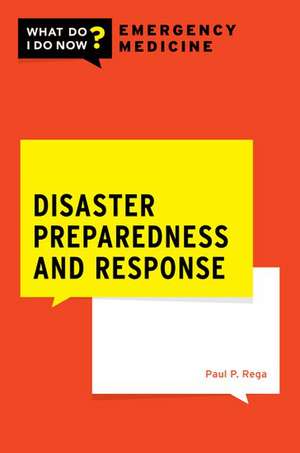
Disaster Preparedness and Response: WHAT DO I DO NOW EMERGENCY MEDICINE
Autor Paul P. Regaen Limba Engleză Paperback – 14 oct 2022
Preț: 375.36 lei
Preț vechi: 471.17 lei
-20%
Puncte Express: 563
Carte disponibilă
Livrare economică 12-18 noiembrie
Livrare prin curier în România Termenul estimat este afișat lângă disponibilitate.
Transport gratuit de la 400.00 lei Plată online sau ramburs, în funcție de opțiunile comenzii.
Retur gratuit în 14 zile Comandă securizată și suport în română.
Specificații
ISBN-13: 9780197577516
ISBN-10: 0197577512
Pagini: 384
Dimensiuni: 236 x 156 x 19 mm
Greutate: 0.57 kg
Editura: Oxford University Press
Colecția OUP USA
Seria WHAT DO I DO NOW EMERGENCY MEDICINE
Locul publicării:New York, United States
ISBN-10: 0197577512
Pagini: 384
Dimensiuni: 236 x 156 x 19 mm
Greutate: 0.57 kg
Editura: Oxford University Press
Colecția OUP USA
Seria WHAT DO I DO NOW EMERGENCY MEDICINE
Locul publicării:New York, United States
V-ar putea interesa
-
 ApocalypseLizzie WadePreț: 143.12 lei
 -
 -12%Preț: 368.13 lei416.41 lei
 -
 WreckersSimon ParkPreț: 188.88 lei
 -
 -30%Preț: 396.13 lei564.35 lei
 -
 Field Guide to Global Health & Disaster MedicineJames A. Chambers-5%Preț: 403.22 lei424.44 lei
 -
 Ciottone's Disaster MedicineGregory R. Ciottone-27%Preț: 907.24 lei1237.21 lei
 -
 Oh's Intensive Care ManualJonathan M. Handy-29%Preț: 692.37 lei971.74 leiRecomandat
 -
 Sabiston Textbook of Surgery: The Biological Basis of Modern Surgical PracticeDouglas Scott Tyler-29%Preț: 1169.15 lei1645.26 leiRecomandat
 -
 Kumar and Clark's Clinical MedicineDavid Randall-26%Preț: 487.97 lei658.70 leiRecomandat
 -
 Introduction to Emergency ManagementGeorge Haddow-32%Preț: 554.83 lei819.27 lei
 -
 Textbook of Adult Emergency MedicinePeter Cameron-28%Preț: 619.48 lei855.73 lei
 -
 Disaster PsychiatryFrederick J Stoddard-5%Preț: 579.00 lei609.47 lei
 -
 Koenig and Schultz's Disaster MedicineKristi L Koenig-5%Preț: 1710.35 lei1800.38 lei
 -
 Essentials of Disaster AnesthesiaJoseph McIsaac-5%Preț: 456.92 lei480.96 lei
 -
 -19%Preț: 582.58 lei719.24 lei
 -
 -31%Preț: 1445.09 lei2109.41 lei
 -
 DisastersKathleen TierneyPreț: 170.63 lei
 -
 Medical Response to Major Incidents and DisastersSten Lennquist-5%Preț: 970.21 lei1021.27 lei
 -
 Preț: 198.99 lei
Recenzii
Dr. Rega's book reflects his decades-long interest in both the foundations and easily-overlooked subtleties of disaster preparedness. Expert care resides in the details, and the emergency physician will find within these pages a wealth of detailed, yet always accessible and eminently readable information to guide strategies for preparedness, training, self-protection, and patient care. As our community of emergency physicians prepares for the next challenge hovering in the darkness, let us thank Paul for illuminating a path forward." -Steven B. Abrams, MD, Attending Physician, Department of Emergency Medicine, Montefiore Medical Center, Bronx NY; Coordinating Editor, Practical Reviews in Emergency Medicine
Paul Rega's book represents the culmination of his career teaching and researching in the field of disaster management and uses the 'three e's: easy-to-read, educational, and entertaining. The topics are introduced by examples of disasters, using each example to introduce principles of disaster and mass casualty management. All emergency providers in every geographic location should be familiar with the principles and concepts of disaster management taught in this book, it is a must-read." -Bruce Janiak, Professor Emeritus of Emergency Medicine, Medical College of Georgia, Augusta University
It's all here: a comprehensive, thorough, and concise guide to the effective management of disasters of any description. Written by a widely-recognized expert in the field, it is full of practical strategies to assist anyone confronting the difficult task of emergency planning and contains an enormous amount of critical information that is difficult to find anywhere, let alone under one cover. It adeptly balances the need for accessibility, detail, and depth to become a one-stop guide to effective disaster planning, response, and resource allocation. Particularly useful to the emergency physician or emergency manager, it is an invaluable resource." -Ronald J. DiCecco, MD, FACEP, Emergency Physician, Critical Care Flight Physician, and EMS Medical Director of 30 years
Paul Rega's book represents the culmination of his career teaching and researching in the field of disaster management and uses the 'three e's: easy-to-read, educational, and entertaining. The topics are introduced by examples of disasters, using each example to introduce principles of disaster and mass casualty management. All emergency providers in every geographic location should be familiar with the principles and concepts of disaster management taught in this book, it is a must-read." -Bruce Janiak, Professor Emeritus of Emergency Medicine, Medical College of Georgia, Augusta University
It's all here: a comprehensive, thorough, and concise guide to the effective management of disasters of any description. Written by a widely-recognized expert in the field, it is full of practical strategies to assist anyone confronting the difficult task of emergency planning and contains an enormous amount of critical information that is difficult to find anywhere, let alone under one cover. It adeptly balances the need for accessibility, detail, and depth to become a one-stop guide to effective disaster planning, response, and resource allocation. Particularly useful to the emergency physician or emergency manager, it is an invaluable resource." -Ronald J. DiCecco, MD, FACEP, Emergency Physician, Critical Care Flight Physician, and EMS Medical Director of 30 years
Notă biografică
Paul P. Rega, M.D. is the Director of Disaster Medicine Curriculum as well as an Assistant Professor for the Department of Emergency Medicine and the Department of Public Health at the University of Toledo College of Medicine. Professional areas of interest include disaster medicine and concepts, hyperbaric medicine, pediatric emergency medicine, and invasive techniques in emergency medicine.