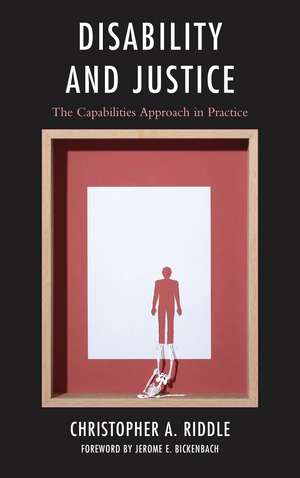
Disability and Justice: The Capabilities Approach in Practice
Autor Christopher A. Riddle Cuvânt înainte de Jerome E. Bickenbachen Limba Engleză Paperback – 14 mar 2016
| Toate formatele și edițiile | Preț | Express |
|---|---|---|
| Paperback (1) | 261.05 lei 6-8 săpt. | |
| Bloomsbury Publishing – 14 mar 2016 | 261.05 lei 6-8 săpt. | |
| Hardback (1) | 497.91 lei 6-8 săpt. | |
| Bloomsbury Publishing – 14 mar 2014 | 497.91 lei 6-8 săpt. |
Preț: 261.05 lei
Preț vechi: 365.43 lei
-29%
Puncte Express: 392
Preț estimativ în valută:
46.15€ • 54.86$ • 40.04£
46.15€ • 54.86$ • 40.04£
Carte tipărită la comandă
Livrare economică 12-26 martie
Specificații
ISBN-13: 9781498536585
ISBN-10: 1498536581
Pagini: 126
Ilustrații: 4 BW Illustrations
Dimensiuni: 149 x 230 x 7 mm
Greutate: 0.18 kg
Editura: Bloomsbury Publishing
Colecția Lexington Books
Locul publicării:New York, United States
ISBN-10: 1498536581
Pagini: 126
Ilustrații: 4 BW Illustrations
Dimensiuni: 149 x 230 x 7 mm
Greutate: 0.18 kg
Editura: Bloomsbury Publishing
Colecția Lexington Books
Locul publicării:New York, United States
Cuprins
1 Disability and Justice
2 Defining Disability
3 The Capabilities Approach
4 The Indexing Problem
5 Stigma-Sensitivity
6 The Special Moral Importance of Health
7 Capabilities and Disability
2 Defining Disability
3 The Capabilities Approach
4 The Indexing Problem
5 Stigma-Sensitivity
6 The Special Moral Importance of Health
7 Capabilities and Disability
Recenzii
Disability and Justice: The Capabilities Approach in Practice is alucid, concise and compelling philosophical discussion of disability, and its significance in political theory. Christopher Riddle has produced useful and plausible arguments with an aim to promote justice for people with disabilities.
Disability and Justice: The Capabilities Approach in Practice provides a compelling case that the capabilities approach is at once the best we have and not yet satisfactory as a theory that addresses the experiences of people with disabilities within its core conception of justice. Drawing on a nuanced understanding of the cutting edge of capability theory and models of disability, Christopher Riddle not only enriches the dialogue between these areas, but also makes distinctive theoretical advances in each. The book will be of particular interest to readers working on the measurement of capabilities, the risk of stigmatization in the implementation of egalitarian policies, and issues of justice and disability more generally.
Disability and Justice: The Capabilities Approach in Practice provides a compelling case that the capabilities approach is at once the best we have and not yet satisfactory as a theory that addresses the experiences of people with disabilities within its core conception of justice. Drawing on a nuanced understanding of the cutting edge of capability theory and models of disability, Christopher Riddle not only enriches the dialogue between these areas, but also makes distinctive theoretical advances in each. The book will be of particular interest to readers working on the measurement of capabilities, the risk of stigmatization in the implementation of egalitarian policies, and issues of justice and disability more generally.