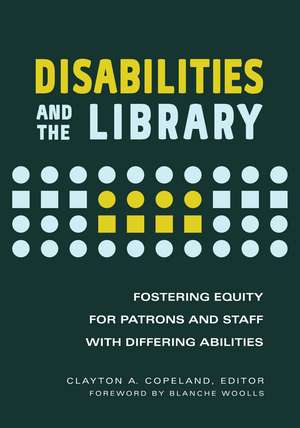
Disabilities and the Library: Fostering Equity for Patrons and Staff with Differing Abilities
Cuvânt înainte de Blanche Woolls Editat de Clayton A. Copelanden Limba Engleză Paperback – 11 noi 2022
Understanding the needs and abilities of patrons who are differently abled increases librarians' ability to serve them from childhood through adulthood. While some librarians are fortunate to have had coursework to help them understand the needs and abilities of the differently abled, many have had little experience working with this diverse group. In addition, many persons who are differently abled are-or would like to become-librarians.
Disabilities and the Library helps readers understand the challenges faced by people who are differently abled, both as patrons and as information professionals. Readers will learn to assess their library's physical facilities, programming, staff, and continuing education to ensure that their libraries are prepared to include people of all abilities. Inclusive programming and collection development suggestions will help librarians to meet the needs of patrons and colleagues with mobility and dexterity problems, learning differences, hearing and vision limitations, sensory and cognitive challenges, autism, and more. Additional information is included about assistive and adaptive technologies and web accessibility. Librarians will value this accessible and important book as they strive for equity and inclusivity.
Preț: 432.00 lei
Preț vechi: 572.93 lei
-25%
Puncte Express: 648
Carte tipărită la comandă
Livrare economică 11-25 noiembrie
Livrare prin curier în România Termenul estimat este afișat lângă disponibilitate.
Transport gratuit pentru acest produs Plată online sau ramburs, în funcție de opțiunile comenzii.
Retur gratuit în 14 zile Comandă securizată și suport în română.
Specificații
ISBN-13: 9781440859076
ISBN-10: 1440859078
Pagini: 532
Ilustrații: 16 bw illus
Dimensiuni: 176 x 252 x 34 mm
Greutate: 1.09 kg
Editura: Bloomsbury Publishing
Colecția Libraries Unlimited
Locul publicării:New York, United States
ISBN-10: 1440859078
Pagini: 532
Ilustrații: 16 bw illus
Dimensiuni: 176 x 252 x 34 mm
Greutate: 1.09 kg
Editura: Bloomsbury Publishing
Colecția Libraries Unlimited
Locul publicării:New York, United States
Cuprins
Foreword: As Far as the Eye May See, Blanche Woolls
Acknowledgments
Introduction, Clayton A. Copeland
PART I: THE HISTORIC ROLE OF DISABILITY RIGHTS ACTIVISTS, LIBRARIANS, AND OTHER ADVOCATES IN PROVIDING UNIVERSAL ACCESS TO INFORMATION
1 Access to Life: A Brief History of Universal Access, Linda Lucas Walling
2 What Is Universal Design?: Theories, Terms, and Trends, Knut M. Nygaard and Haakon Aspelund
PART II: UNDERSTANDING DIFFERENCES AND SEEING THE ABILITIES BORN THROUGH THEM
3 Demystifying Mental Illness: Opportunities for Awareness and Empowerment, David Leach
4 Serving Patrons with Dyslexia in Public and School Libraries, Jill Lauren
5 Blindness and Other Reading Disabilities in Public Libraries, Jane Karp and Linda Lucas Walling
6 Deafness as a Great Equalizer, Alec McFarlane
7 Banned People: Inclusion of Teens and Adults with High-Incidence Neurodevelopmental Disabilities in Library Spaces, Amelia N. Gibson
PART III: INTEGRATING INDIVIDUAL NEEDS: CREATING INCLUSIVE COLLECTIONS AND PROGRAMMING
8 Accessibility Support Collection Development, Jennifer Taggart
9 Selecting Books Portraying Disabilities for Children and Youth, Tina M. Taylor and Mary Anne Prater
10 Differing Abilities, Children, and Picture Books, Linda Lucas Walling and Clayton A. Copeland
11 Marrakesh Treaty and Access for Blind and Visually Impaired Information Professionals, Dick Kawooya
12 Examining Inclusive Programming in a Middle School Library: A Case Study of Adolescents Who Are Differently and Typically Able, Clayton A. Copeland and Karen Gavigan
13 Accessible Programming, Jennifer Taggart
PART IV: INCLUSIVE FACILITIES IN THE PHYSICAL AND VIRTUAL WORLD
14 How Library Designs Can Follow the ADA While Ignoring Wider Issues of Building Accessibility, Fred Schlipf
15 Staying Calm: "Disabilities" and Behavior in the Library, Barbara Klipper and Carrie Banks
16 Web Accessibility Checklist for Inclusion on the Internet: 10 Things to Double-Check Before You Publish Online, Laura March and Amelia N. Gibson
17 Building a Barrier-Free Online Library, Amelia Koford and Drucilla Martinez de Morales
18 Illustrative Information Support Services for People Who Are Differently Abled in Alabama's Public Libraries: An Exploratory Website Content Analysis, Bharat Mehra and Baheya S. Jaber
PART V: LEADERSHIP: INCLUSIVE POLICIES, PRACTICES, AND ENVIRONMENTS FOR LIBRARY STAFF WITH DIFFERING ABILITIES AND NEEDS
19 Designing an Inclusive Hiring Experience and Workplace: A Tripartite Approach, Kim M. Thompson, Paul T. Jaeger, and Clayton A. Copeland
20 Building Collective Leadership to Advance Equity, Cassandra O'Neill
21 Stigma Within the Library: Barriers to Employee Disability Accommodation, JJ Pionke
PART VI: CONCLUSION
22 The First Best Hope for Disabled People: A Letter to Current and Future Librarians, Paul T. Jaeger
Afterword, Samantha K. Hastings
About the Editor and Contributors
Index
Acknowledgments
Introduction, Clayton A. Copeland
PART I: THE HISTORIC ROLE OF DISABILITY RIGHTS ACTIVISTS, LIBRARIANS, AND OTHER ADVOCATES IN PROVIDING UNIVERSAL ACCESS TO INFORMATION
1 Access to Life: A Brief History of Universal Access, Linda Lucas Walling
2 What Is Universal Design?: Theories, Terms, and Trends, Knut M. Nygaard and Haakon Aspelund
PART II: UNDERSTANDING DIFFERENCES AND SEEING THE ABILITIES BORN THROUGH THEM
3 Demystifying Mental Illness: Opportunities for Awareness and Empowerment, David Leach
4 Serving Patrons with Dyslexia in Public and School Libraries, Jill Lauren
5 Blindness and Other Reading Disabilities in Public Libraries, Jane Karp and Linda Lucas Walling
6 Deafness as a Great Equalizer, Alec McFarlane
7 Banned People: Inclusion of Teens and Adults with High-Incidence Neurodevelopmental Disabilities in Library Spaces, Amelia N. Gibson
PART III: INTEGRATING INDIVIDUAL NEEDS: CREATING INCLUSIVE COLLECTIONS AND PROGRAMMING
8 Accessibility Support Collection Development, Jennifer Taggart
9 Selecting Books Portraying Disabilities for Children and Youth, Tina M. Taylor and Mary Anne Prater
10 Differing Abilities, Children, and Picture Books, Linda Lucas Walling and Clayton A. Copeland
11 Marrakesh Treaty and Access for Blind and Visually Impaired Information Professionals, Dick Kawooya
12 Examining Inclusive Programming in a Middle School Library: A Case Study of Adolescents Who Are Differently and Typically Able, Clayton A. Copeland and Karen Gavigan
13 Accessible Programming, Jennifer Taggart
PART IV: INCLUSIVE FACILITIES IN THE PHYSICAL AND VIRTUAL WORLD
14 How Library Designs Can Follow the ADA While Ignoring Wider Issues of Building Accessibility, Fred Schlipf
15 Staying Calm: "Disabilities" and Behavior in the Library, Barbara Klipper and Carrie Banks
16 Web Accessibility Checklist for Inclusion on the Internet: 10 Things to Double-Check Before You Publish Online, Laura March and Amelia N. Gibson
17 Building a Barrier-Free Online Library, Amelia Koford and Drucilla Martinez de Morales
18 Illustrative Information Support Services for People Who Are Differently Abled in Alabama's Public Libraries: An Exploratory Website Content Analysis, Bharat Mehra and Baheya S. Jaber
PART V: LEADERSHIP: INCLUSIVE POLICIES, PRACTICES, AND ENVIRONMENTS FOR LIBRARY STAFF WITH DIFFERING ABILITIES AND NEEDS
19 Designing an Inclusive Hiring Experience and Workplace: A Tripartite Approach, Kim M. Thompson, Paul T. Jaeger, and Clayton A. Copeland
20 Building Collective Leadership to Advance Equity, Cassandra O'Neill
21 Stigma Within the Library: Barriers to Employee Disability Accommodation, JJ Pionke
PART VI: CONCLUSION
22 The First Best Hope for Disabled People: A Letter to Current and Future Librarians, Paul T. Jaeger
Afterword, Samantha K. Hastings
About the Editor and Contributors
Index
Recenzii
Even after decades of legislation enacted into law and much persuasive advocacy, individuals who are differently abled are still in need of access to information and materials available through libraries. Each chapter is a rich collection of reliable sources useful in understanding differences and perfect for fostering community engagement to address equity, diversity, and inclusion for the betterment of the community. Library staff in all library sizes and types-and faculty teaching pre-service librarians-should immediately make this book a primary professional development source.
Shouldn't information be available to all who seek it? Barriers exist, but they can be removed, and access can be made more accessible. This timely and essential guide to understanding the importance of accessibility of libraries to differently abled patrons is a perfect primer for all those charged with curating, conserving, and sharing the world's collective knowledge.
As a cheerleader and advocate for the visually impaired and print disabled, Dr. Copeland exemplifies what it means to be our brother and sisters keeper. As a true pathfinder, she finds joy in guiding each user with rich job searching tools, while ensuring that all have access to resources galore.
Dr. Copeland has provided much-needed perspectives and guidance for librarians striving to enable equitable access and inclusion within libraries and the communities they serve.
An essential volume offering specific guidance to help information professionals carry out their primary charge: to provide information access to everyone. These chapters include background and practical guidance for enabling practitioners to consider accessibility and universal design in every aspect of their practice, and they give LIS educators much-needed tools for integrating this training into their coursework. Readable and absolutely accessible, this powerful toolkit paves the way for making 21st century libraries what they should always have been: a place of welcome for all.
As a wheelchair user with Cerebral Palsy, an MLIS graduate, and a health equity access consultant, I'm thrilled by this new book! In plain language, the contributors show the LIS community that-from library user to library employee-people with disabilities aren't a scary "other;" we're just humans who crave information as much as anyone else. This work shows LIS professionals how they can be most effective in the lives of people with disabilities.
As an LIS educator and DEI officer, I am constantly searching for credible, comprehensive, practical, and compassionate resources to further my own knowledge and equip others with tools to implement in their personal and professional lives; I struck gold with this book. With its emphasis on inclusion of people of all abilities, this is exactly the book the LIS profession needs at exactly the right time!
I am so happy to see more evidence in this book of what has always been my pleasure: to provide mirrors, windows and doors for differently abled as well as typically abled students and friends.
Dr. Copeland's book is essential reading for information professionals who aim to craft accessible library spaces for empowering patrons and staff with differing abilities. For the accomplished scholars featured within, accessibility requires a transformative mindset rather than a checklist of actions.
As a librarian and a parent of a child who is differently able, I know the struggles and frustrations of entering the library (physically or virtually) and not being able to access the information that is wanted and needed. The authors of this book have laid out workable plans for staying current with evolving challenges so that libraries remain relevant and accessible for all of our users!
An informative guide to constructing an environment that fosters diverse inclusivity.
Through the collection assembled here, Dr. Copeland shows that barriers are still present for many people with disabilities in accessing our libraries. More importantly, though, this collection offers true excitement and promising opportunities for libraries to embrace universal design and access. As a disability-led organization, we see this as a welcome and important primer for current, and future, librarians on their role in promoting equal access for all individuals.
Shouldn't information be available to all who seek it? Barriers exist, but they can be removed, and access can be made more accessible. This timely and essential guide to understanding the importance of accessibility of libraries to differently abled patrons is a perfect primer for all those charged with curating, conserving, and sharing the world's collective knowledge.
As a cheerleader and advocate for the visually impaired and print disabled, Dr. Copeland exemplifies what it means to be our brother and sisters keeper. As a true pathfinder, she finds joy in guiding each user with rich job searching tools, while ensuring that all have access to resources galore.
Dr. Copeland has provided much-needed perspectives and guidance for librarians striving to enable equitable access and inclusion within libraries and the communities they serve.
An essential volume offering specific guidance to help information professionals carry out their primary charge: to provide information access to everyone. These chapters include background and practical guidance for enabling practitioners to consider accessibility and universal design in every aspect of their practice, and they give LIS educators much-needed tools for integrating this training into their coursework. Readable and absolutely accessible, this powerful toolkit paves the way for making 21st century libraries what they should always have been: a place of welcome for all.
As a wheelchair user with Cerebral Palsy, an MLIS graduate, and a health equity access consultant, I'm thrilled by this new book! In plain language, the contributors show the LIS community that-from library user to library employee-people with disabilities aren't a scary "other;" we're just humans who crave information as much as anyone else. This work shows LIS professionals how they can be most effective in the lives of people with disabilities.
As an LIS educator and DEI officer, I am constantly searching for credible, comprehensive, practical, and compassionate resources to further my own knowledge and equip others with tools to implement in their personal and professional lives; I struck gold with this book. With its emphasis on inclusion of people of all abilities, this is exactly the book the LIS profession needs at exactly the right time!
I am so happy to see more evidence in this book of what has always been my pleasure: to provide mirrors, windows and doors for differently abled as well as typically abled students and friends.
Dr. Copeland's book is essential reading for information professionals who aim to craft accessible library spaces for empowering patrons and staff with differing abilities. For the accomplished scholars featured within, accessibility requires a transformative mindset rather than a checklist of actions.
As a librarian and a parent of a child who is differently able, I know the struggles and frustrations of entering the library (physically or virtually) and not being able to access the information that is wanted and needed. The authors of this book have laid out workable plans for staying current with evolving challenges so that libraries remain relevant and accessible for all of our users!
An informative guide to constructing an environment that fosters diverse inclusivity.
Through the collection assembled here, Dr. Copeland shows that barriers are still present for many people with disabilities in accessing our libraries. More importantly, though, this collection offers true excitement and promising opportunities for libraries to embrace universal design and access. As a disability-led organization, we see this as a welcome and important primer for current, and future, librarians on their role in promoting equal access for all individuals.