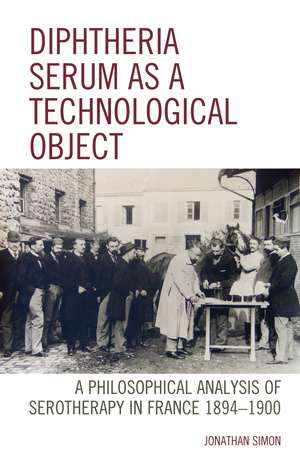
Diphtheria Serum as a Technological Object: A Philosophical Analysis of Serotherapy in France 1894-1900: Postphenomenology and the Philosophy of Technology
Autor Jonathan Simonen Limba Engleză Hardback – 27 dec 2016
Considering the serum as technological object facilitates a philosophical reflection on the nature of medical drugs in general by means of a thorough analysis of this particular historical example. The insights offered in this book will be of interest to students and scholars working on the philosophy of technology, particularly the medical sciences, as well as to historians of medicine, particularly those interested in the history of pharmacy.
Din seria Postphenomenology and the Philosophy of Technology
- nou
 Preț: 550.97 lei
 - 33%
 Preț: 651.20 lei
 - 34%
 Preț: 568.40 lei
 - 11%
 Preț: 321.01 lei
 - 34%
 Preț: 634.19 lei
 - 24%
 Preț: 376.38 lei
 - 33%
 Preț: 547.29 lei
 - 30%
 Preț: 535.04 lei
 - 32%
 Preț: 584.03 lei
 - 26%
 Preț: 272.70 lei
 - 32%
 Preț: 599.48 lei
 - 32%
 Preț: 562.98 lei
 - 32%
 Preț: 583.67 lei
 - 32%
 Preț: 551.50 lei
 - 30%
 Preț: 515.69 lei
 - 15%
 Preț: 383.75 lei
 - 23%
 Preț: 311.74 lei
 - 33%
 Preț: 655.93 lei
 - 27%
 Preț: 257.10 lei
 - 37%
 Preț: 660.52 lei
 - 32%
 Preț: 490.50 lei
 - 32%
 Preț: 674.55 lei
 - 33%
 Preț: 551.31 lei
Preț: 581.93 lei
Preț vechi: 863.21 lei
-33%
Puncte Express: 873
Carte tipărită la comandă
Livrare economică 01-15 decembrie
Livrare prin curier în România Termenul estimat este afișat lângă disponibilitate.
Transport gratuit pentru acest produs Plată online sau ramburs, în funcție de opțiunile comenzii.
Retur gratuit în 14 zile Comandă securizată și suport în română.
Specificații
ISBN-13: 9781498531474
ISBN-10: 1498531474
Pagini: 174
Ilustrații: 9 BW Photos, 2 Tables
Dimensiuni: 158 x 230 x 16 mm
Greutate: 0.45 kg
Editura: Bloomsbury Publishing
Colecția Lexington Books
Seria Postphenomenology and the Philosophy of Technology
Locul publicării:New York, United States
ISBN-10: 1498531474
Pagini: 174
Ilustrații: 9 BW Photos, 2 Tables
Dimensiuni: 158 x 230 x 16 mm
Greutate: 0.45 kg
Editura: Bloomsbury Publishing
Colecția Lexington Books
Seria Postphenomenology and the Philosophy of Technology
Locul publicării:New York, United States
Cuprins
Chapter 1: Introduction
Chapter 2: Blood
Chapter 3: Transforming Serum into a Medical Drug
Chapter 4: Making the Serum Work
Chapter 5: Fitting Serum In: The Environment Shaping and Shaped by Serotherapy in France
Chapter 6: Branding French Serum
Chapter 7: Mothers, Children, Serum, Saints, and Scientists
Chapter 8: Serum and French Politics
Chapter 9: Conclusion
Chapter 2: Blood
Chapter 3: Transforming Serum into a Medical Drug
Chapter 4: Making the Serum Work
Chapter 5: Fitting Serum In: The Environment Shaping and Shaped by Serotherapy in France
Chapter 6: Branding French Serum
Chapter 7: Mothers, Children, Serum, Saints, and Scientists
Chapter 8: Serum and French Politics
Chapter 9: Conclusion
Recenzii
Diphtheria Serum as a Technological Object is a succinct book examining a pharmaceutical innovation and its dispersal and circulation across borders. It is clearly written and argued and merits inclusion in research libraries as well as in graduate seminars on the history of medicine, French institutional history, and the history of technology. It will also appeal to those interested in the scholarly turn toward object-based ontologies and how this perspective can illuminate pharmaceutical history.
Although Simon's approach is avowedly drawn from the philosophy of technology, his study enriches our historical understanding of the history of the diphtheria antiserum in refreshing and unexpected ways. In their effect on human bodies, medicines are, after all, as much technological objects as scalpels and syringes, and this understanding gives Simon's study originality and message. From his account of how the serum was made using the blood of specially selected and cared-for horses, through to his masterly analysis of how the serum was inserted into France's political economy as an instrument of revenge on German medical science for defeat in the Franco-Prussian War, this is no standard history of drug development.
With his in-depth study of the history of diphtheria antiserum in France, Simon makes an original and valuable contribution to the History and Philosophy of Science, Technology and Medicine. Building on his own extensive and highly regarded earlier work on the history of chemistry and pharmacy, Simon convincingly shows that medicines such as diphtheria antiserum are more than just material objects. They are special technological objects, given form and sense by the context in which they are adopted in and the many roles they fulfill, in return shaping the societies in which they are deployed. The relatively short time-frame (1894-1900) as well as the single national context chosen for his study allow Simon not only to perform a synchronic slice across different spaces, but to engage with philosophical issues about the nature of technology whilst developing a sophisticated and original methodological framework for doing so.
Although Simon's approach is avowedly drawn from the philosophy of technology, his study enriches our historical understanding of the history of the diphtheria antiserum in refreshing and unexpected ways. In their effect on human bodies, medicines are, after all, as much technological objects as scalpels and syringes, and this understanding gives Simon's study originality and message. From his account of how the serum was made using the blood of specially selected and cared-for horses, through to his masterly analysis of how the serum was inserted into France's political economy as an instrument of revenge on German medical science for defeat in the Franco-Prussian War, this is no standard history of drug development.
With his in-depth study of the history of diphtheria antiserum in France, Simon makes an original and valuable contribution to the History and Philosophy of Science, Technology and Medicine. Building on his own extensive and highly regarded earlier work on the history of chemistry and pharmacy, Simon convincingly shows that medicines such as diphtheria antiserum are more than just material objects. They are special technological objects, given form and sense by the context in which they are adopted in and the many roles they fulfill, in return shaping the societies in which they are deployed. The relatively short time-frame (1894-1900) as well as the single national context chosen for his study allow Simon not only to perform a synchronic slice across different spaces, but to engage with philosophical issues about the nature of technology whilst developing a sophisticated and original methodological framework for doing so.