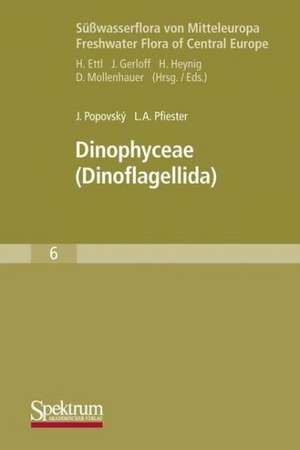
Dinophyceae: Süßwasserflora von Mitteleuropa, cartea 6
Autor Jirí Popovský, L. Pfiester Editat de Burkhard Büdel, Georg Gärtner, Lothar Krienitz, Hans-Rudolf Preisig, Michael Schagerlen Limba Engleză Paperback – 10 oct 2008
Classically phycologists divided dinoflagellates into monads, rhizopods, coccals, capsals and trichals based on morphology. During our studies of freshwater dinoflagellates we have observed and recorded stages transcendent among these forms. We have also lumped many poorly described species. We have listed in the appendix all the freshwater species known. Thus we face a dilemma wether to compile dinoflagellates according to classical systematics or to use the classical approach inserting new information. We have chosen the latter.
Din seria Süßwasserflora von Mitteleuropa
- 9%
 Preț: 947.37 lei
 - 13%
 Preț: 1152.26 lei
 - 11%
 Preț: 583.85 lei
 - 23%
 Preț: 1280.72 lei
 - 13%
 Preț: 1150.76 lei
 - 13%
 Preț: 755.95 lei
 - 13%
 Preț: 918.27 lei
 - 13%
 Preț: 1040.89 lei
 - 13%
 Preț: 985.44 lei
 - 13%
 Preț: 1034.20 lei
 - 23%
 Preț: 1285.64 lei
 - 30%
 Preț: 1436.91 lei
 - 18%
 Preț: 1003.28 lei
 - 13%
 Preț: 763.42 lei
 - 15%
 Preț: 713.11 lei
 - 11%
 Preț: 598.10 lei
 - 13%
 Preț: 1035.04 lei
 - 13%
 Preț: 622.18 lei
 - 13%
 Preț: 1062.53 lei
 - 23%
 Preț: 1039.23 lei
 - 18%
 Preț: 993.93 lei
Preț: 608.52 lei
Preț vechi: 751.26 lei
-19%
Puncte Express: 913
Carte tipărită la comandă
Livrare economică 03-09 decembrie
Livrare prin curier în România Termenul estimat este afișat lângă disponibilitate.
Transport gratuit pentru acest produs Plată online sau ramburs, în funcție de opțiunile comenzii.
Retur gratuit în 14 zile Comandă securizată și suport în română.
Specificații
ISBN-13: 9783827420985
ISBN-10: 3827420989
Pagini: 276
Ilustrații: 272 p.
Dimensiuni: 127 x 190 x 16 mm
Greutate: 0.28 kg
Ediția:1. Auflage 1990. Nachdruck 2008
Editura: Spektrum Akademischer Verlag
Colecția Süßwasserflora von Mitteleuropa
Seria Süßwasserflora von Mitteleuropa
Locul publicării:Heidelberg, Germany
ISBN-10: 3827420989
Pagini: 276
Ilustrații: 272 p.
Dimensiuni: 127 x 190 x 16 mm
Greutate: 0.28 kg
Ediția:1. Auflage 1990. Nachdruck 2008
Editura: Spektrum Akademischer Verlag
Colecția Süßwasserflora von Mitteleuropa
Seria Süßwasserflora von Mitteleuropa
Locul publicării:Heidelberg, Germany
V-ar putea interesa
-
 -20%Preț: 357.46 lei446.14 lei
 -
 -28%Preț: 523.18 lei721.91 lei
 -
 Methods in Comparative Plant Population EcologyDavid Gibson-21%Preț: 483.35 lei612.26 lei
 -
 The Normalized Difference Vegetation IndexNathalie Pettorelli-31%Preț: 743.63 lei1078.10 lei
 -
 -18%Preț: 65.27 lei79.65 lei
 -
 Vegetation Ecology of Central EuropeHeinz H. Ellenberg-11%Preț: 524.19 lei588.98 lei
 -
 -11%Preț: 475.96 lei534.79 lei
 -
 From Plant Traits to Vegetation StructureBill Shipley-11%Preț: 461.57 lei518.61 lei
 -
 Light and Photosynthesis in Aquatic EcosystemsJohn T O Kirk-8%Preț: 623.74 lei677.98 lei
 -
 Animal, Vegetable, MiracleBarbara KingsolverPreț: 93.97 lei
Public țintă
ResearchCuprins
I. General part.- 1. Introduction.- 2. Cell structure.- 3. Morphology.- 4. Reproduction.- 5. Resting stages.- 6. Life history and cell growth.- 7. Occurrence and ecology.- 8. Sampling, identification and culture methods.- 9. Classification.- II. Special part.- Dinophyceae.- 1. Subclass Adinophycidae, 1. Order Desmomastigales, 1. Family Desmomastigaceae Christensen, 2. Family Protaspidaceae Skuja, 3. Family Spiromonadaceae Brugerolle and Mignot.- 2. Subclass Dinophycidae, 1. Order Peridiniales, 1. Family Gymnodiniaceae (Bergh) Schütt, 2. Family Woloszynskiaceae Bourrelly, 3. Family Hemidiniaceae Bourrelly, 4. Family Glenodiniopsidaceae Schiller, 5. Family Peridiniaceae Ehrenberg, 6. Family Ceratiaceae (Schütt) Lindemann, 7. Family Gonyaulacaceae Lindemann, 8. Family Dinosphaeraceae Lindemann, 2. Order Dinococcales, 1. Family Dinococcaceae Fott.
Textul de pe ultima copertă
This volume is a compilation of Dinophyceae which are of interest to phycologists and protozoologists. Since it is very difficult to classify of the unicellular organisms as plants or animals two approaches can be found to the classification of dinoflagellates - the botanical and zoological. We have employed the phycological (botanical) approach in our textbook. However, we view the dinoflagellates as protists which exhibit both plant and animal features. This also holds true for the marine dinoflagellates which are richer in number of genera and species than their freshwater counterparts. Classically phycologists divided dinoflagellates into monads, rhizopods, coccals, capsals and trichals based on morphology. During our studies of freshwater dinoflagellates we have observed and recorded stages transcendent among these forms. We have also lumped many poorly described species. We have listed in the appendix all the freshwater species known. Thus we face a dilemma wether to compile dinoflagellates according to classical systematics or to use the classical approach inserting new information. We have chosen the latter.
Caracteristici
Enabling the species determination of freshwater Dinophyceae. These are microscopic protists Necessary for scientific systematics and official expertise in water assessment