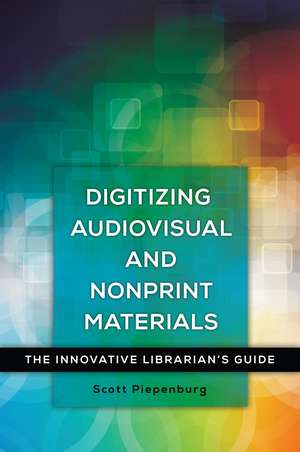
Digitizing Audiovisual and Nonprint Materials: The Innovative Librarian's Guide
Autor Scott Piepenburgen Limba Engleză Paperback – 28 sep 2015
Why give up on at-risk treasures of your AV collection when you can easily digitize them in house? This guide walks you through the process of planning and implementing digitization projects for the common formats libraries have collected over the last 30 or 40 years. It guides first-time users in setting up a facility to convert analog tapes and records into a digital form, explaining how to clean up those sources to produce a high-quality output for end-users. The same theories and skills are applied to the visual domain so you can convert VHS, Beta, U-Matic, and laserdiscs into archival visual formats.
A unique feature of the book is that it will help you understand the process without having to become a techno-geek. Basic information on computer hardware and software is discussed, including the equipment needed to digitize various formats. Techniques for capturing, editing, storing, and making digitized files available to patrons are also covered. Because budgets are always a concern, the work looks at ways you can leverage current resources and facilities with minimal outlay of capital to start a project, and it offers practical guidance on how to maintain the information long term.
Preț: 325.91 lei
Preț vechi: 392.55 lei
-17%
Puncte Express: 489
Carte tipărită la comandă
Livrare economică 23 noiembrie-07 decembrie
Livrare prin curier în România Termenul estimat este afișat lângă disponibilitate.
Transport gratuit de la 400.00 lei Plată online sau ramburs, în funcție de opțiunile comenzii.
Retur gratuit în 14 zile Comandă securizată și suport în română.
Specificații
ISBN-13: 9781440837807
ISBN-10: 1440837805
Pagini: 106
Ilustrații: 56 bw illus
Dimensiuni: 156 x 235 x 5 mm
Greutate: 0.2 kg
Editura: Bloomsbury Publishing
Colecția Libraries Unlimited
Locul publicării:New York, United States
ISBN-10: 1440837805
Pagini: 106
Ilustrații: 56 bw illus
Dimensiuni: 156 x 235 x 5 mm
Greutate: 0.2 kg
Editura: Bloomsbury Publishing
Colecția Libraries Unlimited
Locul publicării:New York, United States
V-ar putea interesa
-
 Merchandising Library Materials to Young AdultsMary Anne Nichols-22%Preț: 327.48 lei422.12 lei
 -
 -23%Preț: 478.53 lei621.47 lei
 -
 The Weeding Handbook: A Shelf-by-Shelf GuideRebecca VnukPreț: 337.32 lei
 -
 Local History Reference Collections for Public LibrariesKathy MarquisPreț: 404.69 lei
 -
 Preț: 371.66 lei
 -
 -25%Preț: 178.24 lei238.34 lei
 -
 -29%Preț: 459.54 lei643.67 lei
 -
 Instructional Design for Librarians and Information ProfessionalsAmerican Library Association-23%Preț: 456.98 lei593.47 lei
 -
 Metadata for Digital CollectionsSteven J. Miller-23%Preț: 490.35 lei636.83 lei
 -
 Metadata, Second EditiionMarcia Lei Zeng-23%Preț: 476.08 lei618.28 lei
 -
 Map Librarianship: An IntroductionMary Lynette Larsgaard-29%Preț: 551.45 lei777.07 lei
 -
 Weeding Library Collections: Library Weeding MethodsStanley J. Slote-15%Preț: 397.76 lei467.95 lei
 -
 Teen Genreflecting 3: A Guide to Reading InterestsDiana Tixier HeraldPreț: 372.17 lei
 -
 Reading Women: A Book Club Guide for Women's FictionNanci Milone Hill-34%Preț: 250.72 lei378.60 lei
 -
 -28%Preț: 557.93 lei775.73 lei
 -
 -34%Preț: 271.59 lei410.93 lei
 -
 -34%Preț: 269.23 lei409.65 lei
Cuprins
CONTENTS
Introduction
Chapter 1: Getting Started
Chapter 2: Hardware
Chapter 3: Digitizing Images
Chapter 4: Digitizing Slides
Chapter 5: Digitizing Sound Recordings
Chapter 6: Digitizing Video Recordings
Chapter 7: Finishing Up
Glossary
Index
Introduction
Chapter 1: Getting Started
Chapter 2: Hardware
Chapter 3: Digitizing Images
Chapter 4: Digitizing Slides
Chapter 5: Digitizing Sound Recordings
Chapter 6: Digitizing Video Recordings
Chapter 7: Finishing Up
Glossary
Index
Recenzii
The strength of the work includes the history of physical formats, particularly audio and video formats, as well as detailed discussions and images of the types of hardware and cables used to aid in the digitization of audio cassettes and VHS tapes. Piepenburg is Head of Cataloging at Valdosta State University and has a rich background in cataloging, and has written about the history of recording technology. His knowledge on these topics shows, and will benefit those looking to establish and enrich their baseline knowledge of audiovisual materials.
This small book is packed with information and librarians of any caliber will find it easy to follow Piepenburg's instructions to begin a digitization project of their own. The low-barrier technical threshold should not deter anyone. The book ends with the advice to "have fun." Librarians and archivists will enjoy reading this fast-paced book and most likely learn a thing or two in the process.
This small book is packed with information and librarians of any caliber will find it easy to follow Piepenburg's instructions to begin a digitization project of their own. The low-barrier technical threshold should not deter anyone. The book ends with the advice to "have fun." Librarians and archivists will enjoy reading this fast-paced book and most likely learn a thing or two in the process.