
Digital Twin Technology and Smart Grid: Advances in Digital Twin Computing and Sensor Networks
Editat de Iraklis Varlamis, Antoine Bagula, Hossein Hassanien Limba Engleză Paperback – 31 aug 2026
The integration of Digital Twin (DT) technology with Smart Grids (SG) represents a groundbreaking development in energy management, making this a highly significant and timely topic. As urban areas expand and energy demands rise, the need for more efficient, sustainable, and resilient energy systems becomes critical. DT technology, with its ability to create real-time, virtual replicas of physical systems, offers unprecedented opportunities for enhancing the performance, reliability, and security of smart grids.
- Explains how digital twins gather real-world data to create a model of a given situation of real micro grid/power grids
- Discusses how the model can be utilized in making informed decisions
- Considers the associated technologies that support digital twins: IoT, AI, ML, and blockchain
- Explores how digital twins can be used in the real-world to monitor and improve services of the micro grid/power grid


Preț: 970.21 lei
Preț vechi: 1563.93 lei
-38% Nou
Puncte Express: 1455
Carte disponibilă
Livrare economică 07-21 noiembrie
Livrare express 03-07 noiembrie pentru 346.18 lei
Livrare prin curier în România Termenul estimat este afișat lângă disponibilitate.
Transport gratuit pentru acest produs Plată online sau ramburs, în funcție de opțiunile comenzii.
Retur gratuit în 14 zile Comandă securizată și suport în română.
Specificații
ISBN-13: 9780443366642
ISBN-10: 0443366640
Pagini: 400
Dimensiuni: 216 x 276 mm
Greutate: 1.2 kg
Editura: ELSEVIER SCIENCE
Seria Advances in Digital Twin Computing and Sensor Networks
ISBN-10: 0443366640
Pagini: 400
Dimensiuni: 216 x 276 mm
Greutate: 1.2 kg
Editura: ELSEVIER SCIENCE
Seria Advances in Digital Twin Computing and Sensor Networks
V-ar putea interesa
-
 Handbook of Green Information and Communication SystemsAlagan Anpalagan-20%Preț: 732.23 lei915.29 lei
-
 Digital Twin: A Dynamic System and Computing PerspectiveRanjan GanguliPreț: 440.34 lei
-
 Smart Grids for Smart Cities, Volume 1O V Gnana Swathika-23%Preț: 1165.37 lei1513.46 lei
-
 Digital Twins in Industrial Production and Smart ManufacturingRajesh Kumar Dhanaraj-23%Preț: 690.28 lei896.46 lei
-
 -23%Preț: 1294.93 lei1681.72 lei
-
 Advances in AI for Cloud, Edge, and Mobile Computing ApplicationsShrikaant Kulkarni-20%Preț: 1296.62 lei1620.78 lei
-
 The Digital TwinNoel Crespi-20%Preț: 1381.08 lei1726.35 lei
-
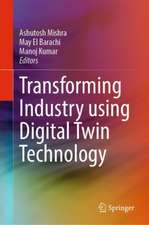 Transforming Industry using Digital Twin TechnologyAshutosh MishraPreț: 483.08 lei
-
 Digital SustainabilityTheo LynnPreț: 331.49 lei
-
 -20%Preț: 547.54 lei684.43 lei
-
 Digital TransformationBirgit Vogel-Heuser-20%Preț: 419.84 lei524.80 lei
-
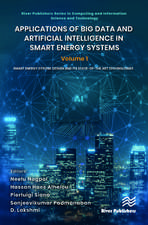 -20%Preț: 723.90 lei904.87 lei
-
 Advances in Smart Grid TechnologyNing Zhou-24%Preț: 2139.53 lei2815.17 lei
-
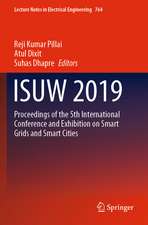 ISUW 2019Reji Kumar Pillai-23%Preț: 1008.35 lei1309.53 lei
-
 Advances in Green Energy TechnologiesShelly Vadhera-18%Preț: 1445.78 lei1763.15 lei
-
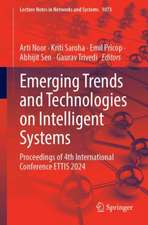 -20%Preț: 1648.37 lei2060.47 lei
-
 Microgrids and Virtual Power PlantsFarhad Shahnia-18%Preț: 1058.74 lei1291.15 lei
-
 Decarbonisation and Digitization of the Energy SystemAshwani Kumar-18%Preț: 1170.53 lei1427.47 lei
Cuprins
PART 1. Introduction
1. Introduction to Digital Twins for the Smart Grid
2. Introduction to Digital Twin: Applications
3. Introduction to Smart Grid
4. Introduction to Digital Twin Technology for Power Grids
PART 2. Digital Twin Computing for Microgrids
5. Using Machine learning Algorithms for Prediction and Diagnosis Problems
6. Machine learning algorithms for forecasting and diagnosis applications in smart grids
7. Intelligent Digital Twins for social acceptance by design in smart grids
8. Fault Detection in modern power Systems
9. Digital Twin testing platforms for power grids
10. Automatic control and reinforcement learning techniques for micro grids
PART 3. Digital Twin Computing for Power Grids
11. Towards digital and smart substations: A Digital Twin approach
12. Machine learning for power system restoration
13. Algorithm and Simulation for Digital Twin-Based Protection System
14. Cloud Computing for Digital Twin Power Grids
15. Fog-Computing for Digital Twin Power Grids
16. Edge-Computing for Digital Twin enabled futureelectricalgridsystems
17. Quantum Computing with Digital Twins and Power Grids
18. Integratiing Generative AI and LLMs with Digital Twins in Smart Grids
19. Harnessing generative AI and large language models for Digital Twin-enabled smart grids
20. Integration of generative artificial intelligence and large language models into Digital Twin-based smart grids
21. Artificial intelligence, Digital Twin and block chain technology for secure smart grids
22. Future perspectives for Digital Twin-based power grids