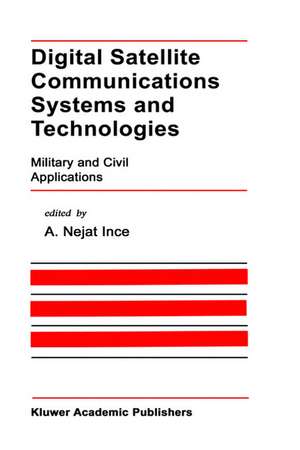
Digital Satellite Communications Systems and Technologies
Editat de A Nejat Inceen Limba Engleză Hardback – 30 sep 1992
Preț: 1907.87 lei
Preț vechi: 2326.67 lei
-18%
Puncte Express: 2862
Carte tipărită la comandă
Livrare economică 28 noiembrie-12 decembrie
Livrare prin curier în România Termenul estimat este afișat lângă disponibilitate.
Transport gratuit pentru acest produs Plată online sau ramburs, în funcție de opțiunile comenzii.
Retur gratuit în 14 zile Comandă securizată și suport în română.
Specificații
ISBN-13: 9780792392545
ISBN-10: 079239254X
Pagini: 604
Ilustrații: XVII, 604 p.
Dimensiuni: 160 x 241 x 38 mm
Greutate: 1.1 kg
Ediția:1992 edition
Editura: Springer Us
Locul publicării:New York, NY, United States
ISBN-10: 079239254X
Pagini: 604
Ilustrații: XVII, 604 p.
Dimensiuni: 160 x 241 x 38 mm
Greutate: 1.1 kg
Ediția:1992 edition
Editura: Springer Us
Locul publicării:New York, NY, United States
V-ar putea interesa
-
 Radar Handbook, Third EditionMerrill Skolnik-23%Preț: 1292.51 lei1678.59 lei
 -
 No Heavenly BodiesChristine E. Evans-8%Preț: 285.75 lei311.84 lei
 -
 Introduction to Digital CommunicationsAli Grami-32%Preț: 700.54 lei1034.41 lei
 -
 -19%Preț: 430.60 lei531.60 lei
 -
 Preț: 412.82 lei
 -
 Satellite Communications, Fifth EditionDennis Roddy-38%Preț: 487.87 lei789.50 lei
 -
 Advanced Electronic Communications SystemsWayne Tomasi-13%Preț: 559.33 lei642.90 lei
 -
 -23%Preț: 857.36 lei1113.46 lei
 -
 -18%Preț: 76.83 lei93.99 leiRecomandat
 -
 Ew 101David L Adamy-15%Preț: 706.38 lei831.03 lei
 -
 -11%Preț: 693.58 lei779.31 lei
 -
 -11%Preț: 690.59 lei775.95 lei
 -
 Recent Advances in Satellite Research & DevelopmentSamuel Gardiner-27%Preț: 1330.26 lei1812.76 lei
 -
 -18%Preț: 807.31 lei984.53 lei
 -
 -11%Preț: 676.47 lei760.07 lei
 -
 -18%Preț: 1387.48 lei1692.04 lei
 -
 Handbook of Satellite ApplicationsJoseph N. Pelton-18%Preț: 7441.65 lei9075.18 lei
 -
 Radio Wave Propagation of Satellite SystemsZhenwei Zhao-18%Preț: 955.47 lei1165.20 lei
Public țintă
ResearchCuprins
Contributing Authors.- Preface.- Acknowledgments.- 1: INTRODUCTION.- 1.1 Objective and approach.- 1.2 Content of the book.- 2: CURRENT NATO COMMUNICATIONS PLANNING (SATCOM AND THE NATO C3 ARCHITECTURE).- 2.1 Planned evolution of the NICS.- 2.2 Implications of the C3 architecture for NATO SATCOM.- 2.3 Planned evolution of the NATO SATCOM system.- 2.4 Future requirements.- 2.5 References.- 3: COMPARISON OF NATO AND OTHER SYSTEMS.- 3.1 Objective.- 3.2 Services and system characteristics.- 3.3 Environmental factors.- 3.4 References.- 4: ISSUES AND FUTURE TRENDS IN SATELLITE COMMUNICATIONS.- 4.1 Objective.- 4.2 Issues.- 4.3 Responses.- 4.4 Areas to be considered.- 5: THREAT TO SATELLITE COMMUNICATIONS.- 5.1 The threat to NATO SATCOM post-2000.- 5.2 Uplink jamming.- 5.3 Downlink jamming.- 5.4 Interception.- 5.5 Nuclear threat.- 5.6 Physical attack.- 5.7 Piracy (unauthorized access).- 5.8 References.- 6: THREAT IMPLICATIONS AND COUNTER¬MEASURES.- 6.1 ECCM techniques.- 6.2 Information coding.- 6.3 Speech coding.- 6.4 Satellite hardening.- 6.5 References.- 7: ENVIRONMENT.- 7.1 Propagation factors.- 7.2 Precipitation effects.- 7.3 Frequency bands.- 7.4 Interference and noise.- 7.5 Countering propagation effects.- 7.6 References.- 8: TECHNOLOGY REVIEW.- 8.1 Device technologies for signal processing.- 8.2 Digital and SAW techniques for on-board processing.- 8.3 Spacecraft phased-array and MBA antennas.- 8.4 Solid-state spaceborne power amplifiers.- 8.5 Laser communications for intersatellite links.- 8.6 Laser communications to submerged submarines.- 8.7 Advanced materials for spacecraft.- 8.8 Superconductivity.- 8.9 Artificial intelligence and neural networks.- 8.10 Robotics and control.- 8.11 Power generation in space (*).- 8.12 Spacecraft propulsion systems.- 8.13 Spacetransportation.- 8.14 Earth station technology.- 8.15 Principles for selecting sponsored R & D projects.- 9: NATIONAL SATCOM SYSTEMS AND DEVELOPMENTS.- 9.1 Introduction.- 9.2 UK systems.- 9.3 Systems and developments in the USA.- 9.4 Canadian systems.- 9.5 French systems and developments.- 9.6 Systems of The Federal Republic of Germany.- 9.7 ESA systems.- 9.8 Russian systems.- 10: POSSIBLE SATCOM SYSTEM ARCHITECTURES.- 10.1 Desired characteristics.- 10.2 Inclined elliptical orbits (Molniya, Tundra, and Loopus types).- 10.3 Satellite cluster systems (CloudSat and MEWS).- 10.4 Tethered satellite systems.- 10.5 LightSat and proliferated LEO systems.- 10.6 Summary evaluation.- 10.7 Candidate architectures.- 10.8 References.- 11: COST-PERFORMANCE ANALYSIS.- 11.1 System features.- 11.2 Cost-performance comparison of candidate architectures.- 11.3 Approaches to cost reduction.- 12: CONCLUDING REMARKS.