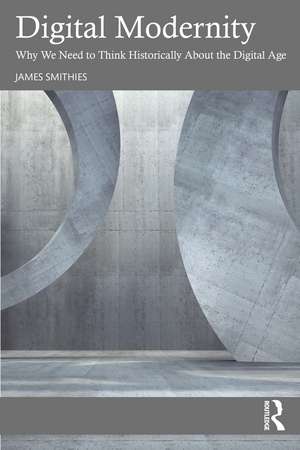
Digital Modernity: Why We Need to Think Historically About the Digital Age
Autor James Smithiesen Limba Engleză Paperback – 9 apr 2026
Bridging digital humanities, critical theory, sociology, philosophy, and global history, Digital Modernity demonstrates that contemporary digital systems are continuations rather than ruptures of the modern project. It offers a robust conceptual framework for examining how technological infrastructures intersect with democracy, governance, colonial legacies, and the public sphere. Across nine chapters, the book moves from conceptual foundations to future-facing proposals. Topics include the cultural logic of Silicon Valley, digital colonialism, digital infrastructure, and the epistemic crisis of the digital public sphere. It also engages philosophical questions about emergence, historicism, and artificial intelligence. Drawing on applied digital humanities, the book rejects technological determinism while offering accessible accounts of computing’s technical and political histories. Readers benefit from a coherent theoretical lens that integrates history with socio-technical critique, enabling a clearer understanding of digital modernity’s present and future stakes.
This book is intended for scholars and students across digital humanities, media and communication studies, science and technology studies, sociology, the philosophy of technology, and modern history. Its interdisciplinary scope also supports research and teaching in software studies, critical AI, infrastructure studies, and global modernities. Suitable for advanced undergraduate and postgraduate courses, it will be especially valuable for researchers seeking to historicize digital systems while advancing critiques grounded in cultural theory, political economy, and postcolonial perspectives. By placing the digital within a longer history of modernity, the book offers both a foundational text and a springboard for further research in critical digital studies.
The Open Access version of this book, available at www.taylorfrancis.com, has been made available under a Creative Commons Attribution-Non Commercial-No Derivatives (CC BY-NC-ND) 4.0 International license.
Preț: 386.80 lei
Puncte Express: 580
Carte disponibilă
Livrare economică 30 octombrie-13 noiembrie
Livrare express 15-21 octombrie pentru 33.42 lei
Livrare prin curier în România Termenul estimat este afișat lângă disponibilitate.
Transport gratuit de la 400.00 lei Plată online sau ramburs, în funcție de opțiunile comenzii.
Retur gratuit în 14 zile Comandă securizată și suport în română.
Specificații
ISBN-13: 9781041164012
ISBN-10: 1041164017
Pagini: 220
Dimensiuni: 156 x 234 mm
Greutate: 0.41 kg
Ediția:1
Editura: Taylor & Francis
Colecția Routledge
Locul publicării:Oxford, United Kingdom
ISBN-10: 1041164017
Pagini: 220
Dimensiuni: 156 x 234 mm
Greutate: 0.41 kg
Ediția:1
Editura: Taylor & Francis
Colecția Routledge
Locul publicării:Oxford, United Kingdom
Public țintă
Academic, Postgraduate, and Undergraduate AdvancedCuprins
Introduction: Technology and History 1 Digital Modernities 2 Computational Blueprints 3 The Digital Modern 4 The Public Sphere 5 Colonialism and Power 6 Race, Technology, and History 7 Into the Engine Room of History 8 Emergent Infrastructure 9 Industrialized Cognition Conclusion: The Future of Digital Modernity
Recenzii
A sweeping view of how our digital age unfolds from the long history of modernity with all its tensions of determinism versus contingency, and Western universalism versus global multiplicity. Smithies’s astonishingly broad, detailed, and interlaced knowledge of computation, philosophy, and history undergirds a powerful guiding message.
Alan Liu, Distinguished Professor of English, University of California, Santa Barbara
Digital Modernity is an essential guide for anyone seeking to understand not just what digital technologies do but how they are deeply entangled in modernity’s contested pasts and what they mean for our collective futures.
Katherine Bode, Professor of Digital Literary Studies, Australian National University
The great contribution of James Smithies is to learn and to bridge the digital revolution and the tradition of critical theory and sociology. This is pioneering work, full of insight and provocation, addressing both text and context, opening up the pathways of understanding.
Peter Beilharz, Emeritus Professor of Sociology, La Trobe University
Alan Liu, Distinguished Professor of English, University of California, Santa Barbara
Digital Modernity is an essential guide for anyone seeking to understand not just what digital technologies do but how they are deeply entangled in modernity’s contested pasts and what they mean for our collective futures.
Katherine Bode, Professor of Digital Literary Studies, Australian National University
The great contribution of James Smithies is to learn and to bridge the digital revolution and the tradition of critical theory and sociology. This is pioneering work, full of insight and provocation, addressing both text and context, opening up the pathways of understanding.
Peter Beilharz, Emeritus Professor of Sociology, La Trobe University
Notă biografică
James Smithies is Professor of Digital Humanities and Director of the Humanities and Social Sciences Digital Research Hub at The Australian National University. Previously, he was Professor of Digital Humanities at King’s College London and the founding director of King’s Digital Lab.
Descriere
This is the first systematic theorization of digital modernity, arguing that the digital age cannot be understood apart from the long historical arc of modernity.