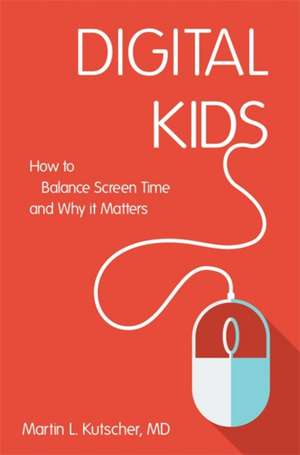
Digital Kids: How to Balance Screen Time, and Why it Matters
Autor Martin L. Kutscher Contribuţii de Natalie Rosinen Limba Engleză Paperback – 21 oct 2016
Martin L. Kutscher, MD analyses neurological, psychological and educational research and draws on his own experience to show when Internet use stops being a good thing and starts to become excessive. He shows how to spot digital addictions, and offers whole family approaches for limiting the harmful effects of too much screen time, such as helping kids to learn to control their own Internet use. He tackles diverse questions ranging from the effects of laptops in the classroom and reading on a digital screen, to whether violent videogames lead to aggression. The author also explains how ADHD and Autism Spectrum Disorder (ASD) can make you more susceptible to Internet addiction, suggesting practical strategies to suit these specific needs. Discussing both the good and bad aspects of the internet, this book tells you everything you need to know to help children and young people use the internet in a healthy, balanced way.
Preț: 109.55 lei
Preț vechi: 136.94 lei
-20%
Puncte Express: 164
Carte disponibilă
Livrare economică 12-26 noiembrie
Livrare prin curier în România Termenul estimat este afișat lângă disponibilitate.
Transport gratuit de la 400.00 lei Plată online sau ramburs, în funcție de opțiunile comenzii.
Retur gratuit în 14 zile Comandă securizată și suport în română.
Specificații
ISBN-13: 9781785927126
ISBN-10: 1785927124
Pagini: 144
Dimensiuni: 167 x 215 x 12 mm
Greutate: 0.15 kg
Editura: JESSICA KINGSLEY PUBLISHERS
Colecția Jessica Kingsley Publishers
Locul publicării:London, United Kingdom
ISBN-10: 1785927124
Pagini: 144
Dimensiuni: 167 x 215 x 12 mm
Greutate: 0.15 kg
Editura: JESSICA KINGSLEY PUBLISHERS
Colecția Jessica Kingsley Publishers
Locul publicării:London, United Kingdom
V-ar putea interesa
-
 The Smartphone SolutionMartha Deiros ColladoPreț: 122.38 lei
 -
 Preț: 72.28 lei
 -
 -26%Preț: 89.75 lei121.99 lei
 -
 The Tech SolutionShimi K KangPreț: 96.67 lei
 -
 How to Raise a Healthy GamerAlok Kanojia-37%Preț: 49.63 lei79.00 lei
 -
 Glow KidsNicholas KardarasPreț: 113.95 lei
 -
 -28%Preț: 96.25 lei132.97 lei
 -
 Preț: 109.80 lei
 -
 Nurturing Young Minds: Mental Wellbeing in the Digital AgeRamesh Manocha-24%Preț: 82.50 lei109.06 lei
 -
 Unplugged Parenting: How to Raise Happy, Healthy Children in the Digital AgeDr Elizabeth Kilbey-26%Preț: 78.22 lei106.30 lei
 -
 DisconnectedThomas KerstingPreț: 124.81 lei
 -
 -19%Preț: 73.52 lei90.82 lei
 -
 Be the Parent, PleaseNaomi Schaefer RileyPreț: 110.12 lei
 -
 Reset Your Child's BrainVictoria Dunckley-17%Preț: 108.87 lei131.61 lei
 -
 Tech-Smart ParentingCatherine KnibbsPreț: 122.32 lei
 -
 The Anxious GenerationJonathan Haidt-29%Preț: 67.13 lei94.64 leiRecomandat
 -
 Screen Time Is Not Forever (Best Behavior)Elizabeth VerdickPreț: 51.27 lei
 -
 Preț: 102.13 lei
 -
 -21%Preț: 632.33 lei802.70 lei
 -
 Healthy Technology Use: Your Questions AnsweredBernadette H. Schell-41%Preț: 136.73 lei230.19 lei
Recenzii
Imagine you're at an Ivy League school with one of their best professors. The lecturer is crisp, to the point and complete. This is what Dr Martin Kutscher has done with Digital Kids. In a crisp, easy way he teaches us the ins and outs of cyberspace, but more importantly, we learn how to raise well-adjusted kids in the Digital Age. Digital Kids is a true contribution and a must for both professionals and parents.
By emphasizing social transactions and the social rules of digital society, as well as the safe use of digital media, this book will help to create boundaries and strengthen understanding of the digital world, without frightening the reader about the use and culture of social media and the internet in general. I strongly recommend this book for parents to encourage them to get involved with what their 'digital kids' are doing online.
Today's children quickly gravitate to - and master - electronic devices. This leaves their parents both proud and fearful. What is the impact on social skills and brain development? The antidote to fear is knowledge, explains veteran pediatric neurologist Martin Kutscher. In this engagingly written book, he gently walks you through the issues and the ways you can create healthy balance in your child's life.
Eye-opening research that validates parents' concerns regarding the relationship their kids have with digital technology can be found in Digital Kids. Dr Kutscher's easy to understand explanations of many topics such as multi-tasking vs multi-switching, the effects of technology on reading comprehension, and the difficulty of switching from playing video games to starting homework, makes Digital Kids a great resource for parents and educators!
A comprehensive, scientifically backed, yet down to earth guide for parents trying to understand this confusing digital world and how it impacts their children, especially the more vulnerable. The honest straightforward talk on parents' responsibilities for their child's internet use and how to meet them is invaluable.
By emphasizing social transactions and the social rules of digital society, as well as the safe use of digital media, this book will help to create boundaries and strengthen understanding of the digital world, without frightening the reader about the use and culture of social media and the internet in general. I strongly recommend this book for parents to encourage them to get involved with what their 'digital kids' are doing online.
Today's children quickly gravitate to - and master - electronic devices. This leaves their parents both proud and fearful. What is the impact on social skills and brain development? The antidote to fear is knowledge, explains veteran pediatric neurologist Martin Kutscher. In this engagingly written book, he gently walks you through the issues and the ways you can create healthy balance in your child's life.
Eye-opening research that validates parents' concerns regarding the relationship their kids have with digital technology can be found in Digital Kids. Dr Kutscher's easy to understand explanations of many topics such as multi-tasking vs multi-switching, the effects of technology on reading comprehension, and the difficulty of switching from playing video games to starting homework, makes Digital Kids a great resource for parents and educators!
A comprehensive, scientifically backed, yet down to earth guide for parents trying to understand this confusing digital world and how it impacts their children, especially the more vulnerable. The honest straightforward talk on parents' responsibilities for their child's internet use and how to meet them is invaluable.
Cuprins
1. Introduction. Part One: Problems with the Use of Digital Technology. 2. Psychological/learning effects of Internet use. 3. How does our attention system work? 4. "But mom, I can pay attention to more than one thing at a time!" The myth of "multi-tasking". 5. Screens interfere with developing voluntary attention. 6. Areas where digital learning does excel. 7. Summary of digital vs. print effects on learning. 8. Other psychological effects of the Internet. 9. Neurological effects of Internet abuse. 10. Physical effects of digital media use. Part Two: Problems with the Content of the Digital Technology. 11. Social Media. 12. Does pornography and other media exposure affect sexuality. 13. Does media exposure increase the risk of violent behavior? 14. Do violent videogames lead to violent behavior? 15. Does media effect substance use? 16. Resultant AAP (2013) recommendations regarding digital media. Part Three: Problems Regarding Specific Populations. 17. Very young children and screen time. 18. Children with ADHD and screen time. 19. Children with Autism Spectrum Disorder (ASD) and screen time. Part Four: The Parental Role. 20. What kind of role model am I for my child? 21. How do I set limits for my child? Part Five: Setting Up the Rules: The Family Meeting and Agreement. 22. The family meeting. 23. The agreement. Part Six: Internet Addiction: The Far End of Internet Problems. 24. Internet problems cover a whole range of severity. 25. What is an addiction? 26. How does someone get addicted? 27. How common is Internet addiction? 28. Why is digital media so addicting? 29. What are particularly addicting Internet activities? 30. What personal traits are associated with Internet addiction? 31. How do we treat Internet addiction? Part Seven: Summary. 32. The recent explosion of digital technology and services. 33. The extent of screen time usage. 34. The parents' dilemma and role in setting limits. 35. Problems with the use of the Internet. 36. Problems with the content of the Internet. 37. Problems regarding specific populations. 38. The parental role. 39. Setting up the rules: the family meeting and agreement. 40. Internet addiction: The far end of Internet problems. References. Resources. About the authors.