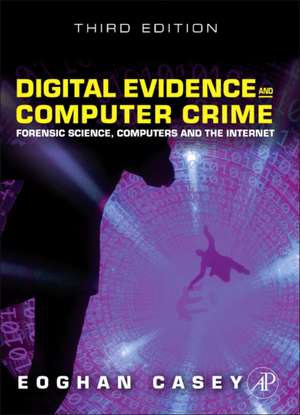
Digital Evidence and Computer Crime: Forensic Science, Computers, and the Internet
Autor Eoghan Caseyen Limba Engleză Hardback – 17 iun 2011
Observăm că Digital Evidence and Computer Crime se prezintă ca un manual de referință exhaustiv, esențial pentru înțelegerea modului în care rețelele informatice pot deveni atât instrumente ale infracțiunii, cât și surse vitale de probe. Această a treia ediție, premiată de InfoSec Reviews, extinde cadrul teoretic prin integrarea unor actualizări tehnice critice pentru platformele Windows, Unix și Macintosh, reflectând evoluția rapidă a peisajului tehnologic.
Subliniem structura riguroasă a volumului, care este împărțit în cinci secțiuni logice. Primele părți stabilesc fundamentul juridic, comparând perspectivele din SUA și Europa, în timp ce secțiunile mediane se concentrează pe metodologia investigației: de la gestionarea scenei crimei digitale până la reconstrucția probatorie. Notăm cu interes includerea unor capitole dedicate infracțiunilor violente și hărțuirii cibernetice, elemente care ancorează textul în realitățile criminologice contemporane. Stilul este unul academic, dar aplicat, susținut de numeroase studii de caz care ilustrează aplicarea conceptelor în instanță.
Această lucrare completează perspectiva oferită de Handbook of Digital Forensics and Investigation, tot sub semnătura lui Eoghan Casey. În timp ce Handbook of Digital Forensics and Investigation funcționează ca o resursă pentru practicieni prin colaborări cu diverși experți, volumul de față servește drept text fundamental de studiu, oferind progresia pedagogică necesară studenților. Față de Digital Investigations de Chad R Johnson, care se axează predilect pe faza de examinare și artefacte Windows, Digital Evidence and Computer Crime oferă o viziune mult mai vastă, incluzând criminalistica rețelelor și cadrul legislativ internațional. În contextul operei sale, această carte reprezintă pilonul teoretic ce susține ghidurile practice precum Malware Forensics.
Preț: 370.88 lei
Preț vechi: 511.02 lei
-27%
Carte tipărită la comandă
Livrare economică 01-15 iunie
Specificații
ISBN-10: 0123742684
Pagini: 840
Ilustrații: Illustrations
Dimensiuni: 191 x 235 x 46 mm
Greutate: 1.88 kg
Ediția:3. Auflage.
Editura: Elsevier
V-ar putea interesa
-
 Handbook of Digital Forensics and InvestigationEoghan Casey-12%Preț: 275.59 lei312.93 lei
 -
 Shooting Incident ReconstructionMichael G. Haag-26%Preț: 517.49 lei702.39 lei
 -
 Rape Investigation HandbookJohn O. Savino-25%Preț: 356.72 lei475.49 lei
 -
 -39%Preț: 75.95 lei124.84 lei
 -
 Cybercrime: Criminal Threats from CyberspaceSusan W. Brenner-18%Preț: 319.01 lei389.06 lei
 -
 Cybercrime: The Psychology of Online OffendersGráinne KirwanPreț: 418.34 lei
 -
 Transportation Systems SecurityAllan McDougall-9%Preț: 864.73 lei950.26 lei
 -
 The War on Terrorism: A Collision of Values, Strategies, and SocietiesThomas A. Johnson-18%Preț: 867.73 lei1058.21 lei
 -
 -15%Preț: 504.26 lei593.25 lei
 -
 The Law of Cybercrimes and Their InvestigationsGeorge Curtis-20%Preț: 915.48 lei1144.35 lei
 -
 -29%Preț: 333.90 lei467.44 lei
 -
 Malware Forensics Field Guide for Linux SystemsCameron H. Malin-20%Preț: 401.43 lei501.79 lei
 -
 Forensic Approaches to Death, Disaster and AbuseMarc OxenhamPreț: 370.93 lei
 -
 A Crime Solving ToolkitBasil A. ReidPreț: 235.88 lei
Public țintă
Computer forensic students and professionals, lawyers, law enforcement, government agencies (IRS, FBI, CIA, CCIPS, etc.).De ce să citești această carte
Recomandăm această lucrare studenților la criminologie, avocaților și profesioniștilor din agențiile guvernamentale. Cititorul câștigă o înțelegere profundă a procesului de colectare a probelor digitale conform standardelor legale internaționale. Este o resursă indispensabilă deoarece îmbină rigoarea științei criminalistice cu expertiza tehnică necesară pentru a naviga prin sistemele de operare moderne și rețelele complexe, oferind totodată instrumentele practice pentru prezentarea dovezilor în sala de judecată.
Despre autor
Eoghan Casey este o figură centrală în domeniul securității informatice, fiind membru fondator al Knowledge Solutions LLC, un parteneriat dedicat formării profesionale și consultanței în criminalistică digitală. Expertiza sa este consolidată de activitatea de cercetare desfășurată în cadrul University College Dublin, unde s-a specializat în informatică. Autor prolific, Casey a publicat lucrări de referință precum Malware Forensics și ghiduri specializate pentru sistemele Linux, contribuțiile sale fiind recunoscute la nivel internațional pentru rigoarea metodologică și aplicabilitatea lor în investigațiile federale și internaționale.
Descriere scurtă
It offers a thorough explanation of how computer networks function, how they can be involved in crimes, and how they can be used as a source of evidence. In particular, it addresses the abuse of computer networks as well as privacy and security issues on computer networks.
This updated edition is organized into five parts. Part 1 is about digital forensics and covers topics ranging from the use of digital evidence in the courtroom to cybercrime law. Part 2 explores topics such as how digital investigations are conducted, handling a digital crime scene, and investigative reconstruction with digital evidence. Part 3 deals with apprehending offenders, whereas Part 4 focuses on the use of computers in digital investigation. The book concludes with Part 5, which includes the application of forensic science to networks.
New to this edition are updated information on dedicated to networked Windows, Unix, and Macintosh computers, as well as Personal Digital Assistants; coverage of developments in related technology and tools; updated language for search warrant and coverage of legal developments in the US impacting computer forensics; and discussion of legislation from other countries to provide international scope. There are detailed case examples that demonstrate key concepts and give students a practical/applied understanding of the topics, along with ancillary materials that include an Instructor's Manual and PowerPoint slides.
This book will prove valuable to computer forensic students and professionals, lawyers, law enforcement, and government agencies (IRS, FBI, CIA, CCIPS, etc.).
- Named The 2011 Best Digital Forensics Book by InfoSec Reviews
- Provides a thorough explanation of how computers & networks function, how they can be involved in crimes, and how they can be used as evidence
- Features coverage of the abuse of computer networks and privacy and security issues on computer networks
Cuprins
1. Foundations of Digital Forensics
2. Language of Computer Crime Investigation
3. Digital Evidence in the Courtroom
4. Cybercrime Law: A United States Perspective
5. Cybercrime Law: European Perspective
PART 2: Digital Investigations
6. Conducting Digital Investigations
7. Handling a Digital Crime Scene
8. Investigative Reconstruction with Digital Evidence
9. Modus Operandi, Motive, and Technology
PART 3: Apprehending Offenders
10. Violent Crime and Digital Evidence
11. Digital Evidence as Alibi
12. Sex Offenders on the Internet
13. Investigating Computer Intrusions
14. Cyberstalking
PART 4: Computers
15. Computer Basics for Digital Investigators
16. Applying Forensic Science to Computers
17. Forensic Examination of Windows Systems
18. Forensic Examination of UNIX Systems
19. Forensic Examination of Macintosh Systems
20. Forensic Examination of Mobile Devices (online only)
PART 5: Network Forensics
21. Network Basics for Digital Investigators
22. Applying Forensic Science to Networks
23. Digital Evidence on the Internet
24. Digital Evidence on Physical and Data-Link Layers
25. Digital Evidence at the Network and Transport Layers
Recenzii
"Just finished ‘Digital Evidence and Computer Crime: Forensic Science, Computers and the Internet’ by Eoghan Casey and featuring other contributing authors, and it’s quite good. I bought this book because I wanted an all-encompassing book that provided insight on the various aspects of an investigation, especially the legal portion. And in this aspect the book does an excellent job, and is in-depth in area’s I have yet to see in other books. The book is divided into five portions digital forensics, digital investigations, apprehending offenders, computers and network forensics. For me the book was worth it for the first three portions; however, the computers and network portions, while a good start, there are more in-depth books that provide better insight… Overall, the book was enjoyable from start to finish and I would recommend it to anyone looking for a great overview of digital forensic investigation process from start to finish. I am happy to add this book to my growing reference library." --Student of Security
"This hefty book on forensic evidence obtained from computers dispels the myths propagated by popular television series. It states from the premise that very few people are well versed in the technical, evidential, and legal issues concerning digital evidence. Oftentimes, the useful evidence that may be found in various digital media is overlooked, collected incorrectly, or analyzed ineffectively. It is the goal of the team of contributors to equip readers with the necessary knowledge and skills to be able to make use of digital evidence correctly and effectively…. It is quite obvious that the various authors draw from several fields, such as forensic science, computer science, political science, criminal justice, the law, and behavioral analysis; as such, it is multi- and interdisciplinary. More specifically, the authors tackle the specific crimes of cyber bullying, cyber stalking, identity theft, online sex offenders, fraudsters, and cyber threats. There is extensive use of boxed stories, legal cases, practitioner’s tips, tables, the discussion of legislation, flow charts, treaties and journals, as well as figures, diagrams, pictures, and computer screen shots. The book is comparative in nature: it covers not only cyber law in the US, but also case law in the UK, Ireland, and the Netherlands. Given the ubiquity of the computer and the crimes that it can generate, learning about how other nations handle these issues helps in the formation of our own methods for dealing with crimes domestically, as well as those that cross national boundaries." --ACM’s Computing Reviews.com
"A better title for Digital Evidence and Computer Crime might be the Comprehensive Guide to Everything You Need to Know About Digital Forensics. One is hard pressed to find another book overflowing with so many valuable details and real-world examples." --Ben Rothke on Slashdot.org (Sept 2011)