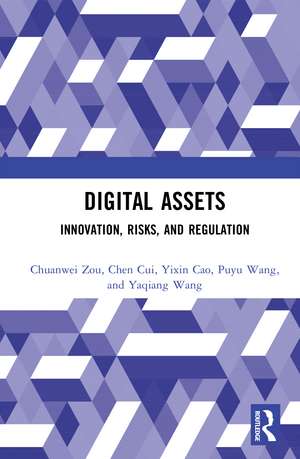
Digital Assets: Innovation, Risks, and Regulation
Autor Chuanwei Zou, Chen Cui, Yixin Cao, Puyu Wang, Yaqiang Wangen Limba Engleză Hardback – 23 oct 2026
The authors lay the technical foundations of digital assets by examining how blockchains such as Bitcoin and Ethereum function, how smart contracts operate, and how cross-chain mechanisms connect separate blockchains. This book categorizes major digital asset classes, including digital currencies, tokenized securities, and cryptoassets. It investigates the institutional architecture underpinning the digital asset market, from wallets to exchanges like Coinbase. Additionally, it delves into multiple layers of the digital asset ecosystem, encompassing DeFi protocols (e.g., automated market makers, decentralized lending), financial products (exchange-traded products, derivatives), and distinctive market activities, such as economic attacks and corporate Bitcoin treasury strategies. This book also provides a critical analysis of the systemic risks associated with the digital asset market and the corresponding regulatory responses.
This book is an essential reference for financial professionals, regulators, researchers, and graduate students seeking to understand the digital asset market.
Preț: 1349.95 lei
Preț vechi: 1646.29 lei
-18% Precomandă
Puncte Express: 2025
Carte nepublicată încă
Livrare prin curier în România Precomanda se expediază când titlul devine disponibil.
Transport gratuit pentru acest produs Plată online sau ramburs, în funcție de opțiunile comenzii.
Retur gratuit în 14 zile Comandă securizată și suport în română.
Doresc să fiu notificat când acest titlu va fi disponibil:
Se trimite...
Specificații
ISBN-13: 9781041321200
ISBN-10: 1041321201
Pagini: 268
Ilustrații: 92
Dimensiuni: 156 x 234 mm
Greutate: 0.66 kg
Ediția:1
Editura: Taylor & Francis
Colecția Routledge
Locul publicării:Oxford, United Kingdom
ISBN-10: 1041321201
Pagini: 268
Ilustrații: 92
Dimensiuni: 156 x 234 mm
Greutate: 0.66 kg
Ediția:1
Editura: Taylor & Francis
Colecția Routledge
Locul publicării:Oxford, United Kingdom
Public țintă
Postgraduate and Professional ReferenceRecenzii
‘We are standing at the “1995 moment” of Web 3.0. This book profoundly reveals how blockchain dramatically lowers investment barriers and delivers inclusive financial services to users worldwide. Its systematic anatomy of the digital asset ecosystem lays the conceptual groundwork for the integration of "AI + Digital Assets," clearly demonstrating that the future AI economy will inevitably rely on blockchain’s high-frequency micropayment and real-time settlement infrastructure. The last mile for traditional finance to join the digital asset ecosystem lies in compliance. By comprehensively mapping the underlying logic and regulatory boundaries of digital assets, this book is highly recommended for every builder navigating the era where "everything goes on-chain."’
Dr. Xiao Feng (Ph.D. in Ecnomics), Group CEO and Chairman of the Board of HashKey Group, Vice Chairman of China Wanxiang Group
Dr. Xiao Feng (Ph.D. in Ecnomics), Group CEO and Chairman of the Board of HashKey Group, Vice Chairman of China Wanxiang Group
Cuprins
PART I: BLOCKCHAIN AS THE FOUNDATION OF DIGITAL ASSET 1: Introduction to Representative Blockchains 2: The Token Paradigm of Blockchains 3: Blockchains’ Economic Models and Governance Mechanism 4: The Blockchain Impossible Trinity and Its Implications 5: Oracles: The Mechanism to Write Information into Blockchain 6: Cross-Chain: The Expansion Mechanism from Chain to Network PART II: MAJOR TYPES OF DIGITAL ASSETS 7: Tokenization in Theory and in Practice 8: Digital Currencies 9: Tokenized Securities: Case Studies of Daml and Liberty 10: Cryptoassets 11: Digital Renminbi: From 1.0 to 2.0 PART III: PARTICIPANTS IN THE DIGITAL ASSET MARKETS 12: Custodial Wallets and Custodians 13: Digital Asset Exchanges: A Case Study of Coinbase 14: Information Intermediaries in Digital Assets PART IV: CONTRACTUAL ARRANGEMENTS IN DIGITAL ASSET MARKETS 15: Overview of Decentralized Finance (DeFi) 16: Decentralized Lending 17: Automated Market Makers (AMMs) PART V: PRODUCTS IN DIGITAL ASSET MARKETS 18: Exchange-Traded Products (ETPs) for Digital Assets 19: Digital Asset Futures and Options PART VI: ACTIVITIES IN DIGITAL ASSET MARKETS 20: Economic Attacks in the DeFi Ecosystem 21: Liquidity Mining and Staking 22: The Rise and Mechanics of the Digital Asset Treasury Model PART VII: RISKS IN DIGITAL ASSET MARKETS 23: Systemic Fragility of the Crypto-Asset Market 24: The Relationship between the Cryptoassets and Mainstream Financial Markets PART VIII: REGULATION OF DIGITAL ASSET MARKETS 25: FATF Requirements on AML and CFT for Virtual Assets 26: The Trump Administration’s Digital Asset Policy 27: The EU Markets in Crypto-Assets Regulation (MiCA) 28: Risks and Regulation of Stablecoins
Notă biografică
Chuanwei Zou is President of Jiangsu Jinke Research Institute on Digital and Technology Finance, Joint Secretary-General of Jiangsu Financial Society, and Honorary Head of Research at Bank of Jiangsu. His research interests cover digital finance, banking, and financial regulation.
Chen Cui is an associate partner at HashKey RWA. Her research covers technology innovation and business models, the economic models and governance mechanisms of application layer blockchain protocols, and global developments in digital asset regulation.
Yixin Cao is an independent researcher in blockchain systems and crypto market structure. With a Ph.D. in Physics from Shanghai Jiao Tong University, she combines data science and economics to study DeFi, transaction behavior, and the evolving logic of decentralized systems.
Puyu Wang is a partner at HashKey RWA. His research and professional focus center on Web3 token economics design and the tokenization of real world assets (RWAs). He specializes in navigating legal frameworks, evaluating tokenization protocols, and unlocking the potential of RWAs as collateral within DeFi ecosystems.
Yaqiang Wang is a research fellow at Jiangsu Jinke Research Institute on Digital and Technology Finance. His research interests focus on the development trajectory of frontier technologies, including AI and blockchain, and relevant governance challenges and policy solutions.
Chen Cui is an associate partner at HashKey RWA. Her research covers technology innovation and business models, the economic models and governance mechanisms of application layer blockchain protocols, and global developments in digital asset regulation.
Yixin Cao is an independent researcher in blockchain systems and crypto market structure. With a Ph.D. in Physics from Shanghai Jiao Tong University, she combines data science and economics to study DeFi, transaction behavior, and the evolving logic of decentralized systems.
Puyu Wang is a partner at HashKey RWA. His research and professional focus center on Web3 token economics design and the tokenization of real world assets (RWAs). He specializes in navigating legal frameworks, evaluating tokenization protocols, and unlocking the potential of RWAs as collateral within DeFi ecosystems.
Yaqiang Wang is a research fellow at Jiangsu Jinke Research Institute on Digital and Technology Finance. His research interests focus on the development trajectory of frontier technologies, including AI and blockchain, and relevant governance challenges and policy solutions.
Descriere
Digital assets are fundamentally transforming the global financial system, yet their mechanics and implications remain poorly understood, even among financial professionals. This book offers the first comprehensive and rigorous exploration of the digital assets landscape.