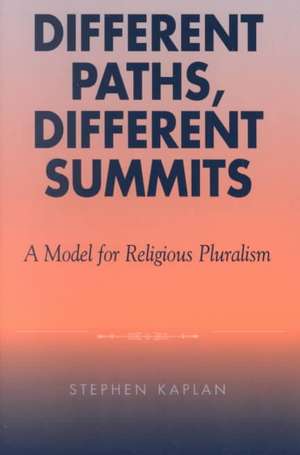
Different Paths, Different Summits: A Model for Religious Pluralism
Autor Stephen Kaplanen Limba Engleză Paperback – 17 dec 2001
Preț: 349.48 lei
Preț vechi: 446.54 lei
-22%
Puncte Express: 524
Carte tipărită la comandă
Livrare economică 09-23 noiembrie
Livrare prin curier în România Termenul estimat este afișat lângă disponibilitate.
Transport gratuit de la 400.00 lei Plată online sau ramburs, în funcție de opțiunile comenzii.
Retur gratuit în 14 zile Comandă securizată și suport în română.
Specificații
ISBN-13: 9780742513327
ISBN-10: 0742513327
Pagini: 256
Ilustrații: bibliography, index
Dimensiuni: 148 x 228 x 15 mm
Greutate: 0.3 kg
Ediția:New.
Editura: Bloomsbury Publishing
Colecția Rowman & Littlefield
Locul publicării:New York, United States
ISBN-10: 0742513327
Pagini: 256
Ilustrații: bibliography, index
Dimensiuni: 148 x 228 x 15 mm
Greutate: 0.3 kg
Ediția:New.
Editura: Bloomsbury Publishing
Colecția Rowman & Littlefield
Locul publicării:New York, United States
Cuprins
Chapter 1 Preface
Chapter 2 An Overview of the Problem and the Proposal
Chapter 3 Putting the Proposal in Context
Chapter 4 The Debate within the Philosophy of Mysticism
Chapter 5 Models, Holography and Bohm's Holographic Model
Chapter 6 A Proposal for a Pluralistic Ontology and Soteriology
Chapter 7 Conclusion: Problems and Possibilities
Chapter 8 Bibliography
Chapter 9 Index
Chapter 2 An Overview of the Problem and the Proposal
Chapter 3 Putting the Proposal in Context
Chapter 4 The Debate within the Philosophy of Mysticism
Chapter 5 Models, Holography and Bohm's Holographic Model
Chapter 6 A Proposal for a Pluralistic Ontology and Soteriology
Chapter 7 Conclusion: Problems and Possibilities
Chapter 8 Bibliography
Chapter 9 Index
Recenzii
Stephen Kaplan's latest book is a singularly creative answer to a thorny problem in theology and religious studies. How can one simultaneously affirm religious pluralism as well as the ultimacy of each religion? His answer is both refreshing and tightly-argued. Kaplan's brilliant proposal is for a 'pluralistic ontology and soteriology,' a timely message which will help define the debate for decades to come.
A strikingly original contribution to the growing body of literature on religious pluralism. It will be useful to scholars interested in religious pluralism and the theology of religions, and for graduate-level courses in those areas.
Kaplan has provided a basis for reconsidering the notion of religious pluralism in terms of both soteriology and ontology. This work, therefore, deserves the attention of philosophers and theologians currently interested in the concept of religious pluralism, as he enlists one of the great scientific minds of our time to provide a foundation for his novel ideas.
A deep assumption of most students of religious experience has been that what is experienced in diverse ways is ultimately the same. A protest in favor of a deeper pluralism is emerging. Kaplan has given us the most richly developed argument for this liberating pluralism. If it is taken seriously, it will deeply affect the future study of religious experience.
A strikingly original contribution to the growing body of literature on religious pluralism. It will be useful to scholars interested in religious pluralism and the theology of religions, and for graduate-level courses in those areas.
Kaplan has provided a basis for reconsidering the notion of religious pluralism in terms of both soteriology and ontology. This work, therefore, deserves the attention of philosophers and theologians currently interested in the concept of religious pluralism, as he enlists one of the great scientific minds of our time to provide a foundation for his novel ideas.
A deep assumption of most students of religious experience has been that what is experienced in diverse ways is ultimately the same. A protest in favor of a deeper pluralism is emerging. Kaplan has given us the most richly developed argument for this liberating pluralism. If it is taken seriously, it will deeply affect the future study of religious experience.