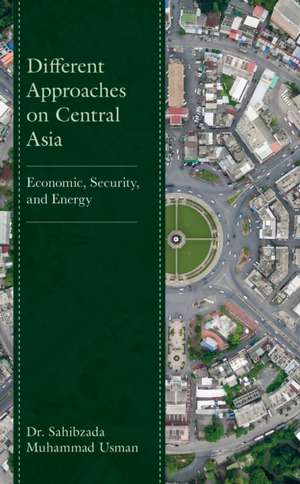
Different Approaches on Central Asia: Economic, Security, and Energy
Autor Sahibzada Muhammad Usmanen Limba Engleză Hardback – 10 apr 2023
Preț: 466.64 lei
Preț vechi: 698.12 lei
-33%
Puncte Express: 700
Carte tipărită la comandă
Livrare economică 08-22 iunie
Specificații
ISBN-13: 9781666913002
ISBN-10: 1666913006
Pagini: 158
Ilustrații: 11 b/w illustrations;
Dimensiuni: 148 x 232 x 16 mm
Greutate: 0.38 kg
Editura: Bloomsbury Publishing
Colecția Lexington Books
Locul publicării:New York, United States
ISBN-10: 1666913006
Pagini: 158
Ilustrații: 11 b/w illustrations;
Dimensiuni: 148 x 232 x 16 mm
Greutate: 0.38 kg
Editura: Bloomsbury Publishing
Colecția Lexington Books
Locul publicării:New York, United States
Cuprins
List of Figures
Acknowledgments
List of Abbreviations
Introduction
Chapter 1: Trade of Central Asian Countries and Its Significances
Chapter 2: America Interest and Its Role in Central Asian Countries
Chapter 3: Russia Interest and Its Role in Central Asian Countries
Chapter 4: Europe Interest and Its Role in Central Asian Countries
Chapter 5: China Interest and Its Role in the Central Asian Countries
Chapter 6: Post Soviet Transition
Conclusion
Bibliography
About the Author
Acknowledgments
List of Abbreviations
Introduction
Chapter 1: Trade of Central Asian Countries and Its Significances
Chapter 2: America Interest and Its Role in Central Asian Countries
Chapter 3: Russia Interest and Its Role in Central Asian Countries
Chapter 4: Europe Interest and Its Role in Central Asian Countries
Chapter 5: China Interest and Its Role in the Central Asian Countries
Chapter 6: Post Soviet Transition
Conclusion
Bibliography
About the Author
Recenzii
This book aims to focus on the global network and the international integration of Central Asia in terms of economy, security, and energy. Central Asia needs regional cooperation and integration, especially in trade and infrastructure. Local political circumstances influence the likelihood of regional integration.