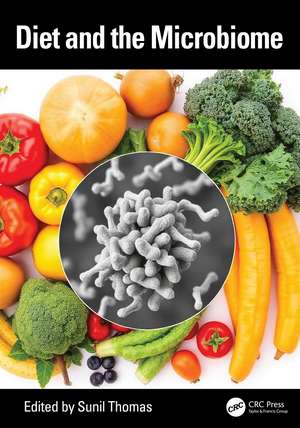
Diet and the Microbiome
Editat de Sunil Thomasen Limba Engleză Hardback – 8 sep 2026
Preț: 1152.57 lei
Preț vechi: 1405.57 lei
-18% Nou
Puncte Express: 1729
Carte tipărită la comandă
Livrare economică 28 noiembrie-12 decembrie
Livrare prin curier în România Termenul estimat este afișat lângă disponibilitate.
Transport gratuit pentru acest produs Plată online sau ramburs, în funcție de opțiunile comenzii.
Retur gratuit în 14 zile Comandă securizată și suport în română.
Specificații
ISBN-13: 9781041069874
ISBN-10: 1041069871
Pagini: 188
Ilustrații: 6
Dimensiuni: 178 x 254 mm
Greutate: 0.51 kg
Ediția:1
Editura: CRC Press
Colecția CRC Press
ISBN-10: 1041069871
Pagini: 188
Ilustrații: 6
Dimensiuni: 178 x 254 mm
Greutate: 0.51 kg
Ediția:1
Editura: CRC Press
Colecția CRC Press
Public țintă
Academic, Postgraduate, and Professional ReferenceNotă biografică
Professor Sunil Thomas is a Research Professor at the Lankenau Institute for Medical Research in Wynnewood, Pennsylvania, where he leads innovative work at the intersection of cell biology, microbiology, and translational medicine. His research is primarily focused on developing next-generation immunotherapies for complex and chronic conditions, including inflammatory bowel diseases and Alzheimer’s disease. A key component of his work involves investigating the role of the microbiome in disease progression and therapeutic response.
Over the course of his career, Professor Thomas has made significant contributions to the fields of infectious disease and vaccine development. He has been involved in the design and development of diagnostic tools and vaccines targeting a range of infectious pathogens. In addition, his research has extended into the structural biology of viruses, providing insights into viral mechanisms that inform both therapeutic and preventive approaches.
Professor Thomas earned his Ph.D. in Environmental Biotechnology from Cochin University of Science and Technology (CUSAT) in India. He subsequently completed postdoctoral training at the Indian Institute of Science in Bangalore and at the Mount Sinai School of Medicine in New York, where he further refined his expertise in molecular and translational biomedical research.
An accomplished scholar, Professor Thomas has authored more than 70 peer-reviewed publications and contributed to books on vaccines and infectious diseases. He is also an inventor on multiple patents, reflecting the practical and translational impact of his research.
Over the course of his career, Professor Thomas has made significant contributions to the fields of infectious disease and vaccine development. He has been involved in the design and development of diagnostic tools and vaccines targeting a range of infectious pathogens. In addition, his research has extended into the structural biology of viruses, providing insights into viral mechanisms that inform both therapeutic and preventive approaches.
Professor Thomas earned his Ph.D. in Environmental Biotechnology from Cochin University of Science and Technology (CUSAT) in India. He subsequently completed postdoctoral training at the Indian Institute of Science in Bangalore and at the Mount Sinai School of Medicine in New York, where he further refined his expertise in molecular and translational biomedical research.
An accomplished scholar, Professor Thomas has authored more than 70 peer-reviewed publications and contributed to books on vaccines and infectious diseases. He is also an inventor on multiple patents, reflecting the practical and translational impact of his research.
Cuprins
1. Feeding the Microbiome: How Diet Shapes Human Health
Valentina Biagioli and Pasquale Striano
2. The Intricate Relationship Between Food and Gut Microbes: Implications in Health and Diseases
Gopal Khodve, Suparna Roy Sarkar, and Sugato Banerjee
3. The Role of Fiber Rich Diet in Modulating the Gut Microbiome and Health Outcomes
Alex Muppasani and Sunil Thomas
4. The Living Pantry: Understanding the Bacterial Ecosystem in Fermented Foods
Kinjal J. Parmar, Charmy R. Kothari, and Ramesh K. Kothari
5. Probiotics and Prebiotics in Gut Health
Olivia Lutz and Sunil Thomas
6. Impact of Physical Exercise on the Gut Microbiota
Gabriel Mayer Tossi, Leidiane de Medeiros Oliveira Lima, Maurício da Silva Krause, and Patricia Martins Bock
7. Dietary Polyphenols and the Gut Microbiome
Tatiana Diacova and Zhaoping Li
8. The Impact of Ultra-Processed Foods on the Microbiome and Human Health
Olivia Lutz and Sunil Thomas
9. Peinosis - The Shortening of the Colon when on a High Fat, High Protein Diet
Sunil Thomas
Valentina Biagioli and Pasquale Striano
2. The Intricate Relationship Between Food and Gut Microbes: Implications in Health and Diseases
Gopal Khodve, Suparna Roy Sarkar, and Sugato Banerjee
3. The Role of Fiber Rich Diet in Modulating the Gut Microbiome and Health Outcomes
Alex Muppasani and Sunil Thomas
4. The Living Pantry: Understanding the Bacterial Ecosystem in Fermented Foods
Kinjal J. Parmar, Charmy R. Kothari, and Ramesh K. Kothari
5. Probiotics and Prebiotics in Gut Health
Olivia Lutz and Sunil Thomas
6. Impact of Physical Exercise on the Gut Microbiota
Gabriel Mayer Tossi, Leidiane de Medeiros Oliveira Lima, Maurício da Silva Krause, and Patricia Martins Bock
7. Dietary Polyphenols and the Gut Microbiome
Tatiana Diacova and Zhaoping Li
8. The Impact of Ultra-Processed Foods on the Microbiome and Human Health
Olivia Lutz and Sunil Thomas
9. Peinosis - The Shortening of the Colon when on a High Fat, High Protein Diet
Sunil Thomas
Descriere
Diet plays a crucial role in shaping the composition of the gut microbiome. Recent research is rapidly strengthening the appreciation that associated microorganisms make essential contributions to human health and well-being. A low diversity of microorganisms is associated with a plethora of diseases and disorders.