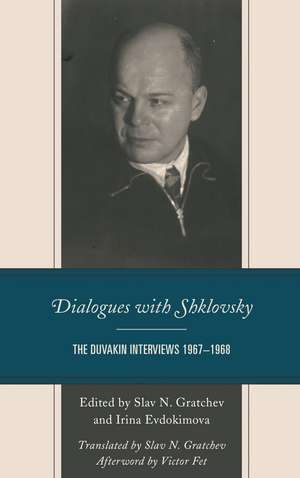
Dialogues with Shklovsky
Editat de Slav N. Gratchev, Irina Evdokimovaen Limba Engleză Hardback – 10 apr 2019
Preț: 545.22 lei
Preț vechi: 816.62 lei
-33%
Puncte Express: 818
Carte tipărită la comandă
Livrare economică 04-18 decembrie
Livrare prin curier în România Termenul estimat este afișat lângă disponibilitate.
Transport gratuit pentru acest produs Plată online sau ramburs, în funcție de opțiunile comenzii.
Retur gratuit în 14 zile Comandă securizată și suport în română.
Specificații
ISBN-13: 9781498596183
ISBN-10: 1498596185
Pagini: 160
Ilustrații: 17 b/w photos;
Dimensiuni: 157 x 235 x 13 mm
Greutate: 0.39 kg
Editura: Lexington Books
Locul publicării:New York, United States
ISBN-10: 1498596185
Pagini: 160
Ilustrații: 17 b/w photos;
Dimensiuni: 157 x 235 x 13 mm
Greutate: 0.39 kg
Editura: Lexington Books
Locul publicării:New York, United States
Cuprins
Introduction by Irina Evdokimova and Slav N. Gratchev
Dialogue One. 1967.
Dialogue Two. 1968.
Monologue. July 14, 1981.
Bibliography
Introduction to Photograph Collection by Alexey Lobov
Photo Gallery
The Miracle of Viktor Duvakin: Afterword by Victor Fet
Dialogue One. 1967.
Dialogue Two. 1968.
Monologue. July 14, 1981.
Bibliography
Introduction to Photograph Collection by Alexey Lobov
Photo Gallery
The Miracle of Viktor Duvakin: Afterword by Victor Fet
Recenzii
Gratchev's translation and his and Evdokimova's accompanying notes, make reading the interviews an edifying pleasure; their copious glosses of key figures and historical events are invaluable. . . This is an amazing text-as a historical document, as a work of literary scholarship, and as a treasure trove of passing insights and quirky metaphors. We are lucky to have it available to us in translation.
What did Khlebnikov make of Mandelstam's poetry; why did Shklovsky consider 'Doctor Zhivago' an unremarkable novel; and how were Mayakovsky and Blok involved with Russian Formalism? If you want to know the answers, read Duvakin's quirky interviews with Victor Shklovsky: a treasure trove of knowledge and vivid impressions of post-1917 Russian culture.
"I knew almost everyone," - Viktor Shklovsky told his interviewer in 1968. He certainly did. A major contributor to the history and theory of art and literature in Russia, Shklovsky was at the center of the avant-garde movement of the 1910s-1920s, and his warning - "Do not forget that we were all crazy at that time" - captures well the hopes, the aspirations, and the audacity of early Soviet writers, poets, and artists. Witty and opinionated, these interviews bring the reader into the midst of the exciting and eccentric milieu of those who had energy and talent to envision a world of art that never existed before. Accompanied by detailed commentaries, this collection is a great addition to the history of Russian culture of the twentieth century.
What did Khlebnikov make of Mandelstam's poetry; why did Shklovsky consider 'Doctor Zhivago' an unremarkable novel; and how were Mayakovsky and Blok involved with Russian Formalism? If you want to know the answers, read Duvakin's quirky interviews with Victor Shklovsky: a treasure trove of knowledge and vivid impressions of post-1917 Russian culture.
"I knew almost everyone," - Viktor Shklovsky told his interviewer in 1968. He certainly did. A major contributor to the history and theory of art and literature in Russia, Shklovsky was at the center of the avant-garde movement of the 1910s-1920s, and his warning - "Do not forget that we were all crazy at that time" - captures well the hopes, the aspirations, and the audacity of early Soviet writers, poets, and artists. Witty and opinionated, these interviews bring the reader into the midst of the exciting and eccentric milieu of those who had energy and talent to envision a world of art that never existed before. Accompanied by detailed commentaries, this collection is a great addition to the history of Russian culture of the twentieth century.