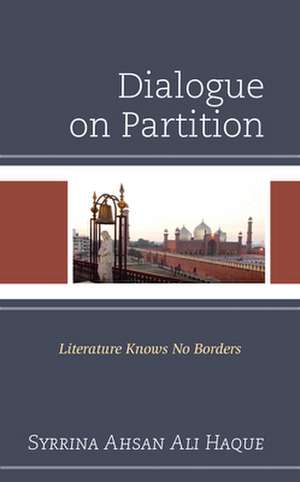
Dialogue on Partition: Literature Knows No Borders
Autor Syrrina Ahsan Ali Haqueen Limba Engleză Hardback – 4 mar 2021
Preț: 524.99 lei
Preț vechi: 815.82 lei
-36%
Puncte Express: 787
Carte tipărită la comandă
Livrare economică 07-21 decembrie
Livrare prin curier în România Termenul estimat este afișat lângă disponibilitate.
Transport gratuit pentru acest produs Plată online sau ramburs, în funcție de opțiunile comenzii.
Retur gratuit în 14 zile Comandă securizată și suport în română.
Specificații
ISBN-13: 9781793636249
ISBN-10: 1793636249
Pagini: 192
Dimensiuni: 146 x 232 x 18 mm
Greutate: 0.45 kg
Editura: Bloomsbury Publishing
Colecția Lexington Books
Locul publicării:New York, United States
ISBN-10: 1793636249
Pagini: 192
Dimensiuni: 146 x 232 x 18 mm
Greutate: 0.45 kg
Editura: Bloomsbury Publishing
Colecția Lexington Books
Locul publicării:New York, United States
Cuprins
Chapter I: Dialogization of Identities in Bapsi Sidhwa's Ice-Candy-Man
Chapter II: The Heteroglot World in Khushwant Singh's Train to Pakistan
Chapter III: Chronotopal Movement in Anita Desai's Clear Light of Day
Chapter IV: The Coexistence of Polyphonic Voices in Mehr Nigar Masroor's Shadows of Time
Chapter V: Creation of Dialogic Paradigms
Chapter II: The Heteroglot World in Khushwant Singh's Train to Pakistan
Chapter III: Chronotopal Movement in Anita Desai's Clear Light of Day
Chapter IV: The Coexistence of Polyphonic Voices in Mehr Nigar Masroor's Shadows of Time
Chapter V: Creation of Dialogic Paradigms
Recenzii
Dialogue on Partition utilizes compelling close readings, impressive historical and cultural contextualizations, and relevant literary and philosophical theories to make an innovative and significant case for approaching the literature of partition. A model of interdisciplinary public scholarship on a hugely salient topic!
Syrrina Haque's important book is a crucial step toward establishing a much-needed dialogue about the rights of minorities within and across the borders of South Asia. Haque's skillful use of Bakhtin's theory of dialogism to highlight the alternatives that partition novels provide to monological nationalist discourses is a must-read.
A dialogue that is indeed needed!
This book reads four novels to bring out their dialogic elements with the admirable purpose of showing how fiction can be an 'epistemological implement' that can imaginatively work across borders. Fictional treatments of the tragic violence attending Partition of greater India into India and Pakistan are selected from Parsi, Sikh, Hindu and Muslim authors to bring out the quest for points of community: love, song, language and the mystical traditions of religions. Suggestive insights such as the role of regionalism add to existing scholarship and the inclusion of Mehr Nigar Masroor's 'Shadows of Time' is a useful complement to commentary on 'Ice Candy Man', 'Train to Pakistan' and 'Clear Light of Day'.
This aptly titled book beautifully illustrates how a historical rupture like Partition can paradoxically lead to dialogue, a dialogue that not only recognizes the centrality of Partition to South Asian studies but also the importance of the literary chronicle to bearing witness.
Dr. Haque's study of four Indo-Pak novels provides a fascinating and fresh perspective on the tragedy of Partition through the lens of the Bakhtinian dialogic. Haque's book offers the timely suggestion that through the polyphonic interactions offered by these novels among the discourse communities impacted by Partition, national, religious, and ethnic boundaries may be revealed as permeable sites of hybridity.
The interest of Dialogue on Partition lies in its application of Bakhtinian heteroglossia to Partition novels such as Sidhwa's Ice-Candy-Man and Desai's Clear Light of Day. With nuance and insight, Haque characterizes the religious and cultural plurality in each text as a polyphonic and uniquely South Asian "confluence between distinct and diverse voices." This is a compelling reconsideration of the multi-vocal quality of both religion and language in classic Partition literature.
Syrrina Haque's important book is a crucial step toward establishing a much-needed dialogue about the rights of minorities within and across the borders of South Asia. Haque's skillful use of Bakhtin's theory of dialogism to highlight the alternatives that partition novels provide to monological nationalist discourses is a must-read.
A dialogue that is indeed needed!
This book reads four novels to bring out their dialogic elements with the admirable purpose of showing how fiction can be an 'epistemological implement' that can imaginatively work across borders. Fictional treatments of the tragic violence attending Partition of greater India into India and Pakistan are selected from Parsi, Sikh, Hindu and Muslim authors to bring out the quest for points of community: love, song, language and the mystical traditions of religions. Suggestive insights such as the role of regionalism add to existing scholarship and the inclusion of Mehr Nigar Masroor's 'Shadows of Time' is a useful complement to commentary on 'Ice Candy Man', 'Train to Pakistan' and 'Clear Light of Day'.
This aptly titled book beautifully illustrates how a historical rupture like Partition can paradoxically lead to dialogue, a dialogue that not only recognizes the centrality of Partition to South Asian studies but also the importance of the literary chronicle to bearing witness.
Dr. Haque's study of four Indo-Pak novels provides a fascinating and fresh perspective on the tragedy of Partition through the lens of the Bakhtinian dialogic. Haque's book offers the timely suggestion that through the polyphonic interactions offered by these novels among the discourse communities impacted by Partition, national, religious, and ethnic boundaries may be revealed as permeable sites of hybridity.
The interest of Dialogue on Partition lies in its application of Bakhtinian heteroglossia to Partition novels such as Sidhwa's Ice-Candy-Man and Desai's Clear Light of Day. With nuance and insight, Haque characterizes the religious and cultural plurality in each text as a polyphonic and uniquely South Asian "confluence between distinct and diverse voices." This is a compelling reconsideration of the multi-vocal quality of both religion and language in classic Partition literature.