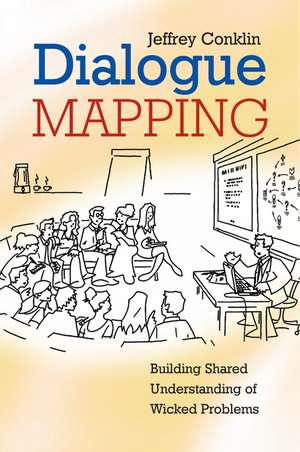
Dialogue Mapping - Building Shared Understanding of Wicked Problems
Autor Jeffrey Conklinen Limba Engleză Paperback – 17 ian 2006
Preț: 410.51 lei
Preț vechi: 506.80 lei
-19%
Carte disponibilă
Livrare economică 02-16 noiembrie
Livrare express 16-22 octombrie pentru 32.16 lei
Specificații
ISBN-10: 0470017686
Pagini: 272
Ilustrații: black & white illustrations
Dimensiuni: 152 x 229 x 16 mm
Greutate: 0.44 kg
Ediția:New.
Editura: John Wiley & Sons, Inc.
Locul publicării:Chichester, United Kingdom
V-ar putea interesa
-
 Color Atlas of High Resolution ManometryJeffrey Conklin-5%Preț: 1067.27 lei1123.43 lei
 -
 Managing Technology-Based ProjectsHans J Thamhain-23%Preț: 752.27 lei976.98 lei
 -
 Strategic Project Portfolio ManagementSimon MoorePreț: 265.50 lei
 -
 Value OptimizationRobert B StewartPreț: 377.07 lei
 -
 Building Better Arts Facilities: Lessons from a U.S. National StudyJoanna Woronkowicz-15%Preț: 455.18 lei535.51 lei
 -
 International Project ManagementBennet Lientz-18%Preț: 1112.48 lei1356.68 lei
 -
 -18%Preț: 1109.31 lei1352.81 lei
 -
 Project Management, Denial, and the Death ZoneGrant AveryPreț: 418.46 lei
 -
 Preț: 112.07 lei
 -
 Preț: 64.96 lei
 -
 The Agile EdgeBrian VanderjackPreț: 105.98 lei
 -
 -19%Preț: 503.06 lei621.07 lei
 -
 -19%Preț: 569.92 lei703.61 lei
Public țintă
People who run projects, managers, project leaders, executives, consultants and facilitators also postgraduate (MBA and MSc) students taking courses in problem structuring methods and project managementDescriere
In contrast to the use of agendas and restrictive structures, dialogue mapping is a facilitation technique that allows the intelligence and learning of the group to emerge naturally. Each participant can see how their comments contribute (or don't) to the coherence and order of the group's thinking.
Dialogue Mapping presents a powerful new approach to meetings and collaboration, in which collective intelligence is achieved through framing powerful questions and conducting a comprehensive and creative exploration of their possible answers.
In the first part of Dialogue Mapping, Jeff Conklin introduces the key concepts:
•Wicked problems: you must come up with solutions in order to understand what the problem really is . . . what the real issues are . . . and the problem definition depends on whom you ask!
•Social complexity: the number and diversity of stakeholders whose participation is essential.
•Opportunity-driven problem solving: empirical evidence says creative thinking does not follow a linear process!
•Shared understanding: overcoming fragmentation requires forging shared understanding about all aspects of the problem-solution space.
The remaining sections provide a hands-on tutorial for practitioners.
Cuprins
Acknowledgements xxi
Part I 1
Chapter 1 Wicked Problems and Social Complexity 3
Chapter 2 Building Shared Understanding 41
Chapter 3 The Dialogue Mapping Experience 67
Part II 85
Chapter 4 IBIS: A Tool for All Reasons 87
Chapter 5 The Dialogue Mapping Listening Cycle 123
Part III 147
Chapter 6 Question Types 149
Chapter 7 Three Moves of Discourse 167
Chapter 8 Limits of Dialogue Mapping 185
Chapter 9 Decisions, Decisions 203
Appendix 227
References 229
Index 233