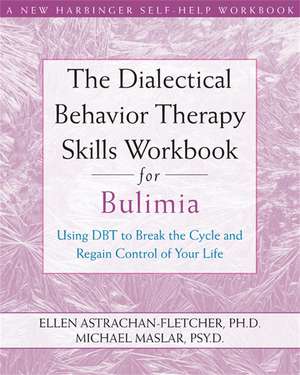
Dialectical Behavior Therapy Workbook for Bulimia: Using DBT to Break the Cycle and Regain Control of Your Life
Autor Ellen Astrachan-Fletcheren Limba Engleză Paperback – 5 aug 2009
In this powerful program used by therapists, you'll learn four key skill sets-mindfulness, distress tolerance, emotion regulation, and interpersonal effectiveness-and begin using them right away to manage bulimic urges. The book includes worksheets and exercises designed to help you take charge of your emotions and end your dependence on bulimia. You'll also learn how to stay motivated and committed to ending bulimia instead of reverting to old behaviors. Used together, the skills presented in this workbook will help you begin to cope with uncomfortable feelings in healthy ways, empower you to feel good about nourishing your body, and finally gain true control over your life.
Preț: 131.19 lei
Preț vechi: 189.40 lei
-31%
Puncte Express: 197
Carte disponibilă
Livrare economică 07-21 noiembrie
Livrare express 27-31 octombrie pentru 89.37 lei
Livrare prin curier în România Termenul estimat este afișat lângă disponibilitate.
Transport gratuit de la 400.00 lei Plată online sau ramburs, în funcție de opțiunile comenzii.
Retur gratuit în 14 zile Comandă securizată și suport în română.
Specificații
ISBN-13: 9781572246195
ISBN-10: 1572246197
Pagini: 208
Dimensiuni: 205 x 254 x 12 mm
Greutate: 0.42 kg
Editura: Little Brown
Colecția New Harbinger
Locul publicării:London, United Kingdom
ISBN-10: 1572246197
Pagini: 208
Dimensiuni: 205 x 254 x 12 mm
Greutate: 0.42 kg
Editura: Little Brown
Colecția New Harbinger
Locul publicării:London, United Kingdom
V-ar putea interesa
-
 Preț: 100.77 lei
 -
 It's Not about FoodCarol Emery NormandiPreț: 133.51 lei
 -
 Eating Disorders – The Path to RecoveryKate MiddletonPreț: 63.57 lei
 -
 Unbearable Lightness: A Story of Loss and GainPortia de Rossi-34%Preț: 47.15 lei71.05 lei
 -
 Anorexia and Bulimia Recovery WorkbookJoshua B. SethPreț: 77.86 lei
 -
 Big Bottom BluesLucie B. LindnerPreț: 62.85 lei
 -
 Preț: 155.74 lei
 -
 50 Ways to Soothe Yourself Without FoodSusan, Psy.D. AlbersPreț: 96.27 lei
 -
 -28%Preț: 100.78 lei139.03 lei
 -
 End Emotional Eating: Using Dialectical Behaviour Skills to Comfort Yourself without FoodJennifer L. Taitz, PsyD, ABPP-32%Preț: 104.93 lei153.48 lei
 -
 -30%Preț: 92.83 lei132.76 lei
 -
 -28%Preț: 55.12 lei76.77 lei
Recenzii
This self-help workbook is an excellent tool to help alleviate bulimia nervosa symptoms. It is also a useful guide for the practitioner who is assisting the patient in his or her quest to overcome an eating disorder. I highly recommend this workbook to sufferers and mental health professionals alike.
DBT has taught me how to meditate more effectively throughout the day, regulate my emotions, and tolerate the most uncomfortable and painful of times. I never knew how to ride the rollercoaster of life without resorting to bingeing until DBT helped to change my behavior and my life. Because DBT centers on mindfulness—being in the present moment—and having both acceptance of my condition as well as the willingness to change, I can now show up for my life without resorting to bingeing or other crutches. DBT has changed my life, and I have faith that it can change yours!
At my first dialectical behavior therapy (DBT) skills training session, I found it easier to speak without using vowels than to speak without judgment. I was skeptical, but desperate to have a life without my eating disorder, and once desperation won the battle over skepticism, I was in. Once I was able to chip away at the judgment, I began to think it might be possible there was a way to deal with distress that didn't involve binge-purging. Before DBT, my emotions were something that required treatment. Happy, sad, angry, or glad, if I felt something, bulimia was right there to take me back to a state of numbness. Being able to radically and mindfully accept, without judgment, that I could actually experience an emotion and not have it end with a binge was a fascinating revelation. I still fight with bulimia, but I am armed with the tools of DBT and it's now a battle I have a chance of winning.
DBT has taught me how to meditate more effectively throughout the day, regulate my emotions, and tolerate the most uncomfortable and painful of times. I never knew how to ride the rollercoaster of life without resorting to bingeing until DBT helped to change my behavior and my life. Because DBT centers on mindfulness—being in the present moment—and having both acceptance of my condition as well as the willingness to change, I can now show up for my life without resorting to bingeing or other crutches. DBT has changed my life, and I have faith that it can change yours!
At my first dialectical behavior therapy (DBT) skills training session, I found it easier to speak without using vowels than to speak without judgment. I was skeptical, but desperate to have a life without my eating disorder, and once desperation won the battle over skepticism, I was in. Once I was able to chip away at the judgment, I began to think it might be possible there was a way to deal with distress that didn't involve binge-purging. Before DBT, my emotions were something that required treatment. Happy, sad, angry, or glad, if I felt something, bulimia was right there to take me back to a state of numbness. Being able to radically and mindfully accept, without judgment, that I could actually experience an emotion and not have it end with a binge was a fascinating revelation. I still fight with bulimia, but I am armed with the tools of DBT and it's now a battle I have a chance of winning.