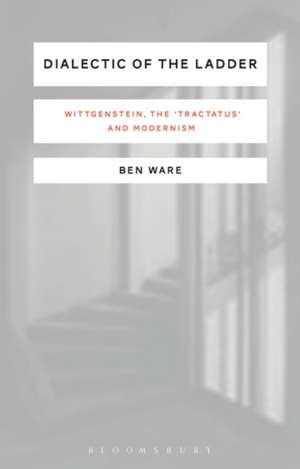
Dialectic of the Ladder: Wittgenstein, the 'Tractatus' and Modernism
Autor Ben Wareen Limba Engleză Paperback – 20 apr 2017
By placing the Tractatus in the force field of modernism, Dialectic of the Ladder clears the ground for a new and challenging exploration of the work's ethical dimension. It also casts new light upon the cultural, aesthetic and political significances of Wittgenstein's writing, revealing hitherto unacknowledged affinities with a host of philosophical and literary authors, including Hegel, Kierkegaard, Marx, Nietzsche, Adorno, Benjamin, and Kafka.
Preț: 276.10 lei
Preț vechi: 377.94 lei
-27%
Puncte Express: 414
Carte tipărită la comandă
Livrare economică 23 noiembrie-07 decembrie
Livrare prin curier în România Termenul estimat este afișat lângă disponibilitate.
Transport gratuit de la 400.00 lei Plată online sau ramburs, în funcție de opțiunile comenzii.
Retur gratuit în 14 zile Comandă securizată și suport în română.
Specificații
ISBN-13: 9781350050921
ISBN-10: 135005092X
Pagini: 240
Dimensiuni: 134 x 214 x 14 mm
Greutate: 0.27 kg
Ediția:NIPPOD
Editura: Bloomsbury Publishing
Colecția Bloomsbury Academic
Locul publicării:London, United Kingdom
ISBN-10: 135005092X
Pagini: 240
Dimensiuni: 134 x 214 x 14 mm
Greutate: 0.27 kg
Ediția:NIPPOD
Editura: Bloomsbury Publishing
Colecția Bloomsbury Academic
Locul publicării:London, United Kingdom
V-ar putea interesa
-
 Collected PapersGareth Evans-28%Preț: 349.25 lei484.26 lei
 -
 Sensory QualitiesAusten Clark-28%Preț: 358.77 lei500.70 lei
 -
 Introduction to Medieval LogicAlexander Broadie-31%Preț: 739.37 lei1075.52 lei
 -
 Realism in MathematicsPenelope Maddy-28%Preț: 350.87 lei490.64 lei
 -
 -29%Preț: 515.33 lei722.75 lei
 -
 -19%Preț: 363.54 lei451.57 lei
 -
 -38%Preț: 814.85 lei1303.96 lei
 -
 Intermediate LogicDavid Bostock-28%Preț: 408.91 lei568.08 lei
 -
 Putting Logic in its Place: Formal Constraints on Rational BeliefDavid Christensen-18%Preț: 367.40 lei447.35 lei
 -
 A Philosophical Guide to ConditionalsJonathan Bennett-28%Preț: 356.64 lei494.02 lei
 -
 The Philosophy of Mathematics TodayMatthias Schirn-27%Preț: 416.82 lei572.70 lei
 -
 -29%Preț: 402.66 lei564.42 lei
 -
 Truth, Thought, Reason: Essays on FregeTyler Burge-21%Preț: 370.94 lei467.80 lei
 -
 Pragmatic TurnRichard J BernsteinPreț: 189.78 lei
 -
 Logic: Key Concepts in PhilosophyLaurence Goldstein-17%Preț: 180.86 lei217.16 lei
 -
 The Bloomsbury Companion to Philosophical LogicProfessor Leon Horsten-22%Preț: 272.05 lei350.25 lei
 -
 The Bloomsbury Companion to LeibnizBrandon C. Look-20%Preț: 274.55 lei342.57 lei
 -
 The Bloomsbury Companion to the Philosophy of ScienceSteven French-16%Preț: 280.00 lei334.45 lei
 -
 How to Win Every Argument: The Use and Abuse of LogicDr Madsen Pirie-36%Preț: 112.38 lei174.71 lei
 -
 Origins of Analytical PhilosophyMichael Dummett-22%Preț: 137.58 lei176.76 lei
Cuprins
Acknowledgements
Abbreviations
Preface
1 Modernity-Modernism-Avant-Garde
2 Ethics and the Literary in Wittgenstein's Tractatus
3 Modernity, Culture and the Question of Politics
4 The Tractatus, Modernism and the Limits of Language
5 Towards a Literary Use of Wittgenstein: The Tractatus
and Kafka's 'Der Bau'
Notes
References
Index
Abbreviations
Preface
1 Modernity-Modernism-Avant-Garde
2 Ethics and the Literary in Wittgenstein's Tractatus
3 Modernity, Culture and the Question of Politics
4 The Tractatus, Modernism and the Limits of Language
5 Towards a Literary Use of Wittgenstein: The Tractatus
and Kafka's 'Der Bau'
Notes
References
Index
Recenzii
Given the fierce complexity of Wittgenstein's thought, Ware is to be praised for the clear exposition of his philosophy and for the many helpful suggestions he proffers for how the philosopher's ideas might be relevant to those studying modernism.
Overall, Benjamin Ware's dialectical reading of the Tractacus is a very stimulating and successful attempt to interpret the literature. I hope to read more from him!
[Ware] broadens the context of existing discussions of the early Wittgenstein's relation to modernist critiques of culture in a very helpful way ... Anyone interested in the text will benefit from engaging with this stimulating work.
Ben Ware's superb study does not only offer a lucid and original reading of Wittgenstein's Tractatus; it also situate it with admirable skill in the context of literary modernism and in doing so casts radical new light on this notoriously difficult philosophical text.
Ben Ware writes a refreshing, opinionated book about Tractatus, in which Ezra Pound, Ludwig Uhland, Oswald Spengler, Thomas Mann and Julien Benda get a non-obvious place in a reading of Wittgenstein. (Bloomsbury translation)
Departing from Wittgenstein's claim that the Tractatus is 'strictly philosophical and at the same time literary' Ben Ware succeeds in showing not only how it works as a contribution to literary modernism but also how this is inseparable from its philosophical achievement. He restores the strangeness to a text that we thought had become familiar and places it in the company of Kierkegaard, Nietzsche, Hofmannsthal and Kafka. It is sure to send readers back to the Tractatus with renewed wonder and curiosity.
Ludwig Wittgenstein notoriously wrote to Bertrand Russell that nobody would ever understand his Tractatus Logico-Philosophicus; for students of modernism and the avant-gardes this is no longer true, thanks to Ben Ware's exciting new study. With a majestic authorial voice Ware leads his readers to appreciate Wittgenstein's short text as a vital part of modern literary history. In a challenging reading of Kafka, Ware further shows how Wittgenstein's book carries within itself a singular way of reading and experiencing literature, as well as oneself. There is little more one can expect from a scholar's work. A formidable achievement.
Overall, Benjamin Ware's dialectical reading of the Tractacus is a very stimulating and successful attempt to interpret the literature. I hope to read more from him!
[Ware] broadens the context of existing discussions of the early Wittgenstein's relation to modernist critiques of culture in a very helpful way ... Anyone interested in the text will benefit from engaging with this stimulating work.
Ben Ware's superb study does not only offer a lucid and original reading of Wittgenstein's Tractatus; it also situate it with admirable skill in the context of literary modernism and in doing so casts radical new light on this notoriously difficult philosophical text.
Ben Ware writes a refreshing, opinionated book about Tractatus, in which Ezra Pound, Ludwig Uhland, Oswald Spengler, Thomas Mann and Julien Benda get a non-obvious place in a reading of Wittgenstein. (Bloomsbury translation)
Departing from Wittgenstein's claim that the Tractatus is 'strictly philosophical and at the same time literary' Ben Ware succeeds in showing not only how it works as a contribution to literary modernism but also how this is inseparable from its philosophical achievement. He restores the strangeness to a text that we thought had become familiar and places it in the company of Kierkegaard, Nietzsche, Hofmannsthal and Kafka. It is sure to send readers back to the Tractatus with renewed wonder and curiosity.
Ludwig Wittgenstein notoriously wrote to Bertrand Russell that nobody would ever understand his Tractatus Logico-Philosophicus; for students of modernism and the avant-gardes this is no longer true, thanks to Ben Ware's exciting new study. With a majestic authorial voice Ware leads his readers to appreciate Wittgenstein's short text as a vital part of modern literary history. In a challenging reading of Kafka, Ware further shows how Wittgenstein's book carries within itself a singular way of reading and experiencing literature, as well as oneself. There is little more one can expect from a scholar's work. A formidable achievement.