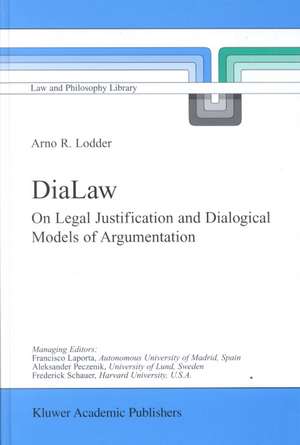
DiaLaw: Law and Philosophy Library, cartea 42
Autor A. R. Lodderen Limba Engleză Hardback – 31 iul 1999
Din seria Law and Philosophy Library
- 24%
 Preț: 791.25 lei
 - 18%
 Preț: 1263.20 lei
 - 18%
 Preț: 907.10 lei
 - 18%
 Preț: 978.99 lei
 - 15%
 Preț: 665.66 lei
 - 15%
 Preț: 663.90 lei
 - 18%
 Preț: 925.84 lei
 - 9%
 Preț: 855.61 lei
 - 15%
 Preț: 557.51 lei
 - 15%
 Preț: 667.86 lei
 - 18%
 Preț: 927.97 lei
 - 15%
 Preț: 669.16 lei
 - 47%
 Preț: 591.35 lei
 - 15%
 Preț: 664.57 lei
 - 18%
 Preț: 1269.74 lei
 - 18%
 Preț: 1269.91 lei
 - 15%
 Preț: 679.92 lei
 - 18%
 Preț: 919.85 lei
 - 18%
 Preț: 930.70 lei
 - 18%
 Preț: 1054.24 lei
 -
 Preț: 403.27 lei
 - 24%
 Preț: 852.10 lei
 - 18%
 Preț: 1035.41 lei
 - 18%
 Preț: 1151.64 lei
 - 18%
 Preț: 1147.53 lei
 - 15%
 Preț: 612.85 lei
 - 18%
 Preț: 809.70 lei
 - 24%
 Preț: 925.96 lei
 - 18%
 Preț: 814.35 lei
 - 18%
 Preț: 761.69 lei
 - 15%
 Preț: 676.83 lei
 - 18%
 Preț: 809.70 lei
 - 18%
 Preț: 923.53 lei
Preț: 975.61 lei
Preț vechi: 1189.76 lei
-18%
Puncte Express: 1463
Carte tipărită la comandă
Livrare economică 05-19 decembrie
Livrare prin curier în România Termenul estimat este afișat lângă disponibilitate.
Transport gratuit pentru acest produs Plată online sau ramburs, în funcție de opțiunile comenzii.
Retur gratuit în 14 zile Comandă securizată și suport în română.
Specificații
ISBN-13: 9780792358305
ISBN-10: 0792358309
Pagini: 216
Ilustrații: XII, 198 p.
Dimensiuni: 160 x 241 x 16 mm
Greutate: 0.44 kg
Ediția:1999
Editura: Springer
Colecția Law and Philosophy Library
Seria Law and Philosophy Library
Locul publicării:Dordrecht, Netherlands
ISBN-10: 0792358309
Pagini: 216
Ilustrații: XII, 198 p.
Dimensiuni: 160 x 241 x 16 mm
Greutate: 0.44 kg
Ediția:1999
Editura: Springer
Colecția Law and Philosophy Library
Seria Law and Philosophy Library
Locul publicării:Dordrecht, Netherlands
V-ar putea interesa
-
 International Law's ObjectsJessie Hohmann-31%Preț: 1140.03 lei1644.51 lei
 -
 -30%Preț: 541.44 lei776.51 lei
 -
 -18%Preț: 363.54 lei440.96 lei
 -
 Imposing Risk: A Normative FrameworkJohn Oberdiek-30%Preț: 557.84 lei802.63 lei
 -
 The Structure of PluralismVictor M. Muniz-Fraticelli-30%Preț: 734.38 lei1049.05 lei
 -
 Reflections on 'The Concept of Law'A. W. Brian Simpson-30%Preț: 576.36 lei822.07 lei
 -
 New Essays on the Nature of RightsDr Mark McBride-32%Preț: 633.62 lei927.63 lei
 -
 -36%Preț: 612.05 lei960.59 lei
 -
 Law's JudgementProfessor William Lucy-32%Preț: 634.08 lei927.92 lei
 -
 Legal Validity: The Fabric of JusticeMaris Köpcke-29%Preț: 553.17 lei782.16 lei
 -
 -18%Preț: 947.53 lei1155.52 lei
 -
 Essays on the Doctrinal Study of LawAulis Aarnio-15%Preț: 558.76 lei657.36 lei
 -
 -18%Preț: 908.45 lei1107.86 lei
 -
 Coherence: Insights from Philosophy, Jurisprudence and Artificial IntelligenceMicha¿ Araszkiewicz-15%Preț: 669.16 lei787.26 lei
 -
 Essays in Legal and Moral PhilosophyOta Weinberger-20%Preț: 631.46 lei789.32 lei
 -
 Preț: 370.46 lei
 -
 -15%Preț: 612.85 lei721.00 lei
 -
 Global Perspectives on SubsidiarityMichelle Evans-15%Preț: 666.56 lei784.18 lei
 -
 The History of Chinese Legal CivilizationJinfan Zhang-18%Preț: 1017.85 lei1241.28 lei
Public țintă
ResearchCuprins
1 Introduction.- 1. Artificial Intelligence and Law.- 2. Legal justification.- 3. Outline of the book.- 2 From law to DiaLaw Why legal justification should be modeled dialogically.- 1. The product and the process of justification.- 2. Justification as a product.- 3. The defeasible nature of legal justification.- 4. The open nature of law.- 5. The Münchhausen Trilemma.- 6. Justification as a process: a dialogical model.- 7. Dealing with defeasibility, open nature, and the Münchhausen Trilemma in a dialogical model.- 8. Justification of dialog rules and altering protocols.- 9. How pure is the procedure of legal justification?.- 10. Conclusion.- 3 DiaLaw Framework and general rules.- 1. Justification in DiaLaw.- 2. Basic concepts of DiaLaw.- 3. DiaLaw’s dialogical framework.- 4. General rules for communication.- 5. Towards legal justification.- 4 DiaLaw Special rules for communication.- 1. Special language elements.- 2. Special rules for communication - legal tools and forced commitment.- 3. Concluding remarks.- 5 DiaLaw in action.- 1. The Tyrell case.- 2. The Chabot case.- 3. Concluding remarks.- 6 Dialogical models of argumentation.- 1. The purpose of models.- 2. A short sample dialog.- 3. Mackenzie’s DC and Hamblin’s H.- 4. Rescher’s Dialectics and the formal elaboration by Brewka.- 5. Gordon’s Pleadings Game.- 6. Survey of moves and commitment.- 7. Other related research.- 8. Conclusion.- 7 What is an argument? Properties of procedural models of argumentation.- 1. Argumentation: two perspectives.- 2. Argumentation: two types.- 3. Towards combining the approaches.- 4. DiaLaw: rational and dia-rational argumentation.- 5. Procedural and structural arguments.- 6. Layers in models of legal argumentation.- 7. Conclusion.- 8 In conclusion.- 1. On legaljustification.- 2. The answers.- 3. The future: towards natural dialog models.- 4. Closing remarks.- Appendix- Prolog code of DiaLaw.- References.- Index of names.- Index of subjects.
Recenzii
`... merit of Lodder's book rather lies on the terrain of clarity of exposition and completeness... By its sober language and transparent but otherwise complete exposition I recommend the use...in graduate courses on AI & Law and legal argumentation.'
Artificial Intelligence and Law, 8 (2000)
Artificial Intelligence and Law, 8 (2000)