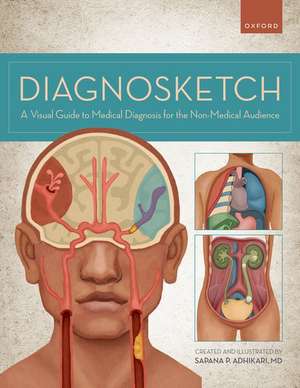
Diagnosketch: A Visual Guide to Medical Diagnosis for the Non-Medical Audience
Autor Sapana Adhikarien Limba Engleză Spirală – 22 dec 2022
Preț: 221.37 lei
Preț vechi: 311.74 lei
-29%
Puncte Express: 332
Carte disponibilă
Livrare economică 23-28 octombrie
Livrare prin curier în România Termenul estimat este afișat lângă disponibilitate.
Transport gratuit de la 400.00 lei Plată online sau ramburs, în funcție de opțiunile comenzii.
Retur gratuit în 14 zile Comandă securizată și suport în română.
Specificații
ISBN-13: 9780197636954
ISBN-10: 0197636950
Pagini: 152
Ilustrații: 100 color illustrations
Dimensiuni: 275 x 226 x 11 mm
Greutate: 0.57 kg
Editura: Oxford University Press
Colecția OUP USA
Locul publicării:New York, United States
ISBN-10: 0197636950
Pagini: 152
Ilustrații: 100 color illustrations
Dimensiuni: 275 x 226 x 11 mm
Greutate: 0.57 kg
Editura: Oxford University Press
Colecția OUP USA
Locul publicării:New York, United States
Recenzii
I use Diagnosketch on every shift, every day. We find this the single most useful and efficient tool at the bedside to help patients understand what is happening to their bodies.
As a nurse who spends a fair amount of time educating patients and their families, this book is a brilliant idea! It allows me the opportunity to impact patients' understanding of their disease, and is an excellent resource in triage.
This book is equally as useful to patients as it is to doctors. The illustrations cover the most common diagnoses in the ED and reflect the diversity of patients we see every day. Everyone will find themselves represented here.
I love this book, there are so many great visuals for the bread and butter of what we see and explain all of the time. What a great resource!
Not only does Diagnosketch help patients understand their anatomy, it also gives physicians, nurses, PAs, and others the opportunity to maximize the use of the very small amount of time they have with their patients. With this book at the bedside, we can be more efficient and patients leave with a better understanding of their ED visit.
Physicians are expected to provide excellent medical care, but it is equally important for them to explain diagnoses and treatments in a manner that gives the non-medical both understanding and reassurance. Diagnosketch uses simple illustrations and text to bridge the communication gap between physician and patient so that even complex issues can be comprehended at the bedside. This will prove to be an essential tool for every emergency department.
This book is an extremely helpful tool for real-time patient education, there is really nothing available that is comparable to Diagnosketch. It is the best resource for concise and easy-to-understand explanations for patients of their diagnoses, while still maintaining medical accuracy and an appropriate level of detail. It helps me get through to my patients and makes bedside education much smoother and more meaningful.
I could really have used these illustrations to explain to my patient with an ovarian cyst what was going on! She was in the hospital with her dad and the doctor here was a man. I had to give the poor girl a crash course in A&P, menstruation, and explain what was going on without scaring her to death. My artwork is subpar at best, I really wish I had this book!
I use Diagnosketch not only with my patients at work but also to explain my job to my children at home. It's a fantastic teaching tool!
This book is amazing! The simplicity of it, with the wonderful illustrations, makes this an awesome teaching tool for our patients. I can't wait to share this with my team.
I work in a rural outpatient clinic setting and make rough drawings on my own all day for patients on the paper covering the tables or the back of glove boxes. I really enjoy this book; patients find the pictures easy-to-understand and I like how clear they are.
This book replaces the need to pull up Google at the bedside to search for images. All common diagnoses are compiled and easy-to-understand!
Diagnosketch takes the nebulous and sometimes frightening terms we use in medicine and paints a clear picture for the patient, helping to remove the anxiety of not understanding what a diagnosis means. The illustrations are universally applicable, transcend different languages and cultures, and demystify the human body and its most common maladies.
As a nurse who spends a fair amount of time educating patients and their families, this book is a brilliant idea! It allows me the opportunity to impact patients' understanding of their disease, and is an excellent resource in triage.
This book is equally as useful to patients as it is to doctors. The illustrations cover the most common diagnoses in the ED and reflect the diversity of patients we see every day. Everyone will find themselves represented here.
I love this book, there are so many great visuals for the bread and butter of what we see and explain all of the time. What a great resource!
Not only does Diagnosketch help patients understand their anatomy, it also gives physicians, nurses, PAs, and others the opportunity to maximize the use of the very small amount of time they have with their patients. With this book at the bedside, we can be more efficient and patients leave with a better understanding of their ED visit.
Physicians are expected to provide excellent medical care, but it is equally important for them to explain diagnoses and treatments in a manner that gives the non-medical both understanding and reassurance. Diagnosketch uses simple illustrations and text to bridge the communication gap between physician and patient so that even complex issues can be comprehended at the bedside. This will prove to be an essential tool for every emergency department.
This book is an extremely helpful tool for real-time patient education, there is really nothing available that is comparable to Diagnosketch. It is the best resource for concise and easy-to-understand explanations for patients of their diagnoses, while still maintaining medical accuracy and an appropriate level of detail. It helps me get through to my patients and makes bedside education much smoother and more meaningful.
I could really have used these illustrations to explain to my patient with an ovarian cyst what was going on! She was in the hospital with her dad and the doctor here was a man. I had to give the poor girl a crash course in A&P, menstruation, and explain what was going on without scaring her to death. My artwork is subpar at best, I really wish I had this book!
I use Diagnosketch not only with my patients at work but also to explain my job to my children at home. It's a fantastic teaching tool!
This book is amazing! The simplicity of it, with the wonderful illustrations, makes this an awesome teaching tool for our patients. I can't wait to share this with my team.
I work in a rural outpatient clinic setting and make rough drawings on my own all day for patients on the paper covering the tables or the back of glove boxes. I really enjoy this book; patients find the pictures easy-to-understand and I like how clear they are.
This book replaces the need to pull up Google at the bedside to search for images. All common diagnoses are compiled and easy-to-understand!
Diagnosketch takes the nebulous and sometimes frightening terms we use in medicine and paints a clear picture for the patient, helping to remove the anxiety of not understanding what a diagnosis means. The illustrations are universally applicable, transcend different languages and cultures, and demystify the human body and its most common maladies.
Notă biografică
Sapana Adhikari is a board-certified Emergency Medicine physician. She attended the Boston University School of Medicine and completed her residency at Boston Medical Center. Throughout her 20 year career, she has practiced clinically in various settings ranging from inner-city trauma centers to rural hospitals in the developing world. She is involved with international health and runs a non-profit organization, smartketi, that focuses on women empowerment in rural Nepal. She is an accomplished artist whose work has been featured in The National Academy of Medicine, Intima: The Journal of Narrative Medicine and the Frederic Jameson Gallery at Duke University. She lives in Charlotte, NC with her husband and three children.
Cuprins
- Table of Contents
- Introduction
- About the Author/Illustrator
- Scripting
- Chapter 1: Skin
- Blood draw
- Intravenous insertion
- Laceration
- Options for repair
- Abscess
- Methicillin Resistant Staphylococcus Aureus
- Paronychia
- Subungual hematoma
- Superficial thrombophlebitis
- Airway anatomy
- Chapter 2: EENT (Eye, ear, nose, throat)
- Corneal abrasion and conjunctivitis
- Dental caries vs dental abscess
- Epistaxis
- Sinusitis
- Otitis media
- Otitis externa
- Strep pharyngitis and peritonsillar abscess (PTA)
- Chapter 3: Cardiopulmonary
- Bronchitis vs pneumonia
- Chronic obstructive pulmonary disease (COPD)
- Deep vein thrombosis (DVT) and pulmonary embolism (PE)
- Pedal edema
- Myocardial infarction (MI)
- Chest pain evaluation
- Atrial fibrillation
- Pericarditis vs pericardial effusion
- Congestive heart failure (CHF)
- Diastolic vs systolic disease
- Hypertension (HTN)
- Hypertensive urgency
- Aortic dissection
- Aortic aneurysm
- Peripheral artery disease and venous insufficiency
- Chapter 4: Gastrointestinal
- Digestion
- Abdominal pain
- Gastroesophageal reflux disease (GERD)
- Gastritis and ulcer
- Upper gastrointestinal bleed (UGIB)
- Lower gastrointestinal bleed (LGIB)
- Hiatal hernia
- Hernia: Normal vs incarcerated
- Esophageal stricture
- Small bowel obstruction (SBO)
- Biliary colic
- Pancreatitis
- Diverticulosis, diverticulitis and perforation
- Constipation
- Perirectal abscess
- Hemorrhoids
- Appendicitis
- Chapter 5: Genitourinary
- Nephrolithiasis
- Cystitis vs pyelonephritis
- Benign prostatic hypertrophy (BPH)
- Urinary retention
- Epididymitis
- Hydrocele vs varicocele
- Testicular torsion
- Ovarian torsion
- Ovarian cyst: Normal cyst vs ruptured cyst
- Early pregnancy: Abdominal pain and/or vaginal bleeding
- Leiomyoma
- Abnormal uterine bleeding
- Vaginal candidiasis
- Bacterial vaginosis
- Pelvic inflammatory disease (PID) and tubo-ovarian abscess (TOA)
- Sexually transmitted infection
- Lower abdomen: Male vs female
- Chapter 6: Orthopedics
- Fracture
- Growth-plate injury
- Degenerative joint disease
- Bursitis
- Rib fracture
- Pneumothorax
- Back pain: Musculoskeletal
- Sacroilitis
- Back pain: Side view
- Lumbar radiculopathy
- Cervical strain
- Motor vehicle accident (MVA)
- Osteoarthritis
- Knee pain: Fracture vs sprain
- Joint disease: Normal anatomy
- Gout vs septic joint
- Baker's cyst
- Ankle pain: Fracture vs sprain
- Carpal tunnel syndrome
- Plantar fasciitis
- Compression fracture
- Chapter 7: Neurology
- Cerebral vascular accident (CVA)
- Transient ischemic attack (TIA)
- Intracranial hemorrhage (ICH)
- Subarachnoid hemorrhage (SAH)
- Meningitis
- Benign positional vertigo (BPV)
- 7th cranial nerve palsy
- Closed head injury
- Chapter 8: Miscellaneous
- Cancer: Diagnosis and work-up
- Diabetes mellitus type 2
- Fever control or pain control
- Bacteria vs virus
- Code status