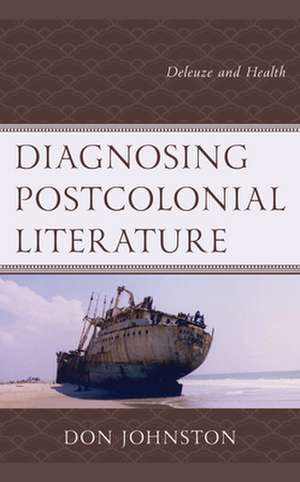
Diagnosing Postcolonial Literature: Deleuze and Health
Autor Don Johnstonen Limba Engleză Hardback – 11 feb 2021
Preț: 550.96 lei
Preț vechi: 816.23 lei
-32%
Puncte Express: 826
Carte tipărită la comandă
Livrare economică 07-21 decembrie
Livrare prin curier în România Termenul estimat este afișat lângă disponibilitate.
Transport gratuit pentru acest produs Plată online sau ramburs, în funcție de opțiunile comenzii.
Retur gratuit în 14 zile Comandă securizată și suport în română.
Specificații
ISBN-13: 9781793631329
ISBN-10: 1793631328
Pagini: 252
Ilustrații: 3 b/w illustrations; 3 tables;
Dimensiuni: 160 x 242 x 20 mm
Greutate: 0.49 kg
Editura: Bloomsbury Publishing
Colecția Lexington Books
Locul publicării:New York, United States
ISBN-10: 1793631328
Pagini: 252
Ilustrații: 3 b/w illustrations; 3 tables;
Dimensiuni: 160 x 242 x 20 mm
Greutate: 0.49 kg
Editura: Bloomsbury Publishing
Colecția Lexington Books
Locul publicării:New York, United States
Cuprins
Chapter 1: Postcolonial Theory's Heedlessness to Health, "D"evelopment's Disregard for Postcolonialism
Chapter 2: Elaborating a Postcolonial Symptomatology
Chapter 3: Those Excluded by the City: Pepetela and Angola's "Savage Capitalism"
Chapter 4: Becoming-witness: the Conflagration of the Arab Community and the Sudanese Arab writer, Tayeb Salih
Chapter 5: Conclusion
Appendix
Chapter 2: Elaborating a Postcolonial Symptomatology
Chapter 3: Those Excluded by the City: Pepetela and Angola's "Savage Capitalism"
Chapter 4: Becoming-witness: the Conflagration of the Arab Community and the Sudanese Arab writer, Tayeb Salih
Chapter 5: Conclusion
Appendix
Recenzii
Diagnosing Postcolonial Literature is an exceptional interdisciplinary achievement. Taking seriously Deleuze's claims that 'the world is the set of symptoms whose illness emerges with man' and that literature 'appears as an enterprise in health', Don Johnston draws from his extensive experience in humanitarian praxis to advance a 'symptomatological' approach to reading postcolonial literature. This highly original book investigates how the cultural exercise of producing and consuming literature can stoke a transformative energy for postcolonial politics by revealing the material conditions that render life vulnerable. Sensitive to contemporary legacies of colonial relations of force that impinge upon a body's generative vitality at the points of material attachment that define experiences of embodiment and embeddedness, Johnston presents a rubric for evaluating syndromes of social malaise described in exemplary works of postcolonial fiction from Angola and Sudan. Conceived as imaginative aids for discerning the affective capabilities of human bodies in the full potential of health and in contexts of real-world conditions of diminishment, works of postcolonial literature become critical tools able to assist readers to identify and contest dehumanizing relations of force in the world. This vital and timely book proposes a novel method of reading postcolonial fiction, enabling us to bring the fields of postcolonial studies, philosophy, literary studies and cultural theory into a valuable new and viable proximity with those of public health and international and human development.
Don Johnston writes about African postcolonial literature from the unique perspective of someone immersed in the politics of international aid and development. Inspired by Deleuze's critical and clinical approach to literature, he develops an expanded symptomatological methodology and applies this to the literary works of Pepetela and Tayeb Salih. As well as helping us to read these works in a new light, he develops an entirely novel approach to the literature of postcolonial societies as symptomatic of societal ill-health. This book is essential reading for anyone interested in the relationship between literature and the societal conditions under which it is produced.
Don Johnston writes about African postcolonial literature from the unique perspective of someone immersed in the politics of international aid and development. Inspired by Deleuze's critical and clinical approach to literature, he develops an expanded symptomatological methodology and applies this to the literary works of Pepetela and Tayeb Salih. As well as helping us to read these works in a new light, he develops an entirely novel approach to the literature of postcolonial societies as symptomatic of societal ill-health. This book is essential reading for anyone interested in the relationship between literature and the societal conditions under which it is produced.