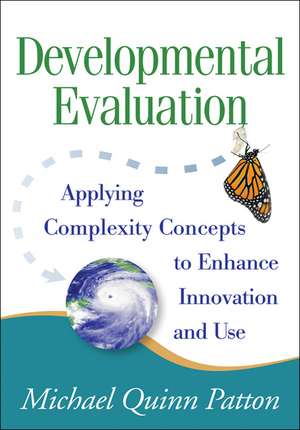
Developmental Evaluation, First Edition: Applying Complexity Concepts to Enhance Innovation and Use
Autor Michael Quinn Pattonen Limba Engleză Paperback – 13 aug 2010
Observăm în Developmental Evaluation, First Edition o abordare riguroasă și interdisciplinară care recalibrează metodologia cercetării prin lentila teoriei complexității, a sistemelor dinamice și a inovației sociale. Michael Quinn Patton propune un cadru de lucru esențial pentru monitorizarea proiectelor unde incertitudinea și emergența sunt constante, nu excepții. Apreciem modul în care autorul reușește să ancoreze concepte abstracte din științele sistemelor în realitatea pragmatică a schimbării sociale, oferind evaluatorilor un limbaj comun cu decidenții de programe.
Structura volumului este organizată progresiv, începând cu poziționarea evaluării dezvoltative ca nișă distinctă și explorând apoi cele cinci scopuri fundamentale ale acesteia. Primele capitole clarifică diferența critică între optimizarea modelelor existente (evaluarea formativă) și generarea de noi intervenții în medii turbulente. Cititorii familiarizați cu Dealing With Complexity in Development Evaluation de J. Michael Bamberger vor aprecia în acest volum focalizarea specifică pe parteneriatul strategic și pe modul în care evaluarea poate facilita învățarea de tip „double-loop” pentru a chestiona ipotezele de bază ale unui program.
În contextul operei sale, această lucrare reprezintă o evoluție firească de la metodele de cercetare calitativă descrise în Qualitative Research & Evaluation Methods către o viziune sistemică globală, regăsită ulterior și în Blue Marble Evaluation. Stilul narativ este unul accesibil, completat de ilustrații și tabele care sintetizează procese complexe, transformând un manual academic într-un ghid de practică profesională relevant pentru orice context care vizează transformarea socială sustenabilă.
Preț: 371.44 lei
Preț vechi: 476.29 lei
-20%
Carte indisponibilă temporar
Specificații
ISBN-10: 1606238728
Pagini: 375
Ilustrații: black & white illustrations, black & white tables
Dimensiuni: 178 x 254 x 24 mm
Greutate: 0.68 kg
Ediția:1
Editura: Guilford Publications
Colecția Guilford Press
Public țintă
Professional Practice & DevelopmentDe ce să citești această carte
Această ediție este fundamentală pentru practicienii și studenții care activează în domenii unde modelele tradiționale de evaluare eșuează din cauza mediilor impredictibile. Cititorul câștigă o metodologie clară pentru a susține inovația socială, învățând cum să adapteze intervențiile la contexte locale și cum să utilizeze datele pentru decizii rapide. Este resursa ideală pentru a transforma evaluarea dintr-o obligație birocratică într-un instrument strategic de dezvoltare.
Despre autor
Michael Quinn Patton este un consultant independent cu o experiență de peste 40 de ani în cercetare aplicată și evaluarea programelor. Deși studiile sale doctorale în sociologie la University of Wisconsin au avut o orientare cantitativă puternică, activitatea sa ulterioară la University of Minnesota l-a consacrat ca o autoritate mondială în metode calitative și abordări inovatoare ale evaluării. Este recunoscut pentru capacitatea de a sintetiza teoria sistemelor complexe în cadre de lucru practice, fiind autorul unor lucrări de referință care au modelat standardele profesionale în domeniul evaluării sociale și organizaționale la nivel global.
Descriere scurtă
See also Developmental Evaluation Exemplars, edited by Michael Quinn Patton, Kate McKegg, and Nan Wehipeihana, which presents 12 in-depth case studies.
Cuprins
*The Distinction Emerges
*Facing Complexity and Facing Reality: Or, Facing the Realities of Complexity
*Developmental Evaluation and Complexity Theory
*Developmental Evaluation and Single-Loop versus Double-Loop Learning
*The Importance of Interpretive Frameworks
*Developmental Evaluation as Utilization-Focused
*Charting the Developmental Journey: Overview of the Book
*Five Developmental Evaluation Purposes and Uses
2. Developmental Evaluation as a Distinct Purpose and Niche
*Beyond Planning: Jumping into the Fire
*Evaluation Questions under These Different Engagement Scenarios
*Vision Encounters Reality: The Territory of Developmental Evaluation
*Systems Issues: Boundary Management as a Developmental Evaluation Focus
*Developing Innovations versus Improving and Testing Models: Developmental Evaluation Distinguished from Formative and Summative Evaluation
*Ongoing Development Informed by Developmental Evaluation
*Strategic Thinking and Developmental Evaluation
*The Niche of Developmental Evaluation: Chapter Overview and Summary
3. Thinking Outside Evaluation’s Boxes
*Creative Evaluation
*Of Plums and Prunes
*History and Biography as Context: The Personal Factor
*More History and Biography as Context
*Fundamental Principles
*Developmental Evaluation in Context
*External Evaluators and Developmental Evaluation
*Ten Key Points about Developmental Evaluation Illustrated by the Caribbean Example
4. Situation Recognition and Responsiveness: Distinguishing Simple, Complicated, and Complex
*Detecting Patterns
*Detecting Complexity as a Distinct Pattern and Territory for Inquiry
*The Challenges of Situation Recognition
*A Situation Recognition Heuristic: Distinguishing Simple, Complicated, and Complex
*Situational Evaluation: Implications for Practice
*Variations on a Theme: The Cynefin Framework
5. Systems Thinking and Complexity Concepts for Developmental Evaluation
*From Train Brakeman to Locomotive Engineer to Evaluation Champion
*Project SleepBetter
*Systems Thinking
*Complexities of Complexity
*Useful Complexity Constructs for Developmental Evaluation
*Complexity-Sensitizing Concepts
6. How the World Is Changed: A Dialectic with Thesis and Antithesis and Developmental Evaluation as the Synthesis
*Competing Perspectives on How the World Is Changed
*The Top-Down Approach
*Adaptation versus Replication: Principles for Developmental Evaluation
*Best Practices versus Effective Principles
*From the Grass Roots to the Adaptive Middle
*Alternative Approaches to Change
*Developmental Evaluation: The Action in the Muddled Middle
*Looking Back and Looking Forward
*Appendix 6.1. Positioning and Contrasting Developmental Evaluation with Other Evaluation Approaches
7. The Adaptive Cycle and Developmental Evaluation
*Some Context for Understanding the Adaptive Cycle: Poetry, Ecology, Sociology, Business, and Evaluation
*The Complexity Doorframe Redux
*Five Developmental Evaluation Purposes and Uses
*Resilience and Developmental Evaluation
*A Strategic Approach to Resilience: Engineering Resilience versus Ecosystem Resilience
*The Adaptive Cycle
*The Adaptive Cycle and Psychosocial Regimes
*Evaluation and the Adaptive Cycle
*Through the Looking Glass of the Adaptive Cycle: Examples of Organizational and Program Cycles
*Transitions and Traps
*Taking an Innovation to Scale: Challenges and Traps in Cross-Scale Change
*Panarchy: Cross-Scale Interactions
*Panarchy-Informed Evaluation: The Fact of a Doorframe
8. Developmental Evaluation Inquiry Frameworks
*Frameworks for Developmental Evaluation Inquiry
*Developmental Evaluation Inquiry Frameworks: Ten and Counting . . .
9. Developmental Evaluation Bricolage: Reflective Practice, Sensitizing Concepts, Action Research, Abduction, Systems Change, and Retrospective Developmental Evaluation
*Reflective Practice for Developmental Evaluation Inquiry and Engagement
*Sensitizing Concepts as a Focus for Reflective Practice and Developmental Evaluation
*Kia ora
*Action Research and Developmental Evaluation
*Intersections of Developmental Evaluation and Action Research: A Distinguished Evaluation Pioneer Reflects
*Reasoning and Developmental Evaluation
*In Praise of Methodological Diversity and Appropriateness: A Methods and Tools Rant
*Systems Change and Developmental Evaluation
*Retrospective Developmental Evaluation
*Damiano’s Retrospective Developmental Evaluation
*Developmental Evaluation Bricolage
10. Utilization-Focused Developmental Evaluation: Engagement Practices, Diverse Designs, and Adaptive Methods
*Different Kinds of Developmental Evaluation
*Diversity of Design and Methods Options
*Utilization-Focused Developmental Evaluation
*Ten Utilization-Focused Developmental Evaluation Design Examples
*Developmental Evaluation Engagement, Design, and Methods Summary
*The First Developmental Evaluation: A Creation Story
Recenzii
There is a real hunger for this book among social innovators, funders, policymakers, and educators. The book is sure to become dog-eared as it is read, used, and reread to help evaluators conduct their work in a manner consistent with the complexity of the challenges they are addressing.--Brenda Zimmerman, PhD, Director, Health Industry Management Program, Schulich School of Business, York University, Canada
In true Michael Quinn Patton style, this book successfully extends both the theory and practice of evaluation in significant and timely ways. Solutions to the world’s most pressing social problems are neither predictable nor known; developmental evaluation is just what the field needs to evaluate the complex realities of today’s organizations and communities. This book is a 'must read' for anyone committed to understanding how, where, when, and for whom social innovations are achieving their goals.--Hallie Preskill, PhD, Executive Director, Strategic Learning and Evaluation Center, FSG Social Impact Advisors, Seattle, Washington