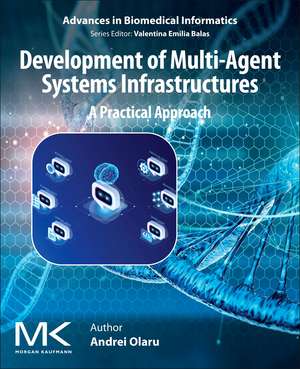
Development of Multi-Agent System Infrastructures: A Practical Approach: Advances in Biomedical Informatics
Autor Andrei Olaruen Limba Engleză Paperback – 15 iun 2026
- Presents models and languages for multi-agent systems (MAS) development
- Includes three key sections covering: modeling and languages for multi-agent systems; entity deployment and interaction; and practical considerations for implementing contemporary MAS frameworks
- Provides a hands-on method for developing working MAS solutions across a variety of applications
- Showcases solutions in a structured, modular format so they can be replicated and used independently from one another

Preț: 851.47 lei
Preț vechi: 1396.99 lei
-39%
Carte tipărită la comandă
Livrare economică 01-15 decembrie
Specificații
ISBN-10: 044340495X
Pagini: 300
Dimensiuni: 191 x 235 mm
Greutate: 0.45 kg
Editura: ELSEVIER SCIENCE
Colecția Advances in Biomedical Informatics
Seria Advances in Biomedical Informatics
V-ar putea interesa
-
 Multi-Agent Reinforcement LearningFilippos Christianos-20%Preț: 487.36 lei609.19 lei
 -
 Formal Methods for Multi-Agent Feedback Control SystemsDimos V. Dimarogonas-20%Preț: 610.14 lei762.68 lei
 -
 -20%Preț: 323.70 lei404.62 lei
 -
 Machine Learning For DummiesLuca Massaron-20%Preț: 149.88 lei187.36 lei
 -
 Agentic AI For DummiesPam Baker-20%Preț: 146.02 lei182.53 lei
 -
 AI Agents in ActionMicheal Lanham-20%Preț: 340.84 lei426.05 lei
 -
 -20%Preț: 342.06 lei427.57 lei
 -
 -18%Preț: 1165.11 lei1420.87 lei
 -
 Engineering Information Systems with Large Language ModelsFrancesca de Luzi-24%Preț: 1016.50 lei1337.51 lei
 -
 Networked SystemsSalem Lahlou-20%Preț: 996.76 lei1245.95 lei
 -
 -20%Preț: 547.54 lei684.43 lei
 -
 -20%Preț: 1277.50 lei1596.87 lei
 -
 -5%Preț: 350.89 lei369.36 lei
 -
 -20%Preț: 327.36 lei409.20 lei
 -
 -20%Preț: 317.68 lei397.10 lei
 -
 -20%Preț: 318.67 lei398.33 lei
 -
 -20%Preț: 623.89 lei779.85 lei
 -
 -20%Preț: 1510.95 lei1888.69 lei
 -
 AI and MicroservicesDileep Kumar Pandiya-20%Preț: 263.90 lei329.88 lei
Cuprins
1. Purpose of this book
2. Foundational concepts
3. Applications, challenges and requirements
4. A comparative study of current MAS frameworks
5. The FLASH-MAS framework
Part 2: Modeling agents and infrastructures
6. Entities in a multi-agent system
7. Integration of agent-oriented programming languages
8. The Entity-operation model
Part 3: Interaction between entities
9. Mobility of entities
10. Decentralized communication protocols
11. Leveraging the advantages of web standards
12. Region-based decentralized communication
13. Entity systems deployed over heterogeneous environments
Part 4: Deploying modern MAS-based applications
14. Complex deployment scenarios
15. Agent-based simulation
16. Monitoring and controlling a distributed system
17. Integrating machine learning into software agents
18. Distributed machine learning in agent communities
Notă biografică
Dr. Andrei Olaru is an Associate Professor with the National University of Science and Technology POLITEHNICA Bucharest (UNSTPB), and a member of the Artificial Intelligence and Multi-agent Systems Laboratory, specialized in multi-agent systems, ambient intelligence, and context-awareness. He has received a double M.Sc. Degree from University Politehnica of Bucharest (UPB, now UNSTPB) and from University of Nantes, and a double Ph.D. Degree from UPB and University Pierre et Marie Curie (now Sorbonne University). Among other subjects, he teaches a course on Multi-Agent Systems to master students at UNSTPB. He is the coordinator of the Financial Computing Master's Degree at UNSTPB. Dr. Olaru has been the director of 2 national research grants and 1 international grant. He is a member of ACM and a member of the Romanian Association for Artificial Intelligence.