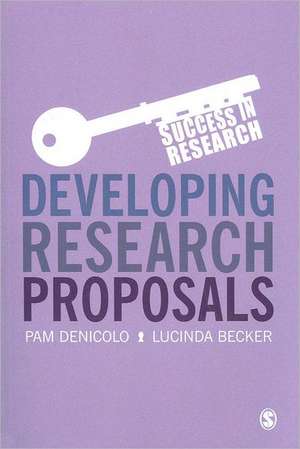
Developing Research Proposals: Success in Research
Autor Pam Denicolo, Lucinda Beckeren Limba Engleză Paperback – 20 ian 2012
În peisajul academic actual, unde competiția pentru resurse și locuri în programele de studii avansate este tot mai acerbă, Developing Research Proposals se poziționează ca un instrument esențial în etapa de planificare a carierei de cercetător. Observăm că Pam Denicolo și Lucinda Becker abordează scrierea propunerii nu doar ca pe un exercițiu administrativ, ci ca pe un proces strategic de comunicare. Volumul face parte din seria Success in Research și reușește să demistifice așteptările comisiilor de evaluare, oferind claritate acolo unde adesea persistă confuzia. Structura cărții este riguros organizată, pornind de la definirea conceptului de propunere și inventarierea abilităților necesare, până la detalii tehnice despre cadrul conceptual, registrul lingvistic și timpul verbelor. Apreciem în mod deosebit secțiunile dedicate identificării oportunităților de finanțare și a supervizorilor potriviți, elemente care transformă acest manual într-un ghid de supraviețuire în mediul universitar. Comparabil cu Research Proposals: A Practical Guide, 3rd Edition de Martyn Denscombe în ceea ce privește rigoarea, volumul de față se distinge prin accentul pus pe vocea autorului și pe adaptarea stilului la audiența specifică, oferind o perspectivă mai aplicată asupra interacțiunii cu recenzorii. Această lucrare completează armonios opera anterioară a lui Pam Denicolo, precum Publishing Journal Articles, formând un corpus de cunoștințe care acoperă întreg spectrul activității academice. Dacă în Constructivist Approaches and Research Methods autoarea explora fundamentele metodologice, aici se concentrează pe pragmatismul necesar pentru a obține validarea proiectelor. Tonul este direct, lipsit de jargon inutil, facilitând o progresie logică de la ideea brută la un document convingător, gata pentru depunere.






Preț: 371.48 lei
Carte disponibilă
Livrare economică 05-19 noiembrie
Livrare express 22-28 octombrie pentru 25.32 lei
Specificații
ISBN-10: 0857028669
Pagini: 154
Dimensiuni: 156 x 234 x 9 mm
Greutate: 0.23 kg
Ediția:First Edition
Editura: SAGE Publications Ltd
Colecția Success in Research
Seria Success in Research
Locul publicării:London, United Kingdom
V-ar putea interesa
-
 Becoming Qualitative Researchers: An IntroductionCorrine Glesne-23%Preț: 887.68 lei1152.83 lei
 -
 Teacher Thinking & Professional ActionDr Pam Denicolo-18%Preț: 1116.43 lei1361.49 lei
 -
 -18%Preț: 1120.74 lei1366.77 lei
 -
 Recognising and Supporting Able Children in Primary SchoolsHilary Lee-Corbin-18%Preț: 1003.26 lei1223.49 lei
 -
 Writing for EngineersJoan van Emden-26%Preț: 170.42 lei228.77 lei
 -
 How to Manage your Postgraduate CourseLucinda BeckerPreț: 239.73 lei
 -
 Handbook of Research on Enhancing Teacher Education with Advanced Instructional TechnologiesNwachukwu Prince Ololube-18%Preț: 1776.23 lei2166.14 lei
 -
 Constructivist Approaches and Research MethodsPam Denicolo-19%Preț: 455.27 lei562.06 lei
 -
 Complexity in Financial MarketsMatthieu Cristelli-15%Preț: 616.24 lei724.99 lei
 -
 Stochastic ProcessesWolfgang Paul-18%Preț: 893.95 lei1090.19 lei
 -
 Applied Panel Data Analysis for Economic and Social SurveysHans-Jürgen Andreß-15%Preț: 583.97 lei687.02 lei
 -
 Städtische Bewerbungen um internationale SporteventsMarcus FrankePreț: 320.68 lei
 -
 Die Territorialisierung sozialer SicherungMonika SenghaasPreț: 409.31 lei
 -
 New RacismNorma Romm-18%Preț: 959.81 lei1170.50 lei
 -
 -15%Preț: 621.32 lei730.97 lei
De ce să citești această carte
Recomandăm această carte studenților de la masterat și doctorat, dar și cercetătorilor aflați la început de drum care doresc să obțină finanțări competitive. Cititorul câștigă o înțelegere profundă a modului în care gândesc evaluatorii și învață să structureze o argumentație solidă. Este o investiție în claritatea academică, oferind instrumente concrete pentru a transforma o idee de cercetare într-un proiect viabil și finanțabil.
Despre autor
Professor (Emeritus) Pam Denicolo este un psiholog recunoscut și o figură centrală în managementul educației postuniversitare din Marea Britanie. După o carieră prodigioasă la University of Reading, unde a pus bazele sistemului Graduate School, s-a dedicat sprijinirii doctoranzilor și cercetătorilor prin funcții de conducere în UK Council for Graduate Education și Society for Research into Higher Education. Experiența sa de editor executiv pentru serii dedicate supervizării academice îi conferă o autoritate incontestabilă în domeniul metodologiei și dezvoltării profesionale, expertiză reflectată în abordarea pragmatică a lucrărilor sale.
Descriere scurtă
Denicolo and Becker recognise the importance of developing an effective research proposal for gaining either a place on a research degree programme or funding to support research projects and set out to explore the main factors that that proposal writers need to attend to in developing successful proposals of their own.
Developing Research Proposals will help readers to understand the context within which their proposal will be read, what the reviewers are looking for and will be influenced by, while also supporting the development of relevant skills through advice and practical activities.
This book:
- Explores the nature and purpose of different kinds of proposals
- Focuses on the actual research proposed
- Discusses how best to carry out and structure the literature review
- Examines the posing and phrasing of research questions and hypotheses
- Looks at how methods and methodology should be handled in a proposal
- Discusses the crucial issues of planning, strategy and timing in developing targeted proposals
The Success in Research series, from Cindy Becker and Pam Denicolo, provides short, authoritative and accessible guides on key areas of professional and research development.
Avoiding jargon and cutting to the chase of what you really need to know, these practical and supportive books cover a range of areas from presenting research to achieving impact, and from publishing journal articles to developing proposals. They are essential reading for any student or researcher interested in developing their skills and broadening their professional and methodological knowledge in an academic context.
Recenzii
Maryam Nazari
Online Information Review
This book is essential reading for those writing research proposals for a PhD application as well as those writing proposals to funding bodies. It is intended for those who are writing proposals for the first time but also for those who may have written proposals before, but never succeeded in getting funding... For me, this book is perfectly pitched. It is simple, but not simplistic. It offers practical advice, but also interrogates your thinking about the actual research design...This book is an excellent addition to any newer researcher's bookshelf as well as for administrative staff and those in research offices who support academics writing proposals. You get a sense that the authors are true experts and genuinely want to support new and early academics in what is an increasingly competitive part of modern day academia.
Annika Coughlin
SRA News
Developing Research Proposals is a very accessible and authoritative guide, and part of Sage’s informative Success in Research Series... Overall, the authors have written a book providing a wealth of information and advice that would come in handy not only to those interested in maximizing their chances to get a research degree place or funding for project in a complex and demanding environment, but also to those interested in their personal development as researchers.
Andreea Moise
LSE Review of Books
Cuprins
Serendipity
Intended Readers
Overview of the Rook
The Task Before You
What is a Research Proposal?
A Pervasive Task Defined
A Celebration of Difference
First Steps in Meeting the Needs of Your Readership
Finding out about Research Degree Opportunities
Finding out about Research Funding Opportunities
General Preliminary Explorations
Skills Inventory
When Is a Research Proposal Required and Why?
Motivation
Sources of Funding
Gaining a Richer View of Funders' Requirements
Gaining Financial Awards for Study
Identifying Potential Supervisors/Advisors
Securing a Place on a Higher Degree by Research Programme
Sections Within a Proposal - What Funders or Research Degree Reviewers Are Looking for
Main Features of Proposals
What Are the Key Aspects of Proposal Preparation?
Pre-Preparation
The Title, Abstract and Covering Letter
The Body of the Proposal - Audience and Style
Developing Your Proposal Draft
Language Register, Voice and Verb Tense
The Conceptual Framework
Stages in the Production of Proposal - Advance Planning
The Constraints of Time
What Should Be Included in the Introduction, Rationale and Literature Review?
Orientating Your Reader to Your Purpose
The Introduction
The Rationale
Preparing for the Literature Review
The Literature Review Itself
The Process of Searching the Literature
Constructing Your Argument
What Is the Significance of the Aims, Objectives, and Research Questions/Hypotheses?
Level of Specificity Required
Clarification of Terms - Aims and Objectives
Research Questions and Hypotheses
Paradigms
Why Paradigm Identification Is Important
The Link between Aims/Objectives and Research Questions/Hypotheses
What Should Be Included in the Methodology/Research Implementation Sections?
Consistency between Purpose and Procedures
Clarification of 'Shorthand' Terms
Methodology - Approach and Justification
Consistency and Justification
Research Using Positivist Approaches
Presenting and Analysing Quantitative Results
Research Using Interpretivist Approaches
Presenting and Analysing Qualitative Results
Using the Right Language
Ethical Considerations
Evaluation Plan
What Financial Considerations Are Required?
The Ground Rules of Budgeting
The Financial Demands of a Research Degree Project
Financial Considerations for All Researchers
Types and Styles of Budgets for Funding Applications
Key Elements of the Budget: Personnel
Key Elements of the Budget: Operating Costs
The Budget after Submission of the Proposal
What Planning and Organisation Details Are Required?
Establishing Goals and Deadlines
Project Planning and Time Management
Implementation Plans
Research Governance
People Management
Schedules and Timelines
Who Are the other Potential Contributors to and Referees for Your Project?
Building Professional Relationships
Building on Overviews of Requirements
Making Contacts and Seeking Help
Developing Collaborations and Partnerships
The Review Process
What Reviewers Are Seeking from Proposals
Reality Check - Grit Your Teeth!
Where Does It End? Reactions, Reflections and Anticipations
After Submission
Receiving Feedback from Reviewers
Reasons for Rejection
Responding to Feedback
Back to the Beginning
The Continuous Cycle of Proposal Writing
Appendix 1 Funding Sources
Appendix 2 Resources
Glossary
Index
Notă biografică
Working across a range of disciplines (Psychology, Health & Social Care and Pharmacy), Pam Denicolo, a Professor Emerita from the University of Reading, a Fellow of the Academy of Social Sciences, and an Honorary Member of the Royal Pharmaceutical Society, has wide-ranging experience both of using a range of research approaches and methods and of teaching how to use them well to a broad range of students and professionals world-wide. She has served on executive boards and committees of national and international learned societies and organisations devoted to research and teaching. She continues to publish widely student support materials, books, and journal articles on research because she remains passionately committed to mentoring and coaching newer researchers and academics.