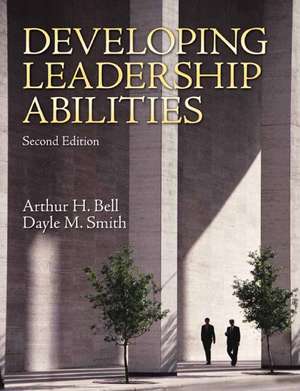
Developing Leadership Abilities
Autor PH. D. Bell, Arthur H., Dayle M. PH. D. Smithen Limba Engleză Paperback – 30 iun 2009
Developing Leadership Abilities, Second Edition was written to help college students get on the fast track to becoming a leader. Providing dozens of practical examples, the book moves quickly while giving an organized, readable, and logical analysis of leadership.
The book offers the following pedagogical tools to help students reach their own leadership potential:
v Insights Boxesa??throughout the chapters ensure that key points stand out.
v Your Turn featuresa??give frequent opportunities to record personal experiences, insights, impressions, and questions.
v Meet a Leader-- Introduces the reader successful leaders college and career environments.
v Personal Leadership Plan--Helps students hone their skills in the leadership realm.< /P>
v Assess Your Approach to Leadership a??This brief exercise gives students an opportunity for self-reflection and a mirror on how their own background will affect their leadership qualities.
v Summarya??Located at the end of each chapter, reinforces the key points.
The book is brief enough to keep student interest and is based on solid empirical data. The booka??s conversational and interactive format answers the q uestions: what makes a leader, what do leaders do, and how do leaders overcome problems?
Preț: 464.57 lei
Puncte Express: 697
Carte tipărită la comandă
Livrare economică 28 noiembrie-12 decembrie
Livrare prin curier în România Termenul estimat este afișat lângă disponibilitate.
Transport gratuit pentru acest produs Plată online sau ramburs, în funcție de opțiunile comenzii.
Retur gratuit în 14 zile Comandă securizată și suport în română.
Specificații
ISBN-13: 9780137152780
ISBN-10: 0137152787
Pagini: 138
Dimensiuni: 175 x 229 x 10 mm
Greutate: 0.25 kg
Ediția:2Nouă
Editura: Pearson Education
Locul publicării:Upper Saddle River, United States
ISBN-10: 0137152787
Pagini: 138
Dimensiuni: 175 x 229 x 10 mm
Greutate: 0.25 kg
Ediția:2Nouă
Editura: Pearson Education
Locul publicării:Upper Saddle River, United States
V-ar putea interesa
-
 The High Engagement Work CultureD. BowlesPreț: 390.68 lei
 -
 Leadership Craft, Leadership ArtS. TaylorPreț: 436.70 lei
 -
 Executive Power in Theory and PracticeH. Liebert-18%Preț: 729.40 lei889.52 lei
 -
 Financial Times Guide to Management, TheAnn FranckePreț: 196.28 lei
 -
 Emotional Fitness CoachingWarren RedmanPreț: 312.23 lei
 -
 How to Be a Brilliant LeaderSimon CooperPreț: 105.93 lei
 -
 Leading Teams - 10 Challenges : 10 SolutionsMandy FlintPreț: 130.71 lei
 -
 RepeatabilityChris ZookPreț: 185.13 lei
 -
 Yes to the MessFrank J BarrettPreț: 190.31 lei
 -
 Being GlobalÁngel CabreraPreț: 184.82 lei
 -
 InfluenceHarold ScharlattPreț: 98.24 lei
 -
 LeadershipJohn C. MaxwellPreț: 93.00 lei
Descriere
“What kind of leader am I? What kind of leader will I become?”
Developing Leadership Abilities, Second Edition was written to help college students get on the fast track to becoming a leader. Providing dozens of practical examples, the book moves quickly while giving an organized, readable, and logical analysis of leadership.
The book offers the following pedagogical tools to help students reach their own leadership potential:
v Insights Boxes–throughout the chapters ensure that key points stand out.
v Your Turn features–give frequent opportunities to record personal experiences, insights, impressions, and questions.
v Meet a Leader-- Introduces the reader successful leaders college and career environments.
v Personal Leadership Plan--Helps students hone their skills in the leadership realm.
v Assess Your Approach to Leadership –This brief exercise gives students an opportunity for self-reflection and a mirror on how their own background will affect their leadership qualities.
v Summary–Located at the end of each chapter, reinforces the key points.
The book is brief enough to keep student interest and is based on solid empirical data. The book’s conversational and interactive format answers the q uestions: what makes a leader, what do leaders do, and how do leaders overcome problems?
Developing Leadership Abilities, Second Edition was written to help college students get on the fast track to becoming a leader. Providing dozens of practical examples, the book moves quickly while giving an organized, readable, and logical analysis of leadership.
The book offers the following pedagogical tools to help students reach their own leadership potential:
v Insights Boxes–throughout the chapters ensure that key points stand out.
v Your Turn features–give frequent opportunities to record personal experiences, insights, impressions, and questions.
v Meet a Leader-- Introduces the reader successful leaders college and career environments.
v Personal Leadership Plan--Helps students hone their skills in the leadership realm.
v Assess Your Approach to Leadership –This brief exercise gives students an opportunity for self-reflection and a mirror on how their own background will affect their leadership qualities.
v Summary–Located at the end of each chapter, reinforces the key points.
The book is brief enough to keep student interest and is based on solid empirical data. The book’s conversational and interactive format answers the q uestions: what makes a leader, what do leaders do, and how do leaders overcome problems?
Cuprins
Chapter One: Surprising Facts about Leaders
Chapter Two: Assessing Your Leadership Tendencies
Chapter Three: Expressing Leadership Vision
Chapter Four: Leadership by Listening
Chapter Five: Leadership by Building Relationships and Team
Chapter Six: Leadership by Defining Problems and Reaching Solutions
Chapter Seven: Leadership by Motivating
Chapter Two: Assessing Your Leadership Tendencies
Chapter Three: Expressing Leadership Vision
Chapter Four: Leadership by Listening
Chapter Five: Leadership by Building Relationships and Team
Chapter Six: Leadership by Defining Problems and Reaching Solutions
Chapter Seven: Leadership by Motivating
Notă biografică
Arthur H. Bell holds his Ph.D. from Harvard University and is Executive Director of MBA Programs and Professor of Management Communication at the University of San Francisco. He is the author of 47 books on management, communication, language, and literature. He held previous teaching positions at Georgetown University and the University of Southern California.
Dayle M. Smith holds her Ph.D. from the Annenberg School, University of South California. She is Director of the Business Honors Program and Professor of Management at the University of San Francisco. She is the author of 12 books on management theory and practice. She held previous teaching positions at Georgetown University and the University of Southern California.
We encourage you to visit this Blog at www.developingleadershipabilities2e.blogspot.com. The authors will be answering student and faculty questions here as well as adding interesting articles and other pieces on leadership.
Dayle M. Smith holds her Ph.D. from the Annenberg School, University of South California. She is Director of the Business Honors Program and Professor of Management at the University of San Francisco. She is the author of 12 books on management theory and practice. She held previous teaching positions at Georgetown University and the University of Southern California.
We encourage you to visit this Blog at www.developingleadershipabilities2e.blogspot.com. The authors will be answering student and faculty questions here as well as adding interesting articles and other pieces on leadership.
Textul de pe ultima copertă
Developing Leadership Abilities, 2e Arthur H. Bell, University of San Francisco
Dayle M. Smith, University of San Francisco
What makes a great leader?
What do leaders do? How do leaders overcome problems? Developing Leadership Abilities, Second Edition, gives the answers to these questions andteaches the specific skills that matter most for those assuming a leadership role. The step-by-step approach helps extend and refine leadership insights and techniques. This brief and fast paced book tells college students what they need to know to be leaders, in school and later in the working world. The book provides dozens of practical examples and many opportunities for students to record their own experiences, insights, impressions, and questions. The authors present current, crucial ideas about leadership such as:
v How to tell when leadership–including your own–is in danger of faltering
v How to delegate to those who are unwilling to take on new responsibilities
v How to adjust your leadership style to small groups and teams
v How to be a “leader of oneself” as a prerequisite for leading others
v How to be flexible in changing circumstances
v How to transition between the roles of leader and follower
v How to use emotional intelligence as part of your leadership strategies
v Why gender, culture, and other factors must be considered and understood by successful leaders
v How leadership responsibilities can be distributed throughout the organization
v How leaders can act swiftly to resolve conflict
v How social networking, YouTube, cell phones, and other technologies have influenced leadership options.
Readers of this book will be on the fast track towards gaining the skills to become a leader now and prepare these skill sets for future success as leaders--in and out of business.
Dayle M. Smith, University of San Francisco
What makes a great leader?
What do leaders do? How do leaders overcome problems? Developing Leadership Abilities, Second Edition, gives the answers to these questions andteaches the specific skills that matter most for those assuming a leadership role. The step-by-step approach helps extend and refine leadership insights and techniques. This brief and fast paced book tells college students what they need to know to be leaders, in school and later in the working world. The book provides dozens of practical examples and many opportunities for students to record their own experiences, insights, impressions, and questions. The authors present current, crucial ideas about leadership such as:
v How to tell when leadership–including your own–is in danger of faltering
v How to delegate to those who are unwilling to take on new responsibilities
v How to adjust your leadership style to small groups and teams
v How to be a “leader of oneself” as a prerequisite for leading others
v How to be flexible in changing circumstances
v How to transition between the roles of leader and follower
v How to use emotional intelligence as part of your leadership strategies
v Why gender, culture, and other factors must be considered and understood by successful leaders
v How leadership responsibilities can be distributed throughout the organization
v How leaders can act swiftly to resolve conflict
v How social networking, YouTube, cell phones, and other technologies have influenced leadership options.
Readers of this book will be on the fast track towards gaining the skills to become a leader now and prepare these skill sets for future success as leaders--in and out of business.
Caracteristici
Discusses leadership in a global context--helps readers succeed in college, career, and personal endeavors.
Includes practical leadership abilities that can be applied throughout a student’s life–for example, social memberships, civic involvement, work life, and other areas where leadership opportunities emerge.
“Your Turn”exercises on almost every page give readers the opportunity to enter personal reaction statements–in effect, to “think with” the authors on the road to developing leadership skills.
“Insight” boxes throughout the book–Sum up the major points.
The “Assess Your Approach to Leadership” exercise (Chapter 2)--Gives readers a clear idea of the assumptions, experiences, and expectations they bring to the study of leadership.
Features “Meet a Leader” segments throughout the book--Introduces the reader to men and women in college and career environments as they encounter and deal successfully with leadership challenges and opportunities.
“Personal Leadership Plan” section--Helps students hone their skills in the leadership realm.
Written in a fast-paced conversational tone–Students will find it easy to read and easy to follow.
Includes practical leadership abilities that can be applied throughout a student’s life–for example, social memberships, civic involvement, work life, and other areas where leadership opportunities emerge.
“Your Turn”exercises on almost every page give readers the opportunity to enter personal reaction statements–in effect, to “think with” the authors on the road to developing leadership skills.
“Insight” boxes throughout the book–Sum up the major points.
The “Assess Your Approach to Leadership” exercise (Chapter 2)--Gives readers a clear idea of the assumptions, experiences, and expectations they bring to the study of leadership.
Features “Meet a Leader” segments throughout the book--Introduces the reader to men and women in college and career environments as they encounter and deal successfully with leadership challenges and opportunities.
“Personal Leadership Plan” section--Helps students hone their skills in the leadership realm.
Written in a fast-paced conversational tone–Students will find it easy to read and easy to follow.
Caracteristici noi
NEW! Information on the different technology options and their influence on leadership.
NEW! Makes the prospect of leadership growth an exciting adventure, not a matter of theories to be memorized.
NEW! Learn how cultural intelligence impacts the world of work.
NEW! Strategies for identifying areas for improvement in leadership.
NEW! Brainstorming and suggestions for improving your ability to delegate tasks effectively.
NEW! Importance of group work and teambuilding is addressed.
NEW! Developing the 'Lead by example' model.
NEW! Conflict resolution techniques.
- Provides information on how social networking, YouTube, cell phones, and other technologies have influenced leadership options.
NEW! Makes the prospect of leadership growth an exciting adventure, not a matter of theories to be memorized.
- Discusses how to transition between the roles of leader and follower. Gives tips on making leadership techniques flexible for changing circumstances, and suggests ways to use emotional intelligence as part of your leadership strategies.
NEW! Learn how cultural intelligence impacts the world of work.
- Tells why gender, culture, and other factors must be considered and understood by successful leaders.
NEW! Strategies for identifying areas for improvement in leadership.
- Includes how to tell when leadership, including your own is faltering; Emphasizes why “servant” leadership has replaced “top dog” leadership in many organizations.
NEW! Brainstorming and suggestions for improving your ability to delegate tasks effectively.
- Provides ideas on how to delegate to those who are unwilling to take on new responsibilities.
NEW! Importance of group work and teambuilding is addressed.
- Offers ways to adjust your leadership style to small groups and teams.
NEW! Developing the 'Lead by example' model.
- Focuses on how to be a “leader of oneself” as a prerequisite for leading others; Includes tips on how leadership responsibilities can be distributed throughout the organization.
NEW! Conflict resolution techniques.
- Supplies techniques by which leaders can act swiftly to resolve conflict.