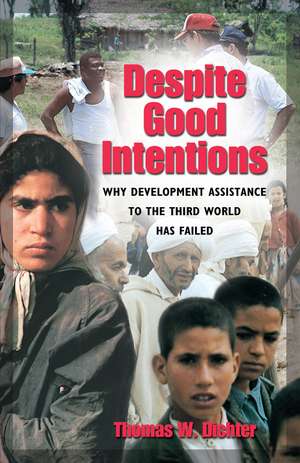
Despite Good Intentions: Why Development Assistance to the Third World Has Failed
Autor Thomas W. Dichteren Limba Engleză Paperback – 16 ian 2003
To make his case, Dichter reviews the major trends in development assistance from the 1960s through the 1990s, illustrating his analysis with eighteen short stories based on his own experiences in the field. The analytic chapters are thus grounded in the daily life of development workers as described in the stories.
Dichter shows how development organizations have often become caught up in their own self-perpetuation and in public relations efforts designed to create an illusion of effectiveness. Tracing the evolution of the role of money (as opposed to ideas) in development assistance, he suggests how financial imperatives have reinforced the tendency to sponsor time-bound projects, creating a dependency among aid recipients. He also examines the rise of careerism and increased bureaucratization in the industry, arguing that assistance efforts have become disconnected from important lessons learned on the ground, and often lessons of world history.
In the end, Dichter calls for a more light-handed and artful approach to development assistance, with fewer agencies and experts involved. His stance is pragmatic, rather than ideological or political. What matters, he says, is what works, and the current practices of the development industry are simply not effective.
Preț: 211.24 lei
Preț vechi: 242.90 lei
-13%
Puncte Express: 317
Carte indisponibilă temporar
Doresc să fiu notificat când acest titlu va fi disponibil:
Se trimite...
Specificații
ISBN-13: 9781558493933
ISBN-10: 155849393X
Pagini: 320
Dimensiuni: 154 x 245 x 25 mm
Greutate: 0.54 kg
Ediția:First Edition
Editura: University of Massachusetts Press
Colecția University of Massachusetts Press
ISBN-10: 155849393X
Pagini: 320
Dimensiuni: 154 x 245 x 25 mm
Greutate: 0.54 kg
Ediția:First Edition
Editura: University of Massachusetts Press
Colecția University of Massachusetts Press
Notă biografică
THOMAS W. DICHTER holds a Ph.D. in anthropology from the University of Chicago and has taught at Tufts University, Clark University, and Princeton University's Woodrow Wilson School.
Cuprins
Preface
Abbreviations
Bibliography
Index
Abbreviations
- Introduction/The Great Paradox of Development Assistance
Story One/Romance
Story Two/Illusion
- Chapter One/The Developing World
Story Three/A Straw in the Wind
Story Four/Being Useful or Being Used
- Chapter Two/The Evolution of the Idea of Development
Story Five/Warm Bodies
Story Six/Sliding Towards Dependency
- Chapter Three/Development Assistance as an Industry
(The “Dev Biz”)
Story Seven/Dedication
Story Eight/Trying Simply to Help
- Chapter Four/Avoiding History
Story Nine/The Helper and the Helped
Story Ten/Confusing Stakes
- Chapter Five/The Consequences of Avoiding Certain Universal of Human Nature
Story Eleven/Spare No Expense— the Very Best
Story Twelve/For the People, By the People
- Chapter Six/The Mismatch of Organizational Imperatives and Money
Story Thirteen/Position, Not Condition
Story Fourteen/ Headless Chickens
- Chapter Seven/The Professionalization of Development
Story Fifteen/Too Many Cooks
Story Sixteen/Rhetorical Support
- Chapter Eight/Marketing Development
Story Seventeen/Unintended Consequences
Story Eighteen/The People’s Program
- Conclusion/The Case for a Radical Reduction in Development Assistance
Bibliography
Index
Recenzii
“A literate, entertaining, and soul-searching critique of the international aid business, by an insider who will make other insiders think hard about what they are doing and where they are going.”—Ian Smillie, author of Patronage or Partnership: Local Capacity Building in Humanitarian Crises
“I can think of no study as comprehensive and grounded in such wide experience and knowledge as Dichter's. . . . The presentation is amazingly effective, especially the alternation of narrative accounts of hypothetical (but very believable) examples of technical assistance projects with factual discussions of aspects of developmental assistance. . . . A highly readable and literate book.”—Barbara B. Burn, author of Expanding the International Dimension of Higher Education
“I can think of no study as comprehensive and grounded in such wide experience and knowledge as Dichter's. . . . The presentation is amazingly effective, especially the alternation of narrative accounts of hypothetical (but very believable) examples of technical assistance projects with factual discussions of aspects of developmental assistance. . . . A highly readable and literate book.”—Barbara B. Burn, author of Expanding the International Dimension of Higher Education