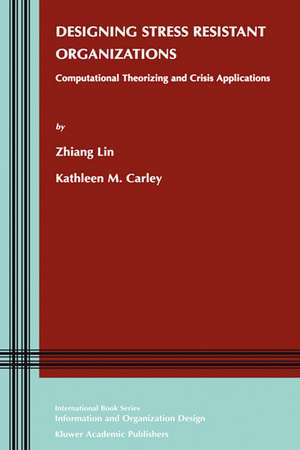
Designing Stress Resistant Organizations
Autor Lin, Kathleen M Carleyen Limba Engleză Hardback – 31 mai 2003
At the theoretical level, the book contains a comprehensive computational framework called DYCORP, which simulates dynamic and interactive organizational behaviors by incorporating multiple factors such as organizational design, task environment, and stress, and which generates consistent and insightful propositions on organizational performance.
The book utilizes an organization science based approach to computational modeling. This approach recognizes the limit of human cognition as it was outlined by Herbert A. Simon in 1947. The model strives to focus on the essence of the reality that is most relevant to the research issue. This approach has been proven to be more beneficial for us to understand the underlying dynamics of the phenomenon.
Preț: 672.49 lei
Preț vechi: 791.17 lei
-15%
Puncte Express: 1009
Carte tipărită la comandă
Livrare economică 28 decembrie 26 - 11 ianuarie 27
Livrare prin curier în România Termenul estimat este afișat lângă disponibilitate.
Transport gratuit pentru acest produs Plată online sau ramburs, în funcție de opțiunile comenzii.
Retur gratuit în 14 zile Comandă securizată și suport în română.
Specificații
ISBN-13: 9781402074363
ISBN-10: 1402074360
Pagini: 211
Ilustrații: XXIII, 211 p.
Dimensiuni: 160 x 241 x 18 mm
Greutate: 0.54 kg
Ediția:2003 edition
Editura: Springer Us
Locul publicării:New York, NY, United States
ISBN-10: 1402074360
Pagini: 211
Ilustrații: XXIII, 211 p.
Dimensiuni: 160 x 241 x 18 mm
Greutate: 0.54 kg
Ediția:2003 edition
Editura: Springer Us
Locul publicării:New York, NY, United States
V-ar putea interesa
-
 Preț: 265.21 lei
-
 McKinsey MindEthan Rasiel-16%Preț: 186.85 lei221.97 lei
-
 The New Strategic ThinkingMichel RobertPreț: 315.65 lei
-
 -25%Preț: 604.44 lei806.73 lei
-
 The Exceptional Manager: Making the DifferenceRick Delbridge-19%Preț: 315.02 lei387.78 lei
-
 Strategic Alliances: Theory and EvidenceJeffrey J. Reuer-27%Preț: 458.32 lei626.31 lei
-
 Fish! OmnibusStephen Lundin And Carr Hagerm-25%Preț: 76.50 lei101.43 lei
-
 Strategy as PracticeGerry JohnsonPreț: 418.78 lei
-
 The Circle of InnovationTom PetersPreț: 159.58 lei
-
 -17%Preț: 102.72 lei123.45 lei
-
 -23%Preț: 822.15 lei1067.73 lei
Public țintă
ResearchCuprins
1. Introduction.- 2. Literature on Organizational Performance.- 3. Computational Theorizing: A Formal Framework of Organizational Performance.- 4. Crisis Applications: An Empirical Analysis of Organizational Performance under Stress.- 5. Linking Theory to Practice.- 6. Conclusion.- A. Coding Scheme for Real World Crisis Cases.- B. Data for Compiling Figures in Chapter 3.- C. Further Descriptions of the DYCORP Framework.- C.1. Main Components of DYCORP.- C.2. General Algorithms for DYCORP.- C.3. Portability of DYCORP for Other Research Issues.- References.