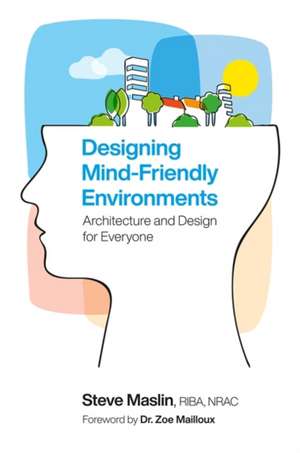
Designing Mind-Friendly Environments: Architecture and Design for Everyone
Autor Steve Maslin Cuvânt înainte de Zoe Maillouxen Limba Engleză Paperback – 21 dec 2021
Assimilating knowledge from medical, therapeutic, social and educational spheres, and using sensory integration theory, the book explores the connection between our minds and our surroundings and considers the impact of the environment on the senses, well-being and neurodiverse needs of people. The book shows how design adaptations to lighting, acoustics, temperature, surfaces, furniture and space can positively benefit the lives of everyone across a range of environments including workplaces, retail, sport and leisure, domestic, educational institutions, cultural and civic spaces, outdoor spaces and places of worship.
Universal in its approach and written by an experienced architect and inclusive design consultant, this book is essential reading for professionals in architecture and design, education, organisational psychology, business management and occupational therapy.
Preț: 191.02 lei
Preț vechi: 261.11 lei
-27% Recomandat
Puncte Express: 287
Preț estimativ în valută:
33.81€ • 39.51$ • 29.35£
33.81€ • 39.51$ • 29.35£
Carte disponibilă
Livrare economică 30 ianuarie-13 februarie
Livrare express 15-21 ianuarie pentru 290.10 lei
Preluare comenzi: 021 569.72.76
Specificații
ISBN-13: 9781785921421
ISBN-10: 1785921428
Pagini: 272
Ilustrații: 50 black & white images
Dimensiuni: 152 x 228 x 18 mm
Greutate: 0.4 kg
Editura: JESSICA KINGSLEY PUBLISHERS
Colecția Jessica Kingsley Publishers
Locul publicării:London, United Kingdom
ISBN-10: 1785921428
Pagini: 272
Ilustrații: 50 black & white images
Dimensiuni: 152 x 228 x 18 mm
Greutate: 0.4 kg
Editura: JESSICA KINGSLEY PUBLISHERS
Colecția Jessica Kingsley Publishers
Locul publicării:London, United Kingdom
Recenzii
Designing Mind-Friendly Environments is an illuminating and thought-provoking book in which Maslin offers rich professional and personal insights into how design and the environment we live and work in affect our health and wellbeing. Teaching us much about our senses and the deeply personal act of perceptual experience along the way, Maslin's book firmly places the person at the centre of design. This is a must-read for anybody interested in inclusive design and a sustainable future.
Cuprins
Acknowledgements
Foreword
Introduction
Section A: Connecting Different "Worlds"
1. Definitions and Voice
2. Learning from People on the Autism Spectrum (and other neurological experiences)
3. Learning from OT, Psychology, UX, and Inclusive Design
4. Design as Social Prescribing
5. Prescription to Commissioning
6. For Whom or With Whom?
Section B: The Human Experience.
7. Diversity
8. Stress
9. Sensory Processing
10. Emotion, Meaning and Metaphor
11. Reasoning, Learning and Understanding.
12. Rest and Sleep
Section C: Contextual Experience
13. Mind and Body in Context
14. Spatial Context
15. Social Context
16. Comfort and Activity
17. Acoustics
18. Lighting
19. Surfaces
20. Tastes, Smells and Air Quality
21. Temperature
22. The Natural World
23. Time and Memory
24. Navigation, place and wayfinding
25. Spatial Choice, Permission and Security
26. Communication
Section D: Different Environments
27. Landscape and Urban
28. Transport
29. Education
30. Health and Social care
31. Workplaces
32. Places of Worship
33. Communal
34. Civic and Cultural
35. Leisure and Sports
36. Food and Drink
37. Retail
38. Hospitality
39. Industrial and Military
40. Judicial and Custodial
41. Domestic
Section E: Getting Serious
42. Facilities management
43. Safeguarding of Wellbeing
44. Fire and Emergencies
Summary
Biography of Author
Table of Figures
Bibliography
Foreword
Introduction
Section A: Connecting Different "Worlds"
1. Definitions and Voice
2. Learning from People on the Autism Spectrum (and other neurological experiences)
3. Learning from OT, Psychology, UX, and Inclusive Design
4. Design as Social Prescribing
5. Prescription to Commissioning
6. For Whom or With Whom?
Section B: The Human Experience.
7. Diversity
8. Stress
9. Sensory Processing
10. Emotion, Meaning and Metaphor
11. Reasoning, Learning and Understanding.
12. Rest and Sleep
Section C: Contextual Experience
13. Mind and Body in Context
14. Spatial Context
15. Social Context
16. Comfort and Activity
17. Acoustics
18. Lighting
19. Surfaces
20. Tastes, Smells and Air Quality
21. Temperature
22. The Natural World
23. Time and Memory
24. Navigation, place and wayfinding
25. Spatial Choice, Permission and Security
26. Communication
Section D: Different Environments
27. Landscape and Urban
28. Transport
29. Education
30. Health and Social care
31. Workplaces
32. Places of Worship
33. Communal
34. Civic and Cultural
35. Leisure and Sports
36. Food and Drink
37. Retail
38. Hospitality
39. Industrial and Military
40. Judicial and Custodial
41. Domestic
Section E: Getting Serious
42. Facilities management
43. Safeguarding of Wellbeing
44. Fire and Emergencies
Summary
Biography of Author
Table of Figures
Bibliography