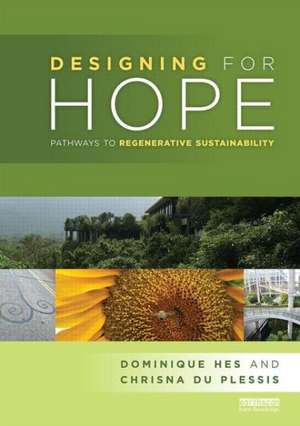
Designing for Hope: Pathways to Regenerative Sustainability
Autor Dominique Hes, Chrisna du Plessisen Limba Engleză Paperback – 23 oct 2014
Această monografie în format paperback reprezintă o incursiune vizuală și teoretică într-o paradigmă care depășește simpla conservare a resurselor. Ne-a atras atenția modul în care Designing for Hope reușește să transforme discursul ecologic dintr-unul al restricțiilor într-o celebrare a abundenței, susținut de peste 300 de ilustrații color și desene tehnice care dau viață conceptelor abstracte. Remarcăm o estetică a clarității, unde diagramele și studiile de caz din mediul construit nu sunt doar anexe, ci elemente centrale ale unei experiențe de învățare imersive. Structurată metodic în cinci secțiuni, lucrarea pornește de la necesitatea unei viziuni ecologice asupra lumii și progresează natural către acțiuni concrete, culminând cu analize practice asupra The Living Building Challenge. Putem afirma că volumul funcționează ca un ghid metodologic pentru profesioniștii care doresc să integreze biomimetismul și permacultura în proiectele lor. Complementar lucrării Regenerative Development and Design semnată de Regenesis Group, care oferă un cadru teoretic riguros pentru integrarea sustenabilității, cartea de față se distinge printr-o perspectivă mai optimistă și aplicată, punând accent pe refacerea legăturii emoționale cu natura. În contextul operei autorilor, dacă Placemaking Fundamentals for the Built Environment se concentra pe implicarea comunității în design, acest titlu publicat de Routledge extinde principiul la scara întregului ecosistem planetar. Este o lectură fluidă, dar densă în informații tehnice, care invită la o practică reflexivă și responsabilă.
Preț: 501.36 lei
Preț vechi: 544.97 lei
-8%
Carte tipărită la comandă
Livrare economică 30 noiembrie-14 decembrie
Specificații
ISBN-10: 1138800627
Pagini: 252
Ilustrații: 2 colour illustrations, 312 colour illustrations, 17 colour line drawings
Dimensiuni: 210 x 297 x 18 mm
Greutate: 1.32 kg
Ediția:1
Editura: Taylor & Francis
Colecția Routledge
Locul publicării:Oxford, United Kingdom
V-ar putea interesa
-
 City Publics: The (Dis)enchantments of Urban EncountersSophie Watson-15%Preț: 419.42 lei493.44 lei
 -
 -15%Preț: 423.91 lei498.71 lei
 -
 Rethinking Technology: A Reader in Architectural TheoryWilliam W. Braham-15%Preț: 450.40 lei529.89 lei
 -
 -15%Preț: 468.95 lei551.71 lei
 -
 Planning the Night-time CityMarion Roberts-15%Preț: 423.54 lei498.29 lei
 -
 Urban Coding and PlanningStephen Marshall-15%Preț: 435.94 lei512.88 lei
 -
 After Sustainable Cities?Mike Hodson-15%Preț: 416.38 lei489.87 lei
 -
 -15%Preț: 465.00 lei547.06 lei
 -
 -15%Preț: 467.48 lei549.97 lei
 -
 Revolution DetroitJohn GallagherPreț: 162.79 lei
 -
 Preț: 368.88 lei
 -
 Global UndergroundsCarlos López Galviz-14%Preț: 159.55 lei186.44 lei
 -
 Radical CitiesJustin McGuirkPreț: 168.90 lei
Public țintă
Professional Practice & DevelopmentDe ce să citești această carte
O recomandăm arhitecților și urbaniștilor care vor să treacă de la proiecte cu impact neutru la clădiri care regenerează activ mediul. Cititorul câștigă o înțelegere profundă a sistemelor vii și instrumente practice pentru a crea spații biofilice. Este o resursă vizuală și teoretică esențială pentru oricine vede designul ca pe o formă de speranță activă în fața schimbărilor climatice.
Descriere scurtă
Cuprins
Recenzii
"Designing for Hope marshalls ideas, tools, techniques, the social and personal agencies and the motivating ideas required to change direction. Theirs is not a utopian vision – although vision is indispensable – but a set of processes with the potential at least to stop the rot and re-invigorate organic growth and human sensibility." – Malcolm Skilbeck
"Designing for Hope represents a timely, important and necessary contribution to the literature that provides a powerful characterization of current and alternative world views. It also offers a comprehensive coverage of the scope and emphasis of regenerative sustainability." – BRI Review, Raymond J. Cole University of British Columbia, Canada
"It’s a beautiful book, with photography used liberally to enhance and explain the various topics. An international range of case studies from both the developed and developing world shows that embedding the ecological worldview into projects is achievable at both the small project scale through to multi-million dollar developments like Singapore’s Khoo Teck Phuat Hospital." – Willow Aliento, The Fifth Estate