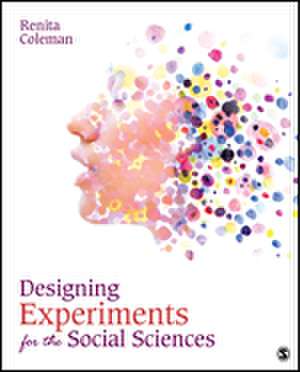
Designing Experiments for the Social Sciences
Autor Renita Colemanen Limba Engleză Paperback – 22 oct 2018
Structura volumului Designing Experiments for the Social Sciences reflectă o metodologie aplicată, prioritizând deciziile procedurale esențiale care preced intervențiile și tratamentele experimentale. Remarcăm o organizare riguroasă în șapte capitole fundamentale care ghidează cititorul de la înțelegerea cauzalității și a eticii cercetării — exemplificată prin studii clasice precum cele ale lui Milgram sau Zimbardo — până la complexitatea designurilor factoriale și a alocării aleatorii. Această primă ediție publicată de Sage Publications, Inc se distinge prin faptul că nu solicită un fundament statistic prealabil, concentrându-se pe „cum să gândești” un experiment eficient, nu doar pe cum să interpretezi cifrele rezultate. Descoperim aici o extensie firească a preocupărilor metodologice ale autoarei Renita Coleman. Dacă în lucrări anterioare, precum Image and Emotion in Voter Decisions, aceasta analiza impactul prezentării candidaților politici, iar în The Moral Media explora etica profesională, în prezentul manual ea sintetizează aceste experiențe de cercetare într-un ghid pedagogic universal. Cartea completează perspectiva oferită de Social Science Experiments de Donald P. Green, adăugând o atenție sporită creării stimulilor și chestionarelor, elemente practice adesea ignorate în textele pur teoretice. De asemenea, se apropie de abordarea din The Design and Conduct of Meaningful Experiments Involving Human Participants de R. Barker Bausell, ambele punând accent pe execuția procedurală, însă Renita Coleman oferă o tipologie mai vastă a experimentelor, de la cele naturale la cele de teren. Progresia conținutului este logică și accesibilă: după stabilirea cadrului teoretic și a ipotezelor, cititorul este introdus în validitatea internă și externă, oferindu-i-se instrumentele necesare pentru a asigura replicabilitatea și rigoarea inferențelor logice. Este un instrument de lucru care transformă designul experimental dintr-un concept abstract într-un proces structurat, pas cu pas.
Preț: 532.94 lei
Carte disponibilă
Livrare economică 11-17 noiembrie
Livrare express 31 octombrie-06 noiembrie pentru 58.39 lei
Specificații
ISBN-10: 1506377327
Pagini: 406
Dimensiuni: 187 x 232 x 25 mm
Greutate: 0.82 kg
Ediția:1. Auflage
Editura: Sage Publications, Inc
Locul publicării:Thousand Oaks, United States
V-ar putea interesa
-
 Preț: 392.44 lei
 -
 Thinking EthnographicallyPaul AtkinsonPreț: 425.24 lei
 -
 -15%Preț: 422.92 lei497.56 lei
 -
 -15%Preț: 505.96 lei595.25 lei
 -
 Transcribing for Social ResearchAlexa HepburnPreț: 425.56 lei
 -
 Image and Emotion in Voter Decisions: The Affect AgendaRenita Coleman-29%Preț: 344.18 lei483.26 lei
 -
 -19%Preț: 501.20 lei618.76 lei
De ce să citești această carte
Recomandăm această carte oricărui student sau cercetător la început de drum în științele sociale care dorește să stăpânească rigoarea designului experimental fără a fi intimidat de statistici complexe. Veți câștiga o înțelegere clară a modului în care se construiesc stimulii și se verifică validitatea unei cercetări, beneficiind de un ghid practic ce transformă teoria în pași de execuție concreți, ancorați în standarde etice înalte.
Descriere scurtă
Designing Experiments for the Social Sciences: How to Plan, Create, and Execute Research Using Experiments is a practical, applied text for courses in experimental design. The text assumes that students have just a basic knowledge of the scientific method, and no statistics background is required. With its focus on how to effectively design experiments, rather than how to analyze them, the book concentrates on the stage where researchers are making decisions about procedural aspects of the experiment before interventions and treatments are given.
Renita Coleman walks readers step-by-step on how to plan and execute experiments from the beginning by discussing choosing and collecting a sample, creating the stimuli and questionnaire, doing a manipulation check or pre-test, analyzing the data, and understanding and interpreting the results. Guidelines for deciding which elements are best used in the creation of a particular kind of experiment are also given. This title offers rich pedagogy, ethical considerations, and examples pertinent to all social science disciplines.
Recenzii
“This book is a must for learning about the experimental design–from forming a research question to interpreting the results, this text covers it all.”
“This text provides students with an excellent explanation of experimental methodology: not just descriptions of elements of the experiment method, but understanding of where those elements came from, how and why they work together, and how students can become scholars.”
“This is a comprehensive text on experiments, clearly and engagingly written, with many excellent examples. Renita Coleman has included everything the student will need to develop, design, and execute a methodologically-sound experiment.”
“This textbook is detailed and well organized, with each topic progressing logically to build on foundational knowledge. Students will find it easy to master research concepts, and practice using the exercises and examples provided. The ‘Study Spotlight’ scenarios and practical examples are effective tools to demonstrate research designs, and the ‘Test Your Knowledge Quizzes’ reinforce student learning.”
“This book is well-written and readable. If you need to grasp concepts of experimental designs, this book guides you as to what the experimental designs are, and what you should keep in mind in conducting your studies.”
Cuprins
Acknowledgments
About the Author
1. Discovering Cause and Effect
Causation
Experiments Compared to Other Methods
Basic Criteria for Experiments
Elements of Experiments
Starting a Study of Your Own
2. Ethics and Famous Experiments in History
The Scurvy Studies
The Contributions of Charles Peirce
Ronald Fisher’s Plots and Tea
B. F. Skinner: Small Samples, High Tech
Stanley Milgram Shocks the World
Philip Zimbardo: Raising Consciences in a Stanford Basement
Conclusion
3. Theory, Literature, and Hypotheses
The Literature Review
Hypotheses and Research Questions
4. Types of Experiments
Campbell and Stanley’s Typology of Experiments
Quasi Experiments
Natural Experiments
Field Experiments
5. Internal and External Validity
Ecological and External Validity
Generalizability
Cause and Effect
Logical Inference
Replication
Internal Validity
6. Factorial Designs
Single-Factor Designs
Factorial Designs
How Subjects Are Used in Designs
Control Groups
7. Random Assignment
The Purpose of Random Assignment
Operationalizing Random Assignment
Reporting Random Assignment
Balanced and Unbalanced Designs
Checking That Random Assignment Was Effective
Blocking, Matching, and Other Strategies
Random Assignment of Other Things
Random Assignment Resistance
8. Sampling and Effect Sizes
Student Samples
Amazon’s Mechanical Turk
Other Subject Sources
Recruiting
Incentives
Sample Size and Power
9. Stimuli and Manipulation Checks
Examples of Stimuli
Advice on Creating Stimuli
Manipulation Checks
Reporting the Stimuli and Manipulation Checks
10. Instruments and Measures
Instruments
Measurement Issues
11. The Institutional Review Board and Conducting Ethical Experiments
Institutional Review Boards
Ethical Issues in Experiments
Protecting Subjects
Researcher Issues
Pilot Studies
Glossary
Index