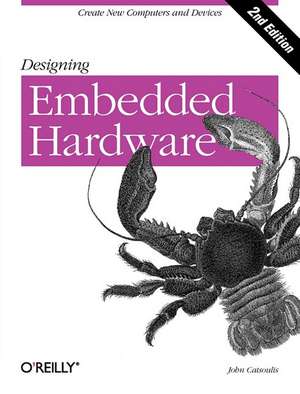
Designing Embedded Hardware: O'Reilly Ser.
Autor John Catsoulisen Limba Engleză Paperback – 21 iun 2005
Notăm cu interes faptul că Designing Embedded Hardware 2e reușește să evite extremele literaturii tehnice, poziționându-se strategic între manualele de programare specifice unui procesor și tratatele teoretice abstracte. Abordarea practică este evidentă prin raportul echilibrat între fundamentele electronice și implementarea fizică; John Catsoulis nu se limitează la a explica arhitecturi, ci ghidează cititorul prin procesul complet de creare a unui dispozitiv, de la alimentarea sistemului până la depanarea finală. Credem că experiența autorului în proiectarea a peste 40 de sisteme se reflectă în selecția riguroasă a componentelor hardware analizate. Analiza include microcontrolere populare precum PIC și Atmel AVR, dar și protocoale industriale critice ca SPI, I2C sau magistrala CAN. Un element distinctiv al acestei ediții revizuite este includerea procesorului MAXQ și a detaliilor despre Digital Signal Processing (DSP), oferind o perspectivă actualizată asupra pieței de sisteme integrate. Cititorul care a aplicat deja ideile din Building Embedded Systems de Changyi Gu va găsi aici elementele de inginerie hardware care completează perfect partea de dezvoltare software, trecând de la scrierea codului la înțelegerea profundă a schemelor electronice și a fișelor tehnice. Putem afirma că volumul publicat de O'Reilly funcționează ca o hartă a obstacolelor tehnice, oferind soluții concrete pentru controlul motoarelor prin PWM și implementarea rețelelor Ethernet. Textul este susținut de ilustrații alb-negru care facilitează descifrarea circuitelor, transformând teoria în competență tehnică aplicabilă imediat în laborator sau în producție.

Preț: 259.22 lei
Preț vechi: 324.02 lei
-20%
Carte disponibilă
Livrare economică 05-19 noiembrie
Livrare express 21-27 octombrie pentru 41.57 lei
Specificații
ISBN-10: 0596007558
Pagini: 398
Ilustrații: 1, black & white illustrations
Dimensiuni: 179 x 234 x 25 mm
Greutate: 0.68 kg
Ediția:2 Revised edition
Editura: O'Reilly
Colecția O'Reilly Ser.
Seria O'Reilly Ser.
Locul publicării:United States
V-ar putea interesa
-
 -23%Preț: 457.84 lei594.82 lei
 -
 -40%Preț: 488.78 lei820.18 lei
 -
 Principles of Computer HardwareAlan Clements-29%Preț: 602.71 lei846.14 lei
 -
 Software Design DecodedAndre van der Hoek-20%Preț: 85.23 lei106.54 lei
 -
 -40%Preț: 458.81 lei768.90 lei
 -
 -31%Preț: 441.34 lei639.30 lei
 -
 Computer Architecture: A Quantitative ApproachJohn L. Hennessy-39%Preț: 534.37 lei882.55 lei
 -
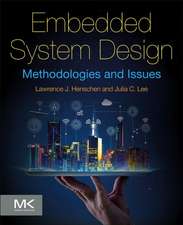 Embedded System Design: Methodologies and IssuesLawrence J. Henschen-40%Preț: 431.09 lei719.49 lei
 -
 The Art of ElectronicsPaul Horowitz-9%Preț: 706.10 lei775.93 lei
 -
 -27%Preț: 274.40 lei373.40 lei
 -
 Making Embedded SystemsElecia White-38%Preț: 200.48 lei324.68 lei
 -
 -18%Preț: 65.80 lei79.99 lei
 -
 -26%Preț: 91.29 lei122.92 lei
 -
 Modern C, Third EditionJens Gustedt-20%Preț: 350.34 lei437.92 lei
 -
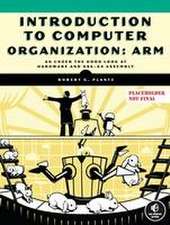 Introduction to Computer Organization: ARM EditionRobert G. Plantz-35%Preț: 303.72 lei468.10 lei
 -
 -19%Preț: 281.74 lei348.18 lei
 -
 -36%Preț: 295.65 lei462.12 lei
 -
 -35%Preț: 242.68 lei372.06 lei
 -
 Atomic HabitsJames Clear-23%Preț: 105.69 lei136.87 leiRecomandat
De ce să citești această carte
Recomandăm această carte inginerilor și programatorilor care doresc să treacă dincolo de abstractizarea software-ului. Cititorul câștigă abilitatea de a proiecta de la zero dispozitive electronice, înțelegând interacțiunea dintre microcontroler și periferice prin protocoale precum USB sau I2C. Este un ghid esențial pentru oricine vrea să construiască hardware robust, evitând erorile clasice de proiectare identificate de John Catsoulis în decenii de practică.