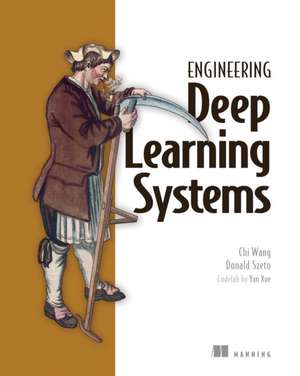
Designing Deep Learning Systems
Autor Chi Wang, Donald Szetoen Limba Engleză Paperback – 25 iul 2023
Remarcăm faptul că principala dificultate în inteligența artificială modernă nu mai este doar crearea unui model funcțional, ci construirea infrastructurii robuste care să permită scalarea acestuia într-un mediu de producție real. În Designing Deep Learning Systems, Chi Wang și Donald Szeto abordează această problemă tehnică oferind un ghid pentru inginerii software care trebuie să gestioneze ciclul de viață complet al unui sistem de deep learning. Structura volumului este una riguros tehnică, pornind de la serviciile de gestionare a seturilor de date și ajungând la orchestrarea fluxurilor de lucru complexe. Considerăm că valoarea adăugată a acestei lucrări publicate de Manning Publications constă în focusul pe componentele de suport: antrenarea distribuită, optimizarea hiperparametrilor și designul serviciilor de model serving. Ca și Andrew Ferlitsch în Deep Learning Design Patterns, autorii distilează experiență reală în principii acționabile, transformând concepte teoretice în soluții de inginerie scalabile. Totuși, spre deosebire de lucrările care se concentrează strict pe arhitectura rețelelor, această carte pune accent pe interoperabilitatea dintre TensorFlow sau PyTorch și sistemele de stocare a metadatelor și artefactelor. Stilul este direct și aplicat, oferind soluții pentru provocări precum latența în servirea modelelor și mentenanța platformelor AI. Prin utilizarea exemplelor în Python și Java, autorii facilitează tranziția de la dezvoltarea software tradițională la rolul de inginer de sisteme de deep learning, oferind o perspectivă clară asupra a ceea ce înseamnă un sistem gata pentru producție.
Preț: 333.47 lei
Preț vechi: 416.84 lei
-20%
Carte disponibilă
Livrare economică 05-19 noiembrie
Livrare express 22-28 octombrie pentru 81.58 lei
Specificații
ISBN-10: 1633439860
Pagini: 360
Dimensiuni: 185 x 234 x 23 mm
Greutate: 0.68 kg
Editura: Manning Publications
V-ar putea interesa
-
 Using Artificial Intelligence Absolute Beginner's GuideMichael Miller-20%Preț: 201.24 lei251.56 lei
 -
 Engineering AI SystemsIngo Weber-20%Preț: 287.38 lei359.22 lei
 -
 Deep LearningIan Goodfellow-21%Preț: 684.46 lei865.01 lei
 -
 Understanding Deep LearningSimon J. D. Prince-21%Preț: 687.48 lei867.24 lei
 -
 -27%Preț: 465.12 lei640.28 lei
 -
 -39%Preț: 394.79 lei646.62 lei
 -
 Data Science Essentials for DummiesLillian Pierson-20%Preț: 76.56 lei95.69 lei
 -
 Coding For Dummies, All New EditionPaul McFedries-20%Preț: 117.52 lei146.90 lei
 -
 Machine Learning For DummiesLuca Massaron-20%Preț: 149.88 lei187.36 lei
 -
 Agentic AI For DummiesPam Baker-20%Preț: 145.95 lei182.44 lei
 -
 The Essential Book of AIAnne Rooney-20%Preț: 76.61 lei95.77 lei
 -
 Programming Neural Networks with PythonJoachim Steinwendner-20%Preț: 301.14 lei376.42 lei
 -
 Keras 3Mohammad Nauman-20%Preț: 309.09 lei386.37 lei
 -
 Deep Learning Design PatternsAndrew Ferlitsch-20%Preț: 420.81 lei526.02 lei
 -
 Think Distributed SystemsDominik Tornow-20%Preț: 332.09 lei415.11 lei
 -
 Hugging Face in ActionWei-Meng Lee-20%Preț: 277.26 lei346.58 lei
 -
 Machine Learning System DesignValerii Babushkin-20%Preț: 384.35 lei480.44 lei
 -
 Deep Learning Crash CourseGiovanni Volpe-35%Preț: 290.84 lei445.88 lei
 -
 Practical Deep Learning, 2nd Edition: A Python-Based IntroductionRonald T. Kneusel-35%Preț: 333.73 lei515.68 lei
 -
 Practical Deep Learning with PyTorchDeepak Gowda-20%Preț: 225.42 lei281.77 lei
De ce să citești această carte
Recomandăm această carte dezvoltatorilor software și inginerilor de date care doresc să treacă de la simple experimente cu modele AI la implementări industriale scalabile. Veți câștiga competențe practice în automatizarea fluxurilor de lucru și gestionarea infrastructurii pentru deep learning, învățând cum să alegeți proiectele open-source potrivite pentru platforma dumneavoastră.
Despre autor
Chi Wang este un dezvoltator software principal în cadrul grupului Salesforce Einstein, fiind implicat direct în dezvoltarea unora dintre cele mai avansate sisteme AI comerciale. Donald Szeto a fost cofondator și CTO la PredictionIO, o platformă de machine learning open-source, aducând în această lucrare o expertiză vastă în arhitecturi de date și sisteme predictive. Împreună, cei doi autori combină rigoarea academică cu experiența practică dobândită în vârful industriei tech.